






Economic Hardship and Currency Collapse: Iran Latest News
The current wave of protests began in late December 2025, initially sparked by severe economic grievances:
- Soaring inflation and rising prices have eroded living standards throughout Iran.
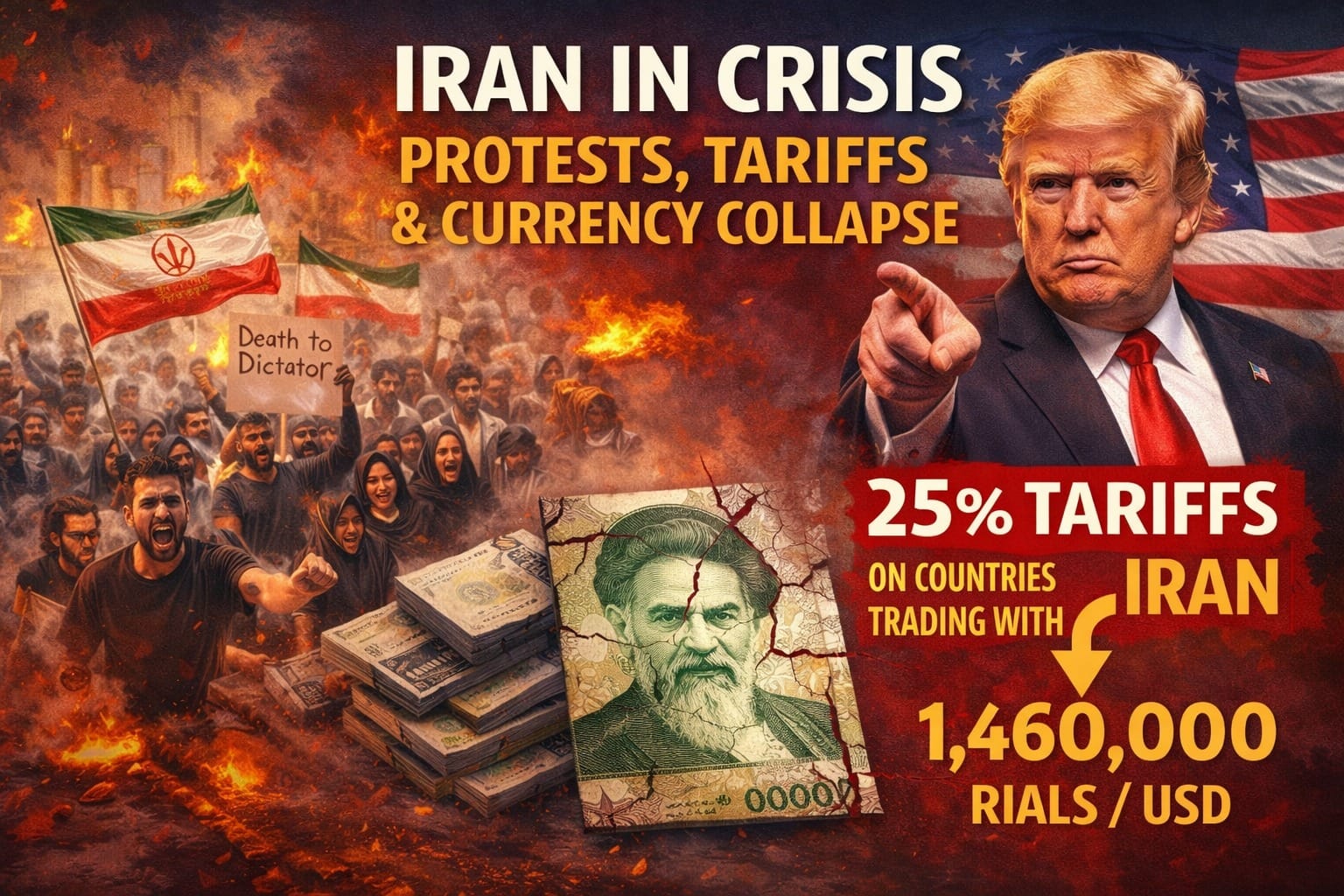
- The Iranian rial has plummeted to record lows, with reports of rates reaching more than 1.46 million rials per US dollar, drastically reducing purchasing power.
- Government stimulus measures — such as a modest monthly stipend of roughly $7 (~10 million rials) — were widely criticized as inadequate.
This economic collapse has been exacerbated by long-standing US sanctions, restricted access to global markets, and mismanagement within Iran’s financial system — pushing ordinary Iranians into hardship and deep frustration with the ruling clerical establishment.
Human Cost of the Iran Protests: The People Who Lost Their Lives
The nationwide protests that erupted in Iran in late December 2025 have taken an extraordinary and tragic human toll, making this one of the deadliest waves of civil unrest in the country in decades. According to an unnamed Iranian official cited by Reuters, about 2,000 people have been killed since the demonstrations began — a figure that includes both protesters and some security personnel. The official statement, released on January 13, 2026, marked the first time Tehran acknowledged such a high death toll during the ongoing crackdown, attributing deaths to what it called “terrorists” while offering limited detail on identities.
Independent activists, human rights groups, and international media paint an even grimmer picture. The U.S.-based Human Rights Activists News Agency reported that the death toll had climbed to at least 2,571, with a breakdown that included over 2,400 protesters, 147 government personnel, and even 12 children among those killed, highlighting the indiscriminate nature of the violence. Thousands more have been detained as security forces used live ammunition, tear gas, and mass arrests in an attempt to suppress dissent.
The sharp rise in fatalities followed a government-imposed internet and communication blackout starting around January 8, which severely limited independent reporting and made it difficult to verify the full extent of the violence. As a result, there are multiple estimates of the death toll. Some sources — citing social media footage, eyewitness accounts, and hospital records — suggest the number of deaths could be much higher than official figures, with tens of thousands possibly killed in the worst-case scenarios. These higher estimates, while unconfirmed, indicate the crisis may rival or surpass previous nationwide unrest.
Some of the youngest victims of the unrest have become symbols of a protest movement driven by deep frustration. For example, Amirhesam Khodayarifard, a 19-year-old protester from Lorestan Province, was reported killed on December 30, 2025, after participating in demonstrations against economic hardship and political repression. Despite government efforts to characterize him otherwise, his family maintained he was a civilian protester, not affiliated with any security forces.
Similarly, 17-year-old Mohammad Noori from Qom was shot during a protest on January 2, 2026 — a stark reminder that even teenagers have been caught up in the security crackdown sweeping the nation. Victims like Noori have drawn international attention to the severity and reach of state response against largely peaceful citizens.
In some cities, reports have emerged of massacres — such as in Fardis, where Iranian Human Rights sources claim security forces used machine guns against demonstrators, killing dozens in a single incident. These localized tragedies reflect the intensity of clashes between protesters and government forces across multiple provinces.
Rights organizations like Iran Human Rights have described the crackdown as a mass killing, warning the actual death toll might be far higher than confirmed figures and calling for international investigations into excessive use of force.
As the unrest continues, the human cost remains at the core of the crisis — with families searching for loved ones, morgues overwhelmed, and communities mourning unprecedented losses. The deaths of protesters have not only intensified domestic anger but also brought renewed global scrutiny on Tehran’s handling of dissent during one of the most turbulent periods in modern Iranian history.
From Economic Grievance to Widespread Protest
What began as economic discontent quickly broadened into political dissent demanding more fundamental change. Demonstrations spread across Iran’s 31 provinces, including major cities like Tehran, Karaj, Qom, Isfahan, and Lorestan. Protesters have chanted slogans calling for the removal of the Supreme Leader and even the end of the Islamic Republic itself — signals of a shift in protester aims beyond purely economic reforms.
The Human Cost: How Many Have Died and Who Were They?
The death toll during the protests is contested, but multiple human rights groups monitoring the unrest have reported heavy casualties due to state crackdown:
Confirmed Deaths and Verified Cases
- Hundreds reported killed: Human rights groups cited figures of more than 646 dead as of mid-January 2026.
- Massacre reports: Independent accounts from Fardis suggest that up to 50 protesters were allegedly killed in machine-gun fire by government forces during a crackdown on 8 January.
Individual Protester Casualties
Several cases highlight the scale of the violence inflicted by security forces:
- Mohammad Noori (17) — a teenager shot by security forces during protests in Qom, later dying of his injuries.
- Reza Moradi Abdolvand (18) — died after being shot multiple times by regime forces in Lorestan.
- Shayan Asadollahi (28) — killed during demonstrations in Azna with live ammunition.
- Latif Karimi — a retired brigadier general reportedly killed by government forces during protests, his death became controversial due to differing narratives from official media and eyewitnesses.
Disputed Tallies and Blackout Challenges
Due to intermittent internet blackouts and restricted information flow, some sources suggest far higher casualty numbers — including estimates claiming in the thousands, with age demographics skewing toward younger protesters.
Also read – India-China’s Shaksgam Valley Dispute and Updates
Trump’s 25 % Tariff on Countries Trading With Iran: What Happened?
In an unexpected escalation of economic pressure early in January 2026, Donald Trump announced a sweeping tariff policy:
- Any country that continues to conduct business with Iran will face a 25 % tariff on its trade with the United States. This announcement was made via social media and positioned as a punitive measure against nations maintaining economic ties with Tehran.
- The policy is described as effective immediately, though legal mechanisms and enforcement details remain unclear.
- White House advisers hinted that such tariffs could be backed by existing emergency powers, though parts of Trump’s broader tariff agenda have faced judicial scrutiny.
Why the Move Was Announced Now
The timing appears linked to the US response to Iran’s domestic unrest and regime crackdown. While the tariffs ostensibly target Tehran’s foreign relations, they also extend pressure onto Iran’s trading partners — a novel approach that widens the economic squeeze beyond direct US sanctions.
Which Countries Are Affected and How?
Iran’s trading footprint extends to over 100 partners globally. Although China remains Tehran’s largest trading partner, several others hold notable economic ties, thereby exposing them to potential tariff risk:
- China — largest purchaser of Iranian oil.
- India — historically among Iran’s significant trade partners.
- Turkey, Iraq, UAE, Germany, South Korea, Japan — each with varying degrees of trade activity.
Impact on India: Trade, Tariffs, and Strategic Dilemmas
For India, Trump’s tariff move carries a complex mix of risks and strategic challenges:
Historical Trade With Iran
India’s bilateral trade with Iran includes commodities like:
- Food products, basmati rice, fruits, vegetables
- Pharmaceuticals and other manufactured goods
- Limited crude oil imports, which India reduced due to previous sanctionary pressures.
Potential Tariff Burden
Analysts warn that Trump’s tariff regime could result in:
- Up to 25 % additional duty on US-bound Indian exports if the country continues trade with Iran.
- Coupled with existing tariff duties on certain Indian goods, the effective tariff burden could reach 75 % on select exports, severely impacting competitiveness.
Market Reaction in India
Indian stock markets reacted negatively in the immediate aftermath of the tariff announcement, with benchmark indices such as the Sensex and Nifty trending down on macroeconomic concerns and the risk of broader trade conflict.
Strategic Balancing Act
India now faces a geopolitical dilemma:
- Balancing relations with the US, a key strategic partner.
- Maintaining regional trade ties with Iran and stabilizing energy and commerce channels in West Asia.
Disentangling from Iran completely may not be feasible due to India’s interests in the region, while continued engagement risks exposure to punitive tariffs from the US, complicating India’s broader foreign policy calculus.
Global Trade Tensions: Ripple Effects and US-China Truce
Trump’s tariff threat also reverberates across the global economic landscape:
- Beijing expressed concern about how the tariff policy could affect the fragile US-China trade truce established late in 2025.
- Although Iran accounts for a small fraction of China’s overall trade, the tariff threat introduces uncertainty in global supply chains, particularly relating to oil imports and manufacturing inputs.
- European and Asian markets are closely watching developments, as additional tariffs could disrupt prevailing trade agreements and financial stability in emerging markets.
Iran’s Internal Response and Regime Stability
Government Crackdown and Mourning
In response to the protests, Iranian authorities have:
- Declared three days of national mourning for security forces and civilians killed.
- Implemented strict communication blackouts and curfews in major cities, though limited mobile calling was briefly restored.
- Depicted protesters as “enemies” or “rioters”, with state media framing the unrest as externally fueled, a common narrative intended to justify stringent countermeasures.
Domestic Warnings of Greater Unrest
An Iranian MP acknowledged the seriousness of the situation, urging the government to address grievances to avoid further escalation — a rare public recognition of the unrest’s depth.
Outlook: What’s Next for Iran and the Region?
Economic Prospects
Unless the rial stabilizes and inflation is curbed, Iran’s economy faces continued contraction, heightened unemployment, and persistent social discontent — all of which fuel the protest movement. International economic pressure from tariffs and sanctions may further weaken economic resilience.
Political Trajectory
Analysts and foreign leaders alike are speculating on the regime’s future. German Chancellor Friedrich Merz has even suggested that Iran’s leadership could be in its “final days and weeks”, reflecting a dramatic shift in perceptions surrounding the regime’s stability.
International Diplomacy
Despite harsh rhetoric, Iran has kept diplomatic channels open with the US, indicating that neither side has entirely ruled out negotiation or de-escalation — even as military options remain on the table.
Conclusion: Iran’s Crisis Is a Global Flashpoint
The Iranian protests, coupled with economic collapse, currency depreciation, and now broad tariffs tied to trade partnerships, mark a significant turning point in Middle Eastern geopolitics. Countries like India find themselves navigating a treacherous diplomatic landscape where commerce intersects with geopolitical strategy. Meanwhile, the Iranian populace continues its fight amidst one of the harshest crackdowns in decades — with consequences that may reshape power dynamics far beyond Tehran’s borders.
SUBSCRIBE TO OUR YOUTUBE CHANNEL THE LOGIC STICK FOR MORE VIDEO INSIGHTS