




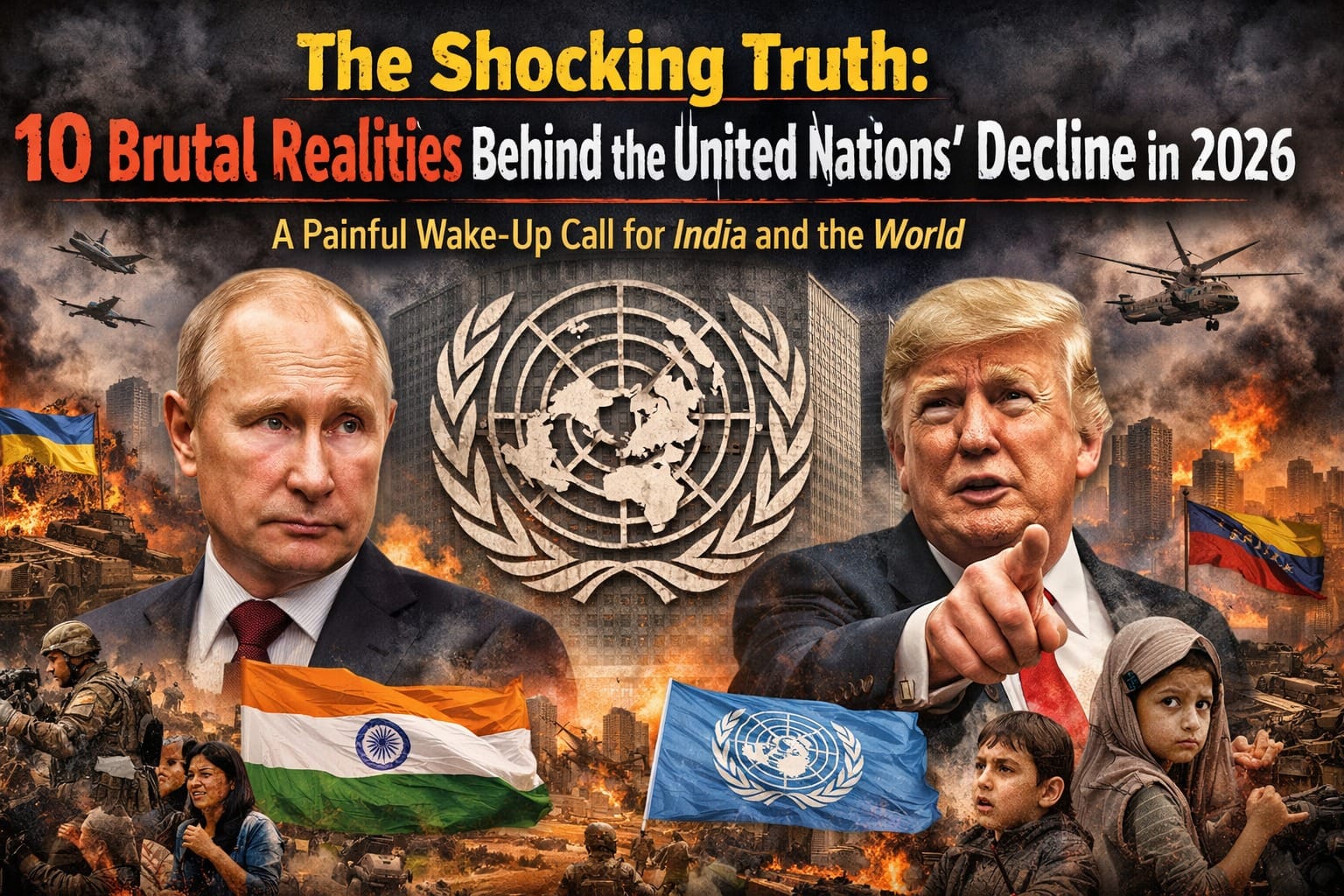
For decades, the United Nations symbolised global authority, peace, and justice. But in 2026, many are asking an uncomfortable question: Has the UN lost control of the world it once promised to protect?
PART 1: The UN We Believed In, How It Actually Works, and Why the Veto Breaks Everything
Introduction: The United Nations We Grew Up Believing In
For most of us growing up in India, the United Nations was introduced as something almost sacred.
In school textbooks, it was described as the highest global authority — a neutral, powerful body created to prevent wars, protect countries, and ensure peace. In Model UN conferences, students played diplomats who believed resolutions could change the world. In news headlines, the UN appeared whenever a crisis erupted, reinforcing the idea that it was the final referee of international order.
As a common citizen living in Mumbai, it was easy to assume one thing:
If something truly terrible happens — a war, an invasion, mass human rights violations — the United Nations will step in and stop it.
But by 2026, that belief feels increasingly disconnected from reality.
Wars continue despite UN debates. Powerful countries openly ignore resolutions. Smaller nations suffer while global powers argue. The UN speaks often — yet acts rarely.
This gap between belief and reality is not accidental. It is structural. And to understand why the United Nations appears to be “losing power” today, we must first understand what it was actually designed to be — and what it was never meant to do.
What the United Nations Was Originally Meant to Be
The United Nations was founded in 1945, immediately after World War II. The world had just witnessed destruction on a scale never seen before: over 60 million dead, entire cities flattened, genocide exposed, and nuclear weapons introduced.
The founding nations wanted to prevent another global catastrophe.
The UN Charter was built on four key ideas:
- Sovereign equality of all states
- Prohibition of aggressive war
- Peaceful settlement of disputes
- Collective security against threats to peace
In theory, this meant that if one country attacked another, the world would respond together.
But here is the first uncomfortable truth:
👉 The UN was not created as a moral authority. It was created as a political compromise.
The strongest countries of 1945 — the US, USSR, UK, France, and China — agreed to cooperate only if their power and interests were protected inside the system.
This compromise shaped everything that followed.
How the United Nations Actually Works (Beyond the Illusion)
The Biggest Myth About the UN
The United Nations is not a world government.
It does not have:
- Its own army
- A global police force
- Automatic enforcement powers
Every action the UN takes depends on the consent and cooperation of its member states, especially the most powerful ones.
Understanding this single fact removes most of the confusion around “UN failure.”
The Real Power Centre: The UN Security Council (UNSC)
The UN Security Council is the only UN body whose decisions can be legally binding.
Structure of the UNSC
- 15 members in total
- 5 permanent members (P5):
- United States
- Russia
- China
- United Kingdom
- France
- 10 non-permanent members (rotating every two years)
Powers of the Security Council
The UNSC can:
- Impose economic sanctions
- Approve or block military action
- Authorise peacekeeping missions
- Determine threats to international peace
On paper, this makes the Security Council extremely powerful.
But in practice, one feature overrides everything else.
The Veto Power: The Single Rule That Breaks the UN
What Is the Veto?
Any of the five permanent members can veto a substantive Security Council resolution.
One “NO” vote = resolution fails.
Even if:
- 14 countries vote in favour
- The majority of the world supports it
- The situation involves mass civilian suffering
The veto kills it instantly.
Why Was the Veto Created?
After World War II, the great powers made a blunt calculation.
They believed:
- A UN without them would be meaningless
- A UN that could act against them would be dangerous
So they demanded a guarantee.
The deal was simple:
“We will participate in the UN — but only if you never force us to act against our core interests.”
The veto was not a flaw.
It was a feature.
Why the Veto Made Sense in 1945 — But Not in 2026
In 1945:
- The world was bipolar or near-bipolar
- Preventing World War III was the priority
- Colonial empires still dominated
The veto ensured that major powers would negotiate instead of fighting each other directly.
But in 2026:
- The world is multipolar
- Conflicts are regional, proxy-based, and prolonged
- Power is more diffused, but veto power is not
The UNSC still reflects the power structure of 1945, not today.
This is why the UN appears outdated — because structurally, it is.
How the Veto Paralyzes the UN in Real Life
When a permanent member is involved in a conflict, the UN cannot act meaningfully.
Examples:
- Russia vetoes resolutions related to Ukraine
- The US vetoes resolutions involving Israel
- China blocks strong action on Myanmar or Taiwan-linked issues
The result is predictable:
- Resolutions get watered down
- Language becomes vague
- Enforcement disappears
What remains are statements, appeals, and expressions of “deep concern.”
This is not incompetence.
It is designed paralysis.
The Role of the UN General Assembly: Voice Without Teeth
The United Nations General Assembly (UNGA) includes all 193 member states.
Each country gets:
- One vote
- Equal speaking rights
The UNGA represents global opinion far better than the Security Council.
However, most UNGA resolutions are:
- Non-binding
- Symbolic
- Political rather than enforceable
When the Security Council is blocked, the UNGA often condemns actions overwhelmingly.
But condemnation does not stop tanks, bombs, or sanctions evasion.
This is why global consensus often exists — without global action.
The Secretary-General: Moral Authority Without Command
The UN Secretary-General is often seen as the “face” of the UN.
They can:
- Warn the world
- Mediate between parties
- Appoint investigators
- Coordinate humanitarian response
But they cannot:
- Order military action
- Enforce compliance
- Override vetoes
The Secretary-General’s power is moral and diplomatic, not executive.
When powerful states ignore that moral authority, there is little the office can do.
Why the UN Appears “Weak” — But Is Actually Honest About Its Limits
The United Nations does not collapse when wars happen.
It continues to:
- Document violations
- Deliver humanitarian aid
- Maintain communication channels
- Preserve international norms
But it fails at what people expect it to do — stop wars outright.
That expectation was never realistic.
The UN does not control countries.
Countries control the UN.
Key Takeaway from Part 1
The UN’s perceived decline is not because it suddenly stopped working.
It is because:
- Power politics returned openly
- Great powers stopped pretending
- Structural limits became visible to ordinary citizens
The UN was built to manage cooperation among powerful states — not to restrain them.
PART 2: Global Conflicts That Exposed the Limits of the United Nations
How Ukraine, Gaza, Sudan, Venezuela, and Myanmar Revealed the UN’s Structural Failure
Introduction: When Theory Meets Bloodshed
If the United Nations truly worked the way people imagine it does, the wars of the last decade should have ended quickly.
Instead, these conflicts did something far more damaging to the UN’s credibility:
they exposed its design limitations in real time, in front of a global audience watching on smartphones.
Ukraine, Gaza, Sudan, Venezuela, Myanmar — these are not just conflicts.
They are case studies in how the UN functions when power, vetoes, and geopolitics collide.
Let’s examine them one by one.
1. Ukraine: The Clearest Example of UN Paralysis in Modern History
The Russia–Ukraine war is the most devastating credibility test the UN has faced since the Cold War.
What Should Have Happened (In Theory)
- An invasion violates the UN Charter
- The Security Council condemns aggression
- Sanctions or enforcement follow
- Peace is restored
What Actually Happened
Russia is a permanent member of the Security Council.
So when resolutions were introduced:
- Russia vetoed them
- Security Council action collapsed instantly
The UN General Assembly condemned Russia overwhelmingly — but General Assembly votes do not stop tanks.
What the UN Could Do
- Humanitarian coordination
- Refugee assistance
- War crime documentation
- Diplomatic platforms
What the UN Could Not Do
- Force Russia to withdraw
- Impose UNSC sanctions
- Authorise collective military response
Ukraine revealed the UN’s ultimate truth:
If a permanent member breaks international law, the UN can document it — but not stop it.
This wasn’t a failure of courage.
It was a failure of structure.
2. Gaza & Israel: When Veto Politics Override Humanitarian Consensus
The Israel–Gaza conflict exposes a different but equally damaging flaw.
The Core Problem
The conflict involves:
- A close US ally
- Deep regional sensitivities
- High emotional and political stakes
As a result:
- Ceasefire resolutions face vetoes
- Language is diluted to avoid vetoes
- Humanitarian access becomes politicised
What the World Sees
- UN officials warning of catastrophe
- Aid agencies struggling to operate
- Repeated emergency meetings
What Never Materialises
- Binding ceasefire enforcement
- Accountability mechanisms with teeth
- Unified Security Council action
Here, the UN is not absent.
It is present but restrained.
Because the US holds veto power, the Security Council becomes a space of damage control, not resolution.
The message this sends globally is dangerous:
Humanitarian suffering is negotiable when geopolitics is involved.
3. Sudan: When the World Looks Away and the UN Follows
Sudan’s civil war is one of the worst humanitarian crises of the decade — yet it receives a fraction of global attention.
Why Sudan Is Different
- No direct P5 military involvement
- No strategic rivalry spotlight
- Limited media coverage
This leads to:
- Weak political urgency
- Funding shortages
- Limited diplomatic pressure
The UN struggles not because of vetoes alone — but because powerful countries are uninterested.
This exposes another uncomfortable truth:
The UN is only as strong as global attention allows it to be.
In Sudan:
- Peacekeeping missions are constrained
- Mediation lacks leverage
- Civilians pay the price
The UN cannot force relevance where the world chooses indifference.
4. Venezuela: Control Without Invasion, Influence Without Resolution
Venezuela represents a different category of conflict — one shaped by economic pressure, political isolation, and foreign influence rather than open war.
The UN’s Role in Venezuela
- Humanitarian monitoring
- Electoral observation discussions
- Human rights reporting
What Limits the UN
- Competing US, Russian, and regional interests
- Sanctions imposed outside UN frameworks
- Political polarisation
Here, the UN becomes a narrative battlefield, not a solution engine.
Different powers use UN platforms to:
- Legitimize positions
- Condemn opponents
- Shape international opinion
But no actor wants to surrender control to the UN.
So the crisis continues — quietly, painfully, indefinitely.
5. Myanmar: When Military Power Ignores Global Condemnation
Myanmar’s military coup and subsequent violence show how authoritarian regimes exploit UN weakness.
The Pattern
- UN condemns coup
- Investigations launched
- General Assembly resolutions passed
The Reality
- China and Russia block strong Security Council action
- ASEAN diplomacy moves slowly
- The military consolidates power
Myanmar proves that:
Condemnation without enforcement becomes background noise.
The UN’s voice remains — but the generals no longer fear it.
6. Why These Conflicts Prove the Same Point
Despite differences, all these cases share four structural problems:
1. Veto Power Blocks Enforcement
Whenever a permanent member or its ally is involved, enforcement disappears.
2. Enforcement Depends on the Same Powers Breaking the Rules
The UN has no independent coercive force.
3. Humanitarian Action Is Allowed — Political Action Is Not
Aid is tolerated; accountability is resisted.
4. Global Attention Determines Urgency
Wars that threaten powerful interests get attention. Others fade.
7. Is the UN Silent — or Is It Being Ignored?
It is important to clarify this.
The UN is not silent.
It speaks constantly.
- Reports
- Warnings
- Emergency sessions
- Appeals
But speech without authority becomes symbolic.
The UN today often functions as:
- A recorder of history
- A coordinator of relief
- A mirror of global power
Not as an enforcer.
8. The Psychological Shift: Why People No Longer Believe
Perhaps the most damaging consequence of these conflicts is loss of belief.
Earlier generations believed:
“The UN will step in.”
Today’s generation believes:
“The UN will comment.”
This shift matters because legitimacy depends on expectation.
When expectations collapse, so does trust.
Key Takeaway from Part 2
Global conflicts did not expose a weak UN.
They exposed an honest UN — one that never had the power people imagined it did.
The UN can:
- Highlight injustice
- Ease suffering
- Preserve dialogue
It cannot:
- Override superpowers
- End wars unilaterally
- Enforce morality
That task still belongs to states.
PART 3: India, UN Reform, and the Future of Global Governance
How India Navigates a Weak UN — and What the World Order Looks Like After 2026
Introduction: Why India Understands the UN Better Than Most
India does not approach the United Nations with illusion.
Unlike many smaller nations that once believed the UN would protect them, or superpowers that use it selectively, India treats the UN for what it actually is:
A strategic arena, not a moral authority.
This understanding shapes every Indian decision at the UN — from abstentions to speeches to reform demands.
To understand India’s position in 2026, we must first understand how India thinks about power, autonomy, and global order.
India’s Relationship with the United Nations: Long, Complex, and Strategic
India is not a peripheral UN player.
- Founding member of the UN
- One of the largest contributors to UN peacekeeping forces
- A consistent voice for decolonisation, sovereignty, and the Global South
Yet India has never blindly trusted the UN system.
Why?
Because India’s own history — colonialism, partition, wars, and Cold War non-alignment — taught it a hard truth early:
International institutions reflect power. They do not replace it.
Why India Still Takes the UN Seriously (Despite Its Failures)
India continues to invest diplomatic capital in the UN for four key reasons.
1. Legitimacy and Narrative Power
Even if the UN cannot enforce outcomes, it shapes:
- Global narratives
- Diplomatic legitimacy
- Historical record
India uses the UN to:
- Frame terrorism discussions
- Push Global South concerns
- Counter selective moralism
In a world of information warfare, narrative legitimacy still matters.
2. Coalition-Building Without Formal Alliances
India avoids rigid military alliances.
The UN allows India to:
- Engage multiple blocs
- Maintain flexibility
- Build issue-based coalitions
This suits India’s long-standing doctrine of strategic autonomy.
3. Rule-Based Order Benefits Middle Powers
India understands that a completely lawless world favours only the strongest.
Even imperfect rules:
- Create friction for aggressors
- Protect sovereignty in principle
- Slow down unilateral action
The UN provides a minimum floor — even if the ceiling is low.
4. Long-Term Reform Leverage
India knows UNSC reform will not happen overnight.
But presence, consistency, and economic rise gradually increase bargaining power.
Why India Often Abstains: The Most Misunderstood Strategy
One of the most criticised aspects of India’s UN behaviour is abstention.
To outsiders, abstention looks like:
- Fence-sitting
- Moral hesitation
- Lack of leadership
In reality, abstention is calculated neutrality.
Why India Abstains
- To avoid being locked into rival blocs
- To preserve dialogue with all sides
- To maintain future diplomatic flexibility
India chooses options over applause.
This approach reflects realism, not weakness.
UNSC Reform: The Change Everyone Wants but No One Enables
Why the Security Council Is Outdated
The UNSC reflects the world of 1945, not 2026.
Key problems:
- No permanent seat for India
- Africa unrepresented permanently
- Latin America excluded
- Asia underrepresented
This creates a legitimacy gap.
Why Reform Never Happens
Reform requires:
- Approval of existing P5
- Amendment of the UN Charter
- Surrender of exclusive privilege
No permanent member wants to dilute veto power.
So reform is:
- Talked about publicly
- Blocked privately
This is why UNSC reform remains structurally frozen.
India’s Realistic Understanding
India knows:
- Moral arguments alone won’t work
- Power precedes reform
- Economic and military weight matter more than speeches
India’s rise strengthens its claim — but reform will come only when power balance forces it.
The Future of the United Nations: What Comes After 2026?
Experts broadly see three possible paths for the UN.
Scenario 1: Gradual Decline (Most Likely Short-Term)
Characteristics:
- More veto paralysis
- Regional alliances gain importance
- UN shifts toward humanitarian coordination
The UN becomes:
- Less political
- More operational
Scenario 2: Functional Adaptation (Most Realistic)
Instead of reforming formally, the UN adapts informally.
How?
- Greater use of UN General Assembly
- Issue-based coalitions
- Norm-setting over enforcement
The UN survives by becoming less ambitious but more useful.
Scenario 3: Crisis-Driven Reform (Least Likely, But Possible)
A major global shock could force reform:
- Large-scale war
- Economic collapse
- Climate catastrophe
Only a crisis that threatens all major powers simultaneously can break veto resistance.
What the UN Will Never Become (Again)
It is important to be honest.
The UN will never become:
- A global government
- A world police force
- A controller of superpowers
Expecting that leads only to disappointment.
What the UN Still Does Better Than Any Alternative
Despite everything, no alternative institution:
- Includes every country
- Provides global legitimacy
- Coordinates humanitarian action at scale
The UN’s value lies not in dominance — but in continuity.
What a Common Citizen in Mumbai Should Expect From the UN
Realistic Expectations
- Relief in humanitarian crises
- Documentation of injustice
- Diplomatic pressure
- International dialogue
Unrealistic Expectations
- Immediate war stoppage
- Punishment of powerful nations
- Moral enforcement of law
The UN reflects the world’s power structure — it does not override it.
The Final Truth: The UN Has Not Failed — Our Expectations Have
The United Nations feels weaker today not because it collapsed — but because the illusion collapsed.
The UN was never meant to:
- Control powerful countries
- Enforce morality
- Replace national power
It was meant to:
- Manage conflict
- Reduce escalation
- Preserve dialogue
In that limited role, it still matters.
Final Conclusion: What India and the World Must Learn
For India, the lesson is clear:
- Use the UN strategically
- Push reform patiently
- Build independent strength
- Avoid moral grandstanding
For the world, the lesson is harder:
Peace is not maintained by institutions alone — but by the willingness of powerful nations to restrain themselves.
Until that changes, the UN will remain what it has always been:
A mirror of global power, not a master of it.