







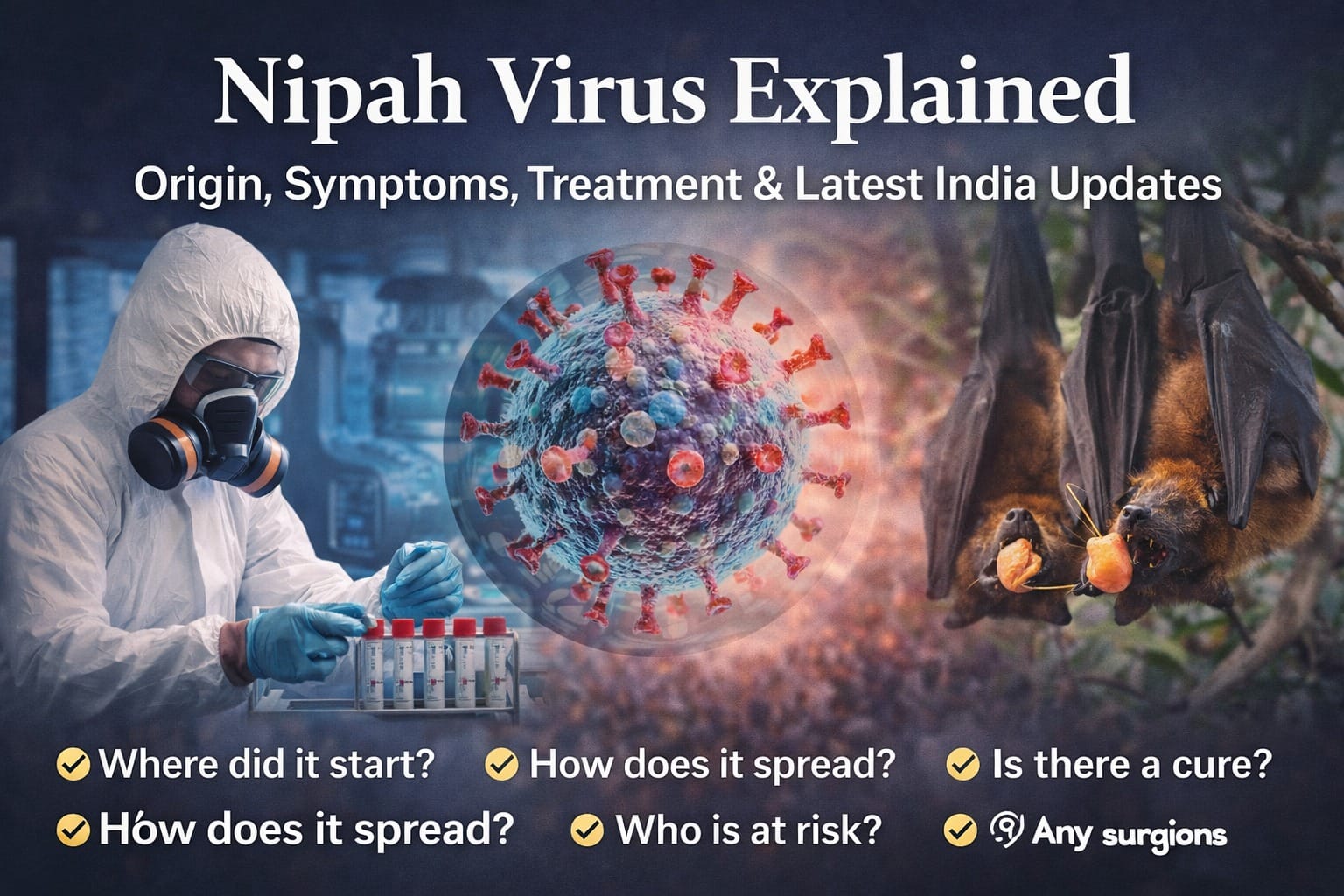
Nipah virus (NiV) is one of the world’s most feared zoonotic infections because it can jump from animals to humans, spread from human to human in close-contact settings, and cause severe disease including fatal encephalitis (brain inflammation). The virus is rare, but when outbreaks occur, they often trigger high public concern due to the potential for rapid escalation, especially in areas where exposure to bats, contaminated food, or close caregiving contact is possible. The World Health Organization (WHO) lists Nipah as a high-priority pathogen and clearly states there is currently no licensed vaccine or specific cure; treatment is mainly supportive care.
This article explains the origin and first-ever outbreak, the latest India scenario in 2026, and the 5Ws (What, Who, When, Where, Why/How), along with symptoms, diagnosis, treatment, and precautions—in a detailed, SEO-friendly format.
What is Nipah Virus (NiV)?
Nipah virus is a zoonotic virus (animal-to-human) that can also spread through contaminated food and direct human-to-human contact. Infection can range from mild or asymptomatic illness to acute respiratory infection and fatal encephalitis.
Why it’s serious:
- It can progress quickly from fever to neurological symptoms.
- Severe cases can lead to coma within 24–48 hours after encephalitis begins.
- Outbreaks are difficult to manage because early symptoms resemble common viral infections.
The 5Ws of Nipah Virus (Quick, Clear, SEO-Friendly)
1) What (What is happening?)
Nipah is a high-risk viral infection that can cause severe respiratory illness and encephalitis. It is dangerous because there is no licensed vaccine or definitive antiviral cure, and containment relies heavily on early detection and infection control.
2) Who (Who is at risk?)
People at higher risk include:
- Those exposed to fruit bats or environments where bats feed/roost
- People consuming contaminated food (classically, raw date palm sap in some regions)
- Healthcare workers and caregivers exposed to bodily fluids of infected patients
- Close household contacts during an outbreak
3) When (When did it start?)
Nipah was first identified during the 1998–1999 outbreak in Malaysia and Singapore, though the virus was isolated and formally described in 1999.
4) Where (Where does Nipah occur?)
Historically, outbreaks have been reported in:
- Malaysia and Singapore (1998–99)
- Bangladesh (recurring)
- India (notably Kerala and earlier outbreaks in West Bengal)
The natural host is fruit bats of the Pteropodidae family.
5) Why/How (Why does it spread, and how?)
Nipah spreads due to a combination of:
- Spillover from bats to humans via contaminated fruits/food
- Transmission to humans via intermediate animals (famously pigs in Malaysia)
- Human-to-human transmission in close-contact settings, especially where infection control is weak or delayed
Origin of Nipah Virus: Where did it come from?
The natural reservoir of Nipah virus is widely recognized as fruit bats (flying foxes). These bats can shed the virus through saliva, urine, and other secretions. When human living spaces, farms, or food sources overlap with bat habitats, the risk of spillover increases.
A critical lesson from past outbreaks is that human-animal-environment interaction plays a major role. When farms expand into bat habitats or when people consume food items that can be contaminated by bats, the chain of infection becomes easier to trigger.
WHO explicitly notes that Nipah can be transmitted from animals to humans, via contaminated food, and from person to person.
The First Nipah Case Ever: Malaysia-Singapore Outbreak (1998–1999)
What happened in the first outbreak?
The first recognized Nipah outbreak began in late September 1998 in peninsular Malaysia, especially around pig-farming areas near Ipoh (Perak). Human cases were associated strongly with exposure to infected pigs.
Why is it called “Nipah”?
The virus was named after Sungai Nipah, the area linked to the human case from which the virus was first isolated.
Key takeaway from the first outbreak
The Malaysia outbreak demonstrated how Nipah can amplify through an intermediate host (pigs), affect large numbers, and cause major public health and economic damage.
Also read – Silver Prices in India in the Last 50 Years
Current Nipah Cases in India 2026: What’s happening right now?
Because outbreaks evolve quickly and different reports can describe different clusters, the best approach is to rely on official health guidance while noting credible media reporting.
1) Official situation update (Government guidance)
India’s National Centre for Disease Control (NCDC) states that, as per the latest central assessment, Nipah is not a major outbreak, and the occurrence is described as local and limited to two districts in Kerala: Kozhikode and Malappuram. The advisory notes there is no need for the general public to be apprehensive, and the Ministry of Health is monitoring the situation closely.
2) West Bengal alert and containment reporting
Separately, NDTV reported a West Bengal situation where two healthcare workers (nurses) tested positive in a private hospital in Barasat (North 24 Parganas), with containment measures including a national joint response team and contact tracing. The report mentions extensive tracing and monitoring to check any spread beyond the confirmed cases.
NDTV also carried reporting that five cases were reported in West Bengal with quarantine and precautionary measures.
What does this mean for “scenario right now” in plain terms?
- Kerala: Official guidance frames it as a localized occurrence (Kozhikode and Malappuram) with monitoring and no generalized panic needed.
- West Bengal: Reports highlight hospital-linked infections and active containment, with case counts varying by report as investigations develop.
If you’re publishing this article, it’s smart (and SEO-safe) to phrase the India 2026 section as: “localized occurrences and active containment measures, with ongoing surveillance” rather than claiming a nationwide outbreak.
Nipah Virus Symptoms: Early Signs People Ignore
Nipah often begins like a common viral illness, which is why early detection is hard.
Early symptoms (common)
- Fever
- Headache
- Muscle pain
- Sore throat
- Vomiting
- Weakness/fatigue
Respiratory symptoms (can become severe)
- Cough
- Difficulty breathing
- Atypical pneumonia or acute respiratory distress
Neurological symptoms (danger zone)
- Drowsiness
- Confusion or altered consciousness
- Seizures
- Encephalitis leading to coma (can be rapid)
How Nipah Virus Spreads (Transmission Routes)
WHO identifies three broad routes: animal-to-human, foodborne, and human-to-human.
1) Animal to human
- Exposure to fruit bats or infected animals (notably pigs in Malaysia outbreak)
2) Foodborne transmission
- Consuming food contaminated by bat secretions
3) Human to human
- Close contact with bodily fluids, particularly in caregiving and healthcare settings
ALSO WATCH – TRENDING**
Diagnosis: How Nipah is Confirmed
Diagnosis is typically done through specialized laboratory testing (for example, RT-PCR during the acute phase). Because Nipah can resemble other infections early, public health systems usually test based on a combination of:
- Symptoms (especially encephalitis/respiratory distress)
- Contact history (exposure to suspected cases or outbreak area)
- Local surveillance alerts and case definitions
Cure and Treatment: Is there a Nipah virus cure?
The reality: No licensed cure, no licensed vaccine
WHO states there is no treatment or vaccine available specifically for Nipah; primary treatment is supportive care.
CDC similarly notes: no licensed treatments, with care focused on rest, hydration, and symptom management.
What supportive care usually includes
- Isolation and strict infection control
- Oxygen/ventilation support if breathing is compromised
- ICU-level monitoring for encephalitis and complications
- Managing seizures, fever, dehydration, secondary infections
Kerala’s clinical guidance documents also emphasize triaging, isolation, infection control, and intensive supportive care as core management principles.
Are any drugs used?
There is ongoing research and discussion around therapeutics (e.g., monoclonal antibodies like m102.4 and antivirals). Evidence is still evolving, and these are not broadly licensed as standard cures.
For a public-facing article, the safest and most accurate phrasing is:
- “No proven cure; treatment is supportive. Some experimental options are under study.”
Nipah Precautions and Prevention: What you can do
Prevention is mainly about breaking the chain of transmission.
Public precautions (simple, effective)
- Avoid close contact with bats and areas where bats roost.
- Avoid consuming potentially contaminated food during alerts; wash fruits thoroughly, peel when possible.
- Do not consume raw/unprocessed foods that could be contaminated in outbreak settings.
- Maintain strong hand hygiene.
- If a case is suspected locally: avoid close contact with sick individuals, follow public health instructions, and seek medical care early.
Healthcare and caregiver precautions
- Use PPE when dealing with suspected/confirmed patients
- Follow isolation protocols and infection prevention control standards
- Strict handling of bodily fluids and contaminated materials
Why Nipah Triggers Panic (and why panic is still not the solution)
Nipah gets labeled “next pandemic threat” in many discussions because:
- It is zoonotic and can spread human-to-human
- It can be fatal
- There is no licensed vaccine or cure
But official Indian guidance in the current context stresses localized occurrence and monitoring, rather than nationwide alarm.
The smart takeaway for readers is:
- Stay informed
- Follow advisories
- Practice hygiene and safe food habits
- Avoid misinformation and panic-forwarding
Nipah Virus FAQ (Quick Answers)
Is Nipah virus airborne?
No. Nipah virus is not airborne like COVID-19 or measles. It does not spread through the air over long distances. Transmission mainly occurs through direct contact with infected animals, contaminated food, or bodily fluids of an infected person, especially in close-contact settings like caregiving or hospitals.
Can Nipah virus spread through water?
No confirmed evidence suggests Nipah spreads through drinking water.
However, food or fruits contaminated by fruit bats (via saliva or urine) can transmit the virus. That’s why health authorities advise washing fruits thoroughly and avoiding potentially contaminated food during outbreaks.
How long is the incubation period of Nipah virus?
The incubation period is usually 4 to 14 days, but in some cases, it can extend up to 45 days.
This long and variable incubation period is one reason why contact tracing and monitoring are critical during outbreaks.
Is Nipah virus contagious between humans?
Yes, but only through close contact.
Human-to-human transmission has been documented, especially among family members and healthcare workers, through exposure to bodily fluids like saliva, respiratory secretions, or blood.
Is there a vaccine or permanent cure for Nipah virus?
No.
There is no licensed vaccine or specific cure for Nipah virus as of now. Treatment focuses on supportive care, such as managing symptoms, providing respiratory support, and preventing complications.
Should people panic if a Nipah case is reported nearby?
No panic is advised.
Health authorities emphasize early detection, isolation, and containment. Following official advisories, maintaining hygiene, and avoiding misinformation are the most effective responses.
Conclusion: Nipah virus in India 2026, explained simply
Nipah virus remains a serious public health threat due to its potential severity and the lack of a licensed cure or vaccine. The virus originated from zoonotic spillover, with the first major recognized outbreak in Malaysia-Singapore (1998–99).
In India (2026), the situation should be described accurately as localized occurrences with active surveillance and containment, with official guidance indicating no major outbreak and occurrence limited to specific districts in Kerala, alongside heightened containment reporting in other areas.
Subscribe to our YouTube Channel for more video insights