






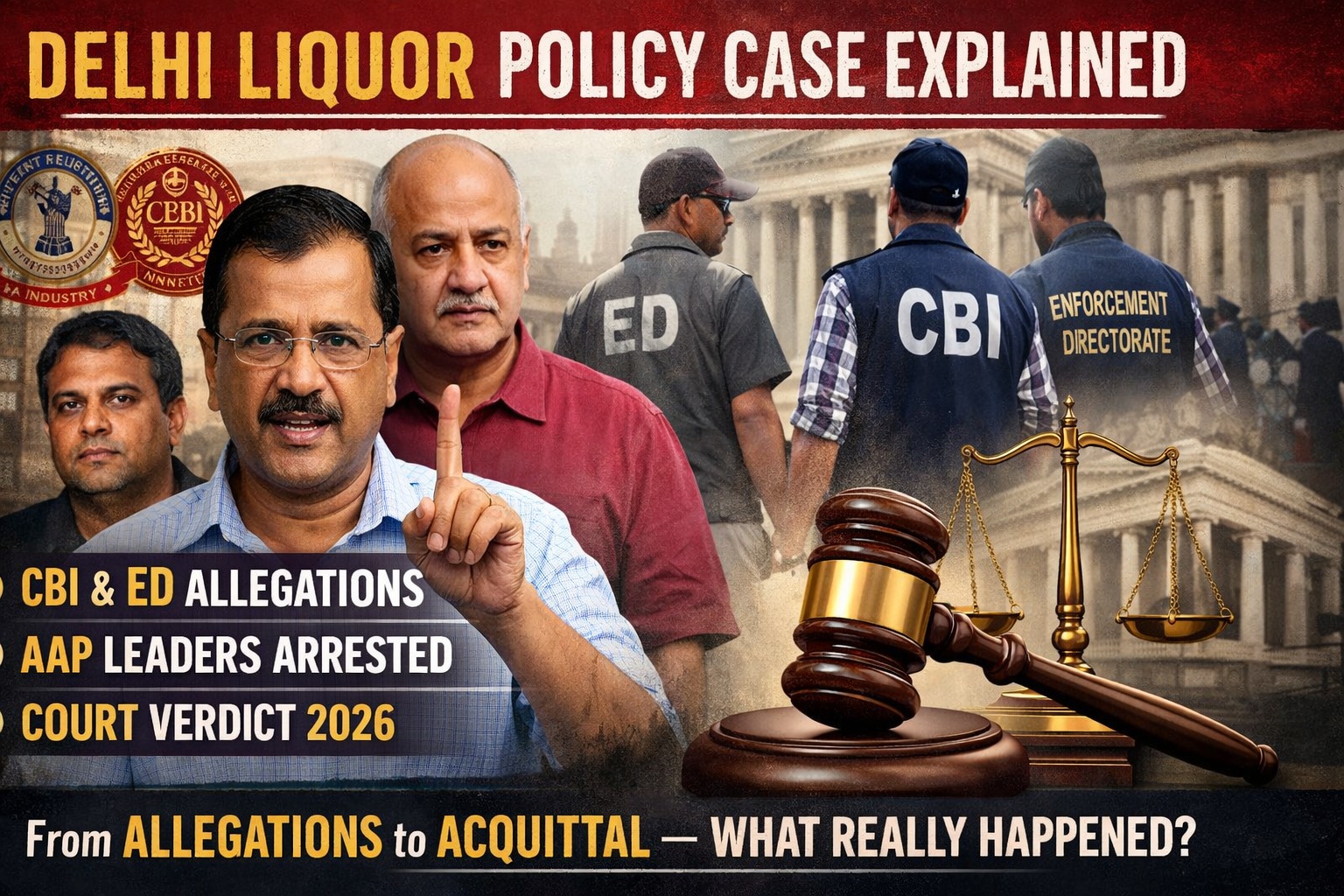
Introduction: Why the Liquor Policy Case Became a National Flashpoint
In India’s contemporary political landscape, no case in recent years drew as much legal, media, and political spotlight as the Delhi Liquor Policy case — often referred to in headlines as the “excise policy scam” or “Delhi liquor scam.”
What began as an administrative reform introduced by the Government of the National Capital Territory of Delhi in 2021–22 grew into a central investigation involving national agencies, multiple arrests, sustained Supreme Court litigation, and eventually a discharge of charges by a trial court in February 2026.
The case involved allegations such as corruption, conspiracy, and money laundering against top leaders of the Aam Aadmi Party (AAP) — including then-Chief Minister Arvind Kejriwal and his deputy Manish Sisodia — and became inseparable from political debates about federal power, criminal procedure, and governance in India.
This article presents an authoritative, verified timeline, explores the roles of the investigating agencies and judicial orders, explains how the case was framed against AAP leaders, and clarifies the legally sound outcome as of early 2026.
Section 1 — The Origins: What Was the 2021–22 Delhi Excise Policy?
The controversy began with the Delhi Government’s Excise Policy 2021–22, intended as a structural reform of the liquor retail ecosystem in Delhi.
According to documented descriptions of the case, the policy:
- Was introduced to reorganize the liquor retail and wholesale sector in Delhi and allow private participation alongside government outlets.
- Was formulated by a committee of ministers in the Delhi government.
- Was presented as a way to increase government revenue which was projected to be in the thousands of crores.
Critics — including opposition parties — said the policy allegedly included provisions that favoured certain private retail entities, gave undue benefits, and waivers on license fees. These claims sparked political and administrative tensions, ultimately attracting central probe agencies.
Section 2 — How Allegations First Emerged (2022)
July–August 2022: Administrative Red Flags and FIR
The first crack appeared once the policy was brought to implementation in late 2021 and early 2022.
- On 8 July 2022, the Delhi Chief Secretary submitted a report alleging irregularities in policy making to the Lieutenant Governor (LG).
- On 22 July 2022, the LG recommended a Central Bureau of Investigation (CBI) probe into the policy’s formulation and execution, citing concerns over revenue loss and procedural violations.
- On 17 August 2022, the CBI registered its initial FIR against policy architects and officials, alleging conspiracy and misuse of official position in policy formulation.
- The Enforcement Directorate (ED), which focuses on money-laundering investigations, registered a separate preliminary case in August 2022 related to alleged laundering of proceeds linked to the same policy.
Early Arrests and Searches
- Throughout late August and September 2022, the CBI and ED conducted raids at multiple locations connected to political figures, officials, and private entities.
- Notable early arrests included corporate executives like Vijay Nair and others, who were alleged to be involved in the policy’s implementation or had connections to beneficiaries.
- The ED alleged that large sums of money were routed through bank accounts and properties, suggesting proceeds of crime that were unaccounted for — basis for money laundering charges.
- The Delhi government itself responded by revoking the controversial liquor policy in September 2022 amid rising scrutiny, effectively reverting to the prior model of state control.
Section 3 — 2023: Deepening Investigations and Major Arrests
February 2023 — CBI Arrests Manish Sisodia
On 26 February 2023, the CBI arrested former Deputy Chief Minister Manish Sisodia after extensive questioning regarding his involvement in the policy’s creation and alleged irregularities. Sisodia was placed in judicial custody.
This was one of the first major arrests of a prominent political leader in the case and marked a significant escalation in the investigation.
September 2023 — ED Expands Cases
By early September 2023, the ED had launched extensive searches across multiple states, seizing assets and pursuing accounts allegedly tied to the same network. ED’s claims focused on money laundering rather than corruption per se, seeing the alleged ill-gotten gains as proceeds of crime.
Political Reactions
Various opposition leaders, including those from the BJP and INC, demanded accountability and pushed the narrative of corruption. AAP, in contrast, dismissed the investigation as politically motivated and framed it as an effort to weaken the party’s governance credibility. Both narratives were aired extensively in Indian media throughout 2023.
Section 4 — 2024: Arrest of Arvind Kejriwal and Supreme Court Battles
2024 became the pivotal year in the Delhi liquor policy saga.
March 21, 2024 — ED Arrests Arvind Kejriwal
On 21 March 2024, the Enforcement Directorate (ED) arrested Arvind Kejriwal in connection with its money-laundering probe related to the liquor policy case after he reportedly failed to comply with multiple summons. This arrest made Kejriwal the first sitting Indian Chief Minister ever to be arrested by a central agency in such a high-profile matter.
Legal Back-and-Forth: Bail and Custody Battles
Once Kejriwal was in custody:
- The Supreme Court granted interim bail in May 2024 — allowing him temporary release to campaign in the 2024 general election — before he surrendered back to custody as per court direction.
- A Delhi trial court granted regular bail later in June, but the High Court stayed that bail pending appeal by ED and CBI, meaning Kejriwal remained in judicial custody.
- Meanwhile, on 26 June 2024, the CBI arrested him from Tihar Jail itself in the corruption angle under its separate FIR, prolonging the legal entanglement.
- On 12 July 2024, the Supreme Court again intervened with interim bail orders.
- In a significant development on 13 September 2024, the Supreme Court granted bail in the corruption case, directing his release from CBI custody — setting the stage for later outcomes.
Impact on Governance and Elections
Kejriwal’s prolonged arrest and the legal limbo surrounding AAP leaders contributed to political headwinds. In the 2025 Delhi Legislative Assembly election, AAP lost control of the capital for the first time in many years. Political commentators cited the cumulative effect of the liquor policy case and other factors as electoral influencers — though interpretations vary widely across different news outlets.
Section 5 — 2025: Bail, Appeals, and the Final Year of Litigation
Throughout 2025, the case continued in courtrooms even as trials had not fully commenced:
ED Cases and Bail
By early 2025, some ED cases saw independent bail grants. According to media reporting, on January 22, 2026, a Delhi court acquitted Kejriwal in two ED cases — indicating that prosecution had failed to establish elements warranting trial on those money-laundering counts.
Similarly, AAP leaders like Sanjay Singh received bail in related matters after ED indicated no objection or following judicial consideration.
CBI Trial Course
Despite extended litigation, no full trial had concluded in the CBI corruption case by the end of 2025. There were motions to admit evidence, framing of charges, and contested bail petitions, setting the stage for the next phase in early 2026.
Section 6 — February 27–28, 2026: Discharge and Court’s Ruling
Key Event — Rouse Avenue Court Discharges All 23 Accused
On 27 February 2026, a Centrally mandated trial court in Delhi delivered a momentous ruling in the CBI corruption case:
- The court refused to take cognizance of the CBI chargesheet against Arvind Kejriwal, Manish Sisodia, and 21 other accused.
- The court held that the prosecution’s material — including evidence presented by the CBI — was “insufficient to establish even prima facie guilt” against any of the accused.
- The trial court discharged all 23 accused persons, effectively terminating the corruption case at the threshold stage prior to trial.
- The court also criticized investigative procedure and recommended departmental inquiry against the CBI investigating officer for alleged investigative lapses.
- Special Judge Jitendra Singh stated that the case did not satisfy threshold conditions for trial based on available evidence, critically undercutting the prosecution’s assertions.
CBI Moves Appeal
Within hours, the CBI formally filed an appeal before the Delhi High Court challenging the trial court’s discharge order. In its petition, the agency claimed that aspects of the investigation were insufficiently considered and sought to stay or overturn the discharge. The High Court was expected to hear the matter swiftly.
ALSO READ
Section 7 — What Exactly Does “Discharge” Mean?
It’s critical for readers to understand legal nuances:
- “Discharge” at the trial stage does not mean acquittal after trial — it means the court found the prosecution’s material insufficient to start trial on the corruption charges.
- It is not equivalent to conviction, nor is it final if appellate courts reverse the discharge.
- The CBI’s appeal means the High Court might reinstate prosecution or modify orders.
Thus, as of February 2026, the corruption case stood legally inactive at trial level but could be revived on appeal — a distinction often misunderstood in mainstream commentary.
Section 8 — How BJP, CBI and ED Framed Their Case (As Per Reputed Sources)
Investigative agencies framed their theory of prosecution around the following core pillars (supported by chargesheets and FIRs):
CBI’s Narrative
- The Delhi excise policy was not merely administrative reform but an engineered plan to benefit selected private parties.
- There were alleged waivers on license fees, extensions of licenses, and benefits that allegedly diverted revenue from public coffers.
- CBI described this as criminal conspiracy, invoking provisions of the IPC and the Prevention of Corruption Act.
- CBI pursued multiple accused through raids, evidence collection, interrogations, and a chargesheet listing alleged misconduct.
ED’s Narrative
- ED’s money-laundering investigation took the corruption allegations as predicate offences, asserting that proceeds of alleged crime were disguised, transferred, or concealed in properties and transactions.
- ED invoked the Prevention of Money Laundering Act, arguing that financial instruments and assets were being used to launder gains.
- ED’s cases brought separate litigation and often intersected with CBI actions, leading to overlapping custody and bail proceedings.
Political Positioning
- BJP leaders publicly supported the central probe and called for accountability, arguing the policy was a textbook case of corruption.
- AAP, by contrast, called these actions politically motivated, describing them as attempts to tarnish credibility and weaken electoral prospects.
- Both narratives were covered widely in Indian media, but judgments and rulings focused on legal merits and sufficiency of evidence rather than political claims.
Section 9 — Was the Case “Proven” Against AAP Leaders? What the Law Says
As of early 2026:
- No conviction has been delivered against AAP leaders in the CBI corruption case; charges were discharged by the trial court.
- In ED money-laundering tracks, some cases resulted in independent bail orders or acquittals in specific matters, but comprehensive trial verdicts on money laundering are pending in some instances.
- Legally, allegations are not facts. Courts require evidence beyond allegations to sustain trial and conviction. The 2026 court ruling essentially found the prosecution’s case too weak to proceed on corruption charges.
Therefore, stating that the BJP, CBI, or ED stated allegations is legally accurate; proving guilt beyond reasonable doubt is a separate judicial threshold that, as of February 2026, was not met in the corruption case.
ALSO READ – Hexagon of Alliances: Natayahu’s Startegic Move
Section 10 — Political and Public Reaction
After the February 2026 ruling:
- Arvind Kejriwal and allies claimed vindication and described the process as politically motivated, stating the discharge confirmed their innocence.
- Political opponents contested that appellate proceedings could reverse the discharge.
- Public and media reactions were deeply polarized — with some seeing the outcome as judicial correction, and others as incomplete justice pending appeals.
Such political commentary is part of public discourse but distinct from judicial findings; readers should differentiate political rhetoric from judicial determinations rooted in evidence and legal standards.
Section 11 – Full Details
The “Delhi excise policy / liquor policy” case became one of India’s biggest political-legal flashpoints because it mixed three combustible things: a high-revenue public policy (liquor), allegations of corruption and money laundering, and the arrest of a sitting Chief Minister (Arvind Kejriwal) during a national election year. The case also ran on two parallel legal tracks:
- CBI corruption case (primarily under IPC/Prevention of Corruption Act), and
- ED money-laundering case (under PMLA), which uses alleged “proceeds of crime” from the predicate offences.
A key update: on 27 Feb 2026, a Delhi trial court declined to proceed with trial in the CBI corruption case and discharged all 23 accused (including Kejriwal and Manish Sisodia), while CBI said it would appeal and ED’s parallel matter remained separate.
What the allegations were (as agencies framed them)
The policy at the centre
Delhi’s Excise Policy 2021–22 (DEP-21/22) changed how wholesale and retail liquor licenses would work. In essence, it aimed to restructure the market (including private participation) and rewrite licensing/retail rules. The policy was later scrapped.
CBI’s core accusation (corruption/conspiracy)
In the CBI case, the prosecution alleged that public servants in Delhi’s Excise Department and others entered into a criminal conspiracy during the framing/implementation of DEP-21/22 to secure unlawful pecuniary advantage for themselves and “favoured private entities.” The case invoked IPC 120B (criminal conspiracy) and Prevention of Corruption Act provisions (as cited in the court order).
ED’s core accusation (money laundering)
ED’s case broadly proceeded on the claim that illegal gratification/kickbacks generated “proceeds of crime” which were then laundered. ED also publicly alleged a larger conspiracy and pursued arrests/summons under PMLA (with litigation moving through trial court, High Court and Supreme Court). A Supreme Court Observer explainer noted ED’s framing of Kejriwal as a key conspirator in its filings.
Important fact-check note: The legal standard at the “charge/discharge” stage is not “proof beyond reasonable doubt.” Courts assess whether the prosecution’s material—taken at face value—creates grave suspicion strong enough to put accused on trial.
Timeline: how the case unfolded (policy → probes → arrests → bail → discharge)
2021–2022: Policy rollout, complaints, and investigative entry
- 5 July 2021: DEP-21/22 brought into force (as referenced in the trial court order).
- July 2022: Allegations of irregularities intensify; the matter moves toward a formal probe (widely reported at the time as the LG recommending a CBI probe after a report).
- 17 Aug 2022: CBI registers FIR RC0032022A0053 based on a complaint from an MHA official, alleging conspiracy in framing/implementation of the excise policy.
- 25 Nov 2022: Main charge sheet dated 24.11.2022 filed (as recorded by the trial court order).
2023: Arrest of Manish Sisodia; the case expands
- 26 Feb 2023: Manish Sisodia arrested by CBI in the excise policy case; litigation on bail and custody follows.
- Oct 2023: AAP MP Sanjay Singh arrested by ED (money-laundering track). He later got bail after ED’s concession/no-objection in Supreme Court proceedings (April 2024).
2024: Kejriwal arrested; Supreme Court interim bail; then CBI arrest from jail
This is the phase that turned the case into a national political event.
- 21 Mar 2024: Arvind Kejriwal arrested by ED under PMLA (money-laundering case).
- 10 May 2024: Supreme Court grants interim bail to Kejriwal for campaigning (until 1 June 2024), after which he surrenders.
- 20 Jun 2024: A Delhi special judge grants regular bail in the ED matter;
- 21 Jun 2024: Delhi High Court stays that bail; Kejriwal continues to remain in jail (all of this is described in the Supreme Court’s later judgment while narrating procedural history).
- 24–26 Jun 2024: CBI seeks permission to interrogate and then arrest Kejriwal; 26 Jun 2024: he is arrested in the CBI corruption case while in Tihar (again, described in the Supreme Court’s procedural narrative).
- 12 Jul 2024: Supreme Court grants interim bail in the ED matter, but Kejriwal remains in jail due to the CBI case.
- 13 Sep 2024: Supreme Court sets aside the Delhi High Court’s denial of bail and directs that Kejriwal be released on bail forthwith in the CBI case (RC No. 0032022A0053 dated 17.08.2022).
What “BJP/CBI/ED made a strong case” means in factual terms (without propaganda)
What can be stated as fact (supported by court records/news)
- Central agencies pursued the case aggressively: multiple summons, arrests, and charge sheets over time; top AAP leaders were jailed for months (or longer), and the matter moved through multiple courts.
- CBI alleged the policy gave unfair advantages to private entities and involved conspiracy/irregularities (Reuters summary of the accusation).
- ED sought cancellation/stay of bail and continued prosecution steps in its matter; the Supreme Court judgment records ED swiftly seeking cancellation and the High Court staying the bail order.
What cannot be stated as fact (unless proved in court)
- That Kejriwal/AAP “definitely did it,” or that BJP’s claims were “true.”
- That agencies “proved” money trail or bribery—because a discharge at the charge stage (in the CBI case) means the court did not find even a prima facie basis sufficient to proceed on that record.
So the precise, truthful statement is:
- Agencies alleged a conspiracy/kickbacks and acted on it with arrests/charge sheets, and courts earlier found enough to remand custody/deny bail at certain points;
- But the CBI corruption case ultimately failed at the charge-framing stage in Feb 2026, with the court discharging all accused—subject to appeal.
Conclusion: Putting the Delhi Liquor Policy Case in Perspective
The Delhi Liquor Policy case represents a multi-year legal journey involving high-level political leadership, central investigation agencies, complex litigation, and significant public attention. As of 27–28 February 2026, important developments include:
✅ The trial court discharged all 23 accused in the corruption (CBI) case for insufficient evidence.
✅ Agencies such as the CBI have appealed the discharge order, keeping legal contestation alive.
✅ ED’s money-laundering matters are separate and have seen various bail and court orders.
✅ No conviction has been secured against top AAP leaders in the central corruption allegations to date.
This evolving case underscores the difference between allegations by agencies and legal proof required for conviction — a differentiation vital for the common Indian reader to understand beyond headlines and political narratives.
SUBSCRIBE TO OUR YOUTUBE CHANNEL THE LOGIC STICK FOR MORE VIDEO INSIGHTS