







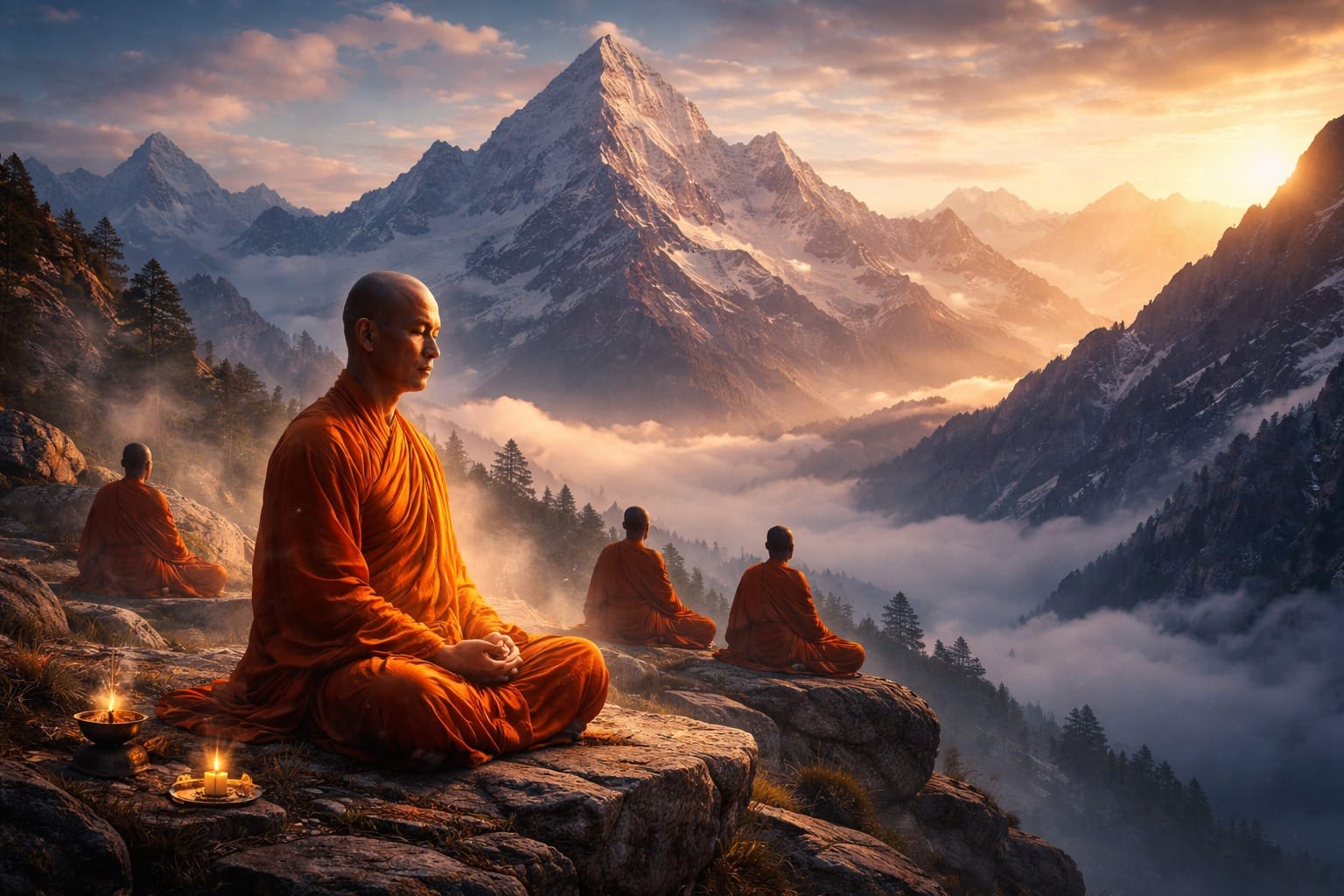
Introduction: The Hidden Powers of Monks and Meditation, and what it does to the Human Mind
For thousands of years, monks sitting quietly in caves, monasteries, and mountains have fascinated the world. From the icy peaks of Tibet to the silent monasteries of Japan and the Himalayan foothills of India, these practitioners dedicate their lives to meditation and spiritual discipline.
Stories surrounding these monks often sound unbelievable. Some say they can slow down their heart rate to almost nothing. Others claim monks can control body temperature in freezing conditions, survive without food for days, and even enter states where they appear detached from physical reality.
Ancient Buddhist texts also describe extraordinary abilities known as Jinzūriki, or supernatural powers achieved through intense meditation practice.
Among these mysterious concepts, one idea stands out above all: Shoonya Avastha, the state of absolute emptiness.
Many spiritual traditions believe that when the mind reaches this state, extraordinary transformations occur. Some even suggest that phenomena such as levitation or out-of-body experiences may arise.
But what exactly is Shoonya?
Is it mystical mythology, misunderstood psychology, or a genuine human capability?
To understand this, we must explore the intersection of meditation, neuroscience, Buddhist philosophy, and ancient spiritual texts.
Understanding Shoonya Avastha: The State of Absolute Emptiness
The word Shoonya originates from Sanskrit and literally means “zero” or “emptiness.”
However, in spiritual traditions, Shoonya does not simply mean nothingness. Instead, it refers to a state where the mind becomes completely free of:
• Thoughts
• Ego
• Identity
• Attachment
• Desire
• Fear
In Buddhist philosophy, this concept is closely related to Śūnyatā, often translated as emptiness or voidness.
But this emptiness is not negative. It is considered the ultimate state of awareness where reality is experienced without distortion.
In Shoonya Avastha, practitioners describe experiencing:
• Total silence within the mind
• Dissolution of personal identity
• A feeling of unity with existence
• Timeless awareness without past or future
Advanced meditators claim that this state cannot be understood intellectually. It can only be experienced directly through deep meditation practice.
How Monks Train Their Minds to Reach Shoonya
Reaching Shoonya is not an overnight process.
Most monks spend decades training their minds through intense spiritual discipline.
Their training usually involves several stages:
1. Concentration Meditation (Samatha)
The first stage focuses on training the mind to remain still.
Monks practice observing the breath or focusing on a single object. Over time, the mind stops jumping between thoughts.
This develops deep concentration.
2. Insight Meditation (Vipassana)
Once concentration stabilizes, monks begin observing the nature of reality.
They analyze how thoughts, emotions, and sensations arise and disappear.
This process gradually weakens attachment to the ego.
3. Dissolution of Self
Eventually practitioners realize that the “self” they believed in is simply a mental construct.
At this stage, awareness begins separating from identity.
4. Entering Shoonya
When all mental activity dissolves, monks describe entering the state of Shoonya Avastha.
Here the mind becomes completely silent.
There is awareness, but no thinker.
The Extraordinary Abilities Described in Buddhist Scriptures
Ancient Buddhist texts mention certain abilities that may arise during deep meditation.
These powers are known as Iddhi or Jinzūriki.
However, Buddhist masters repeatedly warn that these abilities are side effects of spiritual development, not the goal itself.
Some abilities described in scriptures include:
Clairvoyance
The ability to perceive distant events or objects beyond normal sensory perception.
Telepathy
Understanding the thoughts or mental states of others.
Control over Body Functions
Some monks reportedly slow down breathing, heart rate, and metabolism to extraordinary levels.
Modern science has actually observed similar phenomena in advanced meditators.
Extraordinary Physical Endurance
Monks practicing Tummo meditation in Tibet have demonstrated the ability to raise body temperature while sitting in freezing conditions.
Scientific experiments conducted by Harvard researcher Herbert Benson showed monks drying cold wet sheets placed on their bodies in freezing Himalayan temperatures.
Altered Perception of Reality
Many practitioners report experiences of timelessness, weightlessness, or separation from the physical body.
This is where stories of levitation or floating sensations originate.
The Truth About Levitation in Meditation
One of the most fascinating claims surrounding meditation is the idea that monks can levitate.
Historical texts, including certain Buddhist and yogic scriptures, mention “lightness of body” as an advanced meditation state.
However, interpretations vary.
Most modern scholars believe levitation descriptions may refer to subjective experiences rather than physical flight.
When meditators enter extremely deep states of consciousness:
• The brain reduces sensory processing
• Body awareness decreases
• The sense of gravity disappears
As a result, practitioners often report feeling weightless or floating.
Neuroscience studies show that deep meditation significantly alters activity in brain regions responsible for body perception.
In other words, the mind may feel detached from the body.
While there is no scientific evidence confirming physical levitation, the psychological experience of weightlessness is very real.
Scientific Research on Meditation and the Brain
Modern neuroscience has begun exploring meditation more seriously over the past few decades.
Brain scans of long-term meditators reveal remarkable changes.
Increased Brain Plasticity
Meditation strengthens neural connections related to attention, emotional regulation, and awareness.
Reduced Stress Hormones
Practitioners often show lower levels of cortisol, the hormone responsible for stress.
Enhanced Focus and Awareness
MRI scans show increased activity in the prefrontal cortex, the region responsible for decision-making and self-control.
Quieting the Default Mode Network
The Default Mode Network (DMN) is the brain system responsible for constant internal chatter.
Deep meditation significantly reduces DMN activity.
Interestingly, this silence resembles descriptions of Shoonya Avastha.
Why Monks Avoid Talking About Their Powers
Despite all these stories, most monks refuse to discuss supernatural abilities.
In Buddhist teachings, focusing on powers is considered a distraction.
The real purpose of meditation is liberation from suffering.
Chasing mystical experiences can strengthen the ego rather than dissolve it.
Many masters emphasize that spiritual progress should be measured not by powers, but by qualities like:
• Compassion
• Wisdom
• Detachment
• Inner peace
In fact, some traditions deliberately discourage discussing extraordinary experiences.
Shoonya and the Science of Consciousness
Interestingly, the concept of Shoonya also aligns with modern philosophical discussions about consciousness.
Scientists still struggle to explain the fundamental nature of awareness.
Meditation practitioners suggest that consciousness may exist independent of thoughts.
When thoughts disappear, awareness still remains.
This raises fascinating questions:
Is consciousness the brain’s product?
Or is the brain simply a receiver of consciousness?
While science does not yet have definitive answers, meditation research continues exploring these possibilities.
Can Ordinary People Experience Shoonya?
Most people assume Shoonya is accessible only to monks.
However, meditation teachers suggest that even beginners can experience brief glimpses of mental silence.
For example:
During deep relaxation
During moments of awe in nature
During intense creative focus
These brief moments occur when the mind temporarily stops generating thoughts.
However, maintaining such states requires long-term practice and discipline.
Monks spend years developing the mental stability needed to remain in Shoonya for extended periods.
The Deeper Meaning of Emptiness
Ultimately, Shoonya is not about supernatural powers.
Its deeper meaning lies in understanding the nature of existence.
Buddhist philosophy teaches that everything in the universe is interconnected and constantly changing.
Nothing exists independently.
Understanding this dissolves the illusion of separation.
When the ego disappears, compassion naturally arises.
This is why enlightened masters often appear peaceful, humble, and deeply compassionate.
Their power lies not in mystical abilities, but in clarity of awareness.
The Real Miracle of Meditation
While stories of supernatural powers capture our imagination, the real miracle of meditation is far more practical.
Meditation helps people:
• Overcome stress and anxiety
• Improve mental clarity
• Develop emotional balance
• Cultivate compassion and patience
In a fast-moving world filled with constant distractions, learning to quiet the mind may be one of the most powerful skills a human being can develop.
The ancient monks understood something modern society is rediscovering.
True power lies not in controlling the world, but in mastering the mind.
The Mysteries of Advanced Meditation
In the previous part, we explored the concept of Shoonya Avastha, the state of emptiness described in Buddhist and yogic traditions. We also examined the idea of supernatural abilities known as Jinzūriki in Buddhism.
But many deeper questions remain.
Can monks truly control their bodies in ways science cannot explain?
Do Tibetan monks really generate heat through meditation?
What are the Siddhis, the legendary spiritual powers described in ancient Indian scriptures?
Across centuries, spiritual traditions from India, Tibet, and China have documented extraordinary meditation practices that push the boundaries of human potential.
To understand these phenomena, we must examine the intersection of spirituality, neuroscience, and ancient texts.
Tibetan Monks and the Science of Tummo Meditation
One of the most fascinating practices associated with meditation powers is Tummo meditation.
Tummo, often called “inner fire meditation,” is a technique practiced by Tibetan monks.
The practice involves:
• Deep breathing patterns
• Visualization techniques
• Intense concentration
• Control of body energy
Through these methods, monks claim to generate internal body heat.
Scientific Experiments on Tummo Meditation
In the 1980s, researchers led by Dr. Herbert Benson from Harvard Medical School studied Tibetan monks practicing Tummo meditation.
The results shocked scientists.
Monks sitting in freezing Himalayan temperatures were able to:
• Raise their body temperature significantly
• Dry cold wet sheets wrapped around their bodies
• Maintain warmth even in sub-zero conditions
This experiment demonstrated that meditation can influence autonomic body functions, something previously believed impossible.
Today, scientists studying Tibetan monks meditation powers believe meditation may activate the sympathetic nervous system in unique ways.
This suggests that advanced meditation may unlock hidden physiological abilities of the human body.
Also read – 5 Transformative Conscious Parenting Exercises
The Concept of Siddhis in Yogic and Buddhist Traditions
Another major concept related to supernatural meditation abilities is the idea of Siddhis.
The Sanskrit word Siddhi means perfection or accomplishment.
Ancient Indian yogic texts such as the Yoga Sutras of Patanjali describe Siddhis as powers that arise through deep meditation and spiritual discipline.
Some Siddhis mentioned include:
Anima
The ability to become extremely small or invisible.
Mahima
The ability to expand consciousness infinitely.
Laghima
A state where the body becomes extremely light.
This concept is often linked with the idea of levitation in meditation.
Garima
The ability to become extremely heavy.
Prakamya
The ability to manifest desires.
Telepathy and Clairvoyance
Perceiving distant objects or thoughts.
While these descriptions may sound mystical, many scholars interpret them symbolically.
They represent expanded states of consciousness rather than physical magic.
Levitation in Meditation: Myth or Altered Consciousness?
One of the most popular questions people ask is:
Can monks levitate through meditation?
Ancient scriptures from both Buddhist and yogic traditions refer to states where the body becomes extremely light.
In Buddhist texts, this ability is sometimes linked with advanced Jhana meditation states.
However, modern scientific understanding suggests another explanation.
The Neurological Explanation
When meditators enter deep states of awareness:
• The brain reduces activity in the parietal lobe
• Body awareness decreases
• The sense of spatial orientation fades
The parietal lobe is responsible for telling us where our body is in space.
When this region becomes quiet, practitioners may feel:
• Weightless
• Detached from gravity
• Floating
This may explain why many monks describe the sensation of levitation during meditation.
While there is no scientific proof that monks physically float in the air, the experience of floating can feel completely real to the meditator.
The Extraordinary Mental Discipline of Buddhist Monks
Achieving advanced meditation states requires incredible discipline.
Monks often spend 10–20 years training their minds before reaching deeper states of consciousness.
Their daily routine may include:
• 4–8 hours of meditation
• Scriptural study
• Mindfulness practice during everyday tasks
• Strict ethical discipline
• Minimal material possessions
This lifestyle gradually rewires the brain.
Research using MRI scans on experienced monks shows that their brains display:
• Increased grey matter density
• Stronger emotional control
• Reduced stress response
• Enhanced attention and awareness
This suggests that monks meditation abilities are deeply connected to brain plasticity.
The CIA and Government Research on Meditation
Interestingly, meditation and altered states of consciousness have also attracted the attention of governments.
During the Cold War era, both the United States and Soviet Union explored research related to human consciousness.
Some programs investigated whether meditation could lead to abilities such as:
• remote viewing
• heightened perception
• mind-body control
The CIA’s Gateway Process research documents, which later became public, explored how meditation and altered brain states could influence consciousness.
While these experiments remain controversial, they highlight how seriously the scientific community has begun studying meditation.
Shoonya and the Dissolution of Ego
At the heart of all these practices lies the concept of Shoonya Avastha.
Shoonya is often misunderstood as emptiness or nothingness.
In reality, it refers to the absence of ego and mental noise.
When a practitioner enters Shoonya:
• Thoughts slow down dramatically
• Personal identity dissolves
• Awareness becomes pure observation
This state is described in many spiritual traditions.
In Buddhism, it is connected with Nirvana.
In Hindu philosophy, it resembles Samadhi.
In Zen Buddhism, it appears as Satori.
Despite different names, the experience points toward the same phenomenon:
Pure consciousness without the interference of the thinking mind.
What Happens to the Brain During Deep Meditation
Modern neuroscience has discovered fascinating changes during meditation.
Brain scans of experienced meditators show:
Reduced Default Mode Network Activity
The Default Mode Network (DMN) is responsible for constant internal chatter.
In deep meditation, this network becomes quiet.
This may correspond to the Shoonya state of mental silence.
Increased Gamma Brain Waves
Advanced meditators show extremely strong gamma brain wave activity.
Gamma waves are linked with:
• heightened awareness
• cognitive integration
• peak mental performance
Improved Emotional Stability
Meditation strengthens the prefrontal cortex, helping regulate emotions and reactions.
This is why monks often display extraordinary calmness even in stressful situations.
Why Spiritual Masters Warn Against Chasing Powers
Despite all these fascinating abilities, spiritual teachers consistently warn against pursuing them.
In Buddhist teachings, supernatural abilities are considered distractions on the spiritual path.
Why?
Because the goal of meditation is not power.
The goal is freedom from suffering.
Many masters emphasize that chasing mystical experiences can actually strengthen the ego.
Instead, the focus should remain on:
• compassion
• wisdom
• self-awareness
• detachment
In fact, many enlightened teachers deliberately avoid demonstrating or discussing supernatural abilities.
The Real Transformation Meditation Creates
The true power of meditation may not be levitation or supernatural perception.
The real transformation occurs internally.
Long-term meditation practitioners often experience:
• reduced anxiety
• improved mental clarity
• deeper emotional stability
• increased empathy
• greater resilience
In a world overwhelmed by distraction, meditation helps reconnect individuals with their inner awareness.
This is the real power monks have cultivated for centuries.
Can Ordinary People Achieve These States?
A common misconception is that meditation powers are reserved only for monks.
While reaching advanced states like Shoonya requires deep practice, anyone can benefit from meditation.
Even beginners may experience:
• moments of mental silence
• improved focus
• emotional calmness
• reduced stress
With consistent practice, people can gradually deepen their meditation experience.
However, achieving profound states like Shoonya typically requires:
• long-term dedication
• disciplined practice
• guidance from experienced teachers
The Ancient Wisdom Behind Meditation
Meditation practices developed thousands of years ago without modern scientific tools.
Yet ancient monks discovered profound truths about the human mind.
Today, neuroscience is slowly confirming what spiritual traditions have long suggested:
The mind is far more powerful than we realize.
Meditation offers a pathway to explore that potential.
Whether one views meditation from a spiritual perspective or a scientific one, its benefits are undeniable.
Conclusion: The True Meaning of Monks’ Powers
Stories of monks levitating, generating heat, or developing supernatural abilities continue to captivate the imagination.
But the deeper truth behind these traditions may be even more fascinating.
The real power monks develop is mastery over the mind.
Through decades of meditation, they learn to silence thoughts, dissolve ego, and experience awareness in its purest form.
This state of inner stillness is what ancient traditions describe as Shoonya Avastha.
While the mysteries surrounding meditation may never be fully explained, one thing is certain:
The human mind holds extraordinary potential.
And meditation remains one of the most powerful tools to unlock it.
Subscribe to our YouTube Channel, The Logic Stick for more video insights