






Nandigram Voter List Controversy 2026: Disproportionate Deletions Raise Questions Ahead of West Bengal Elections
Introduction
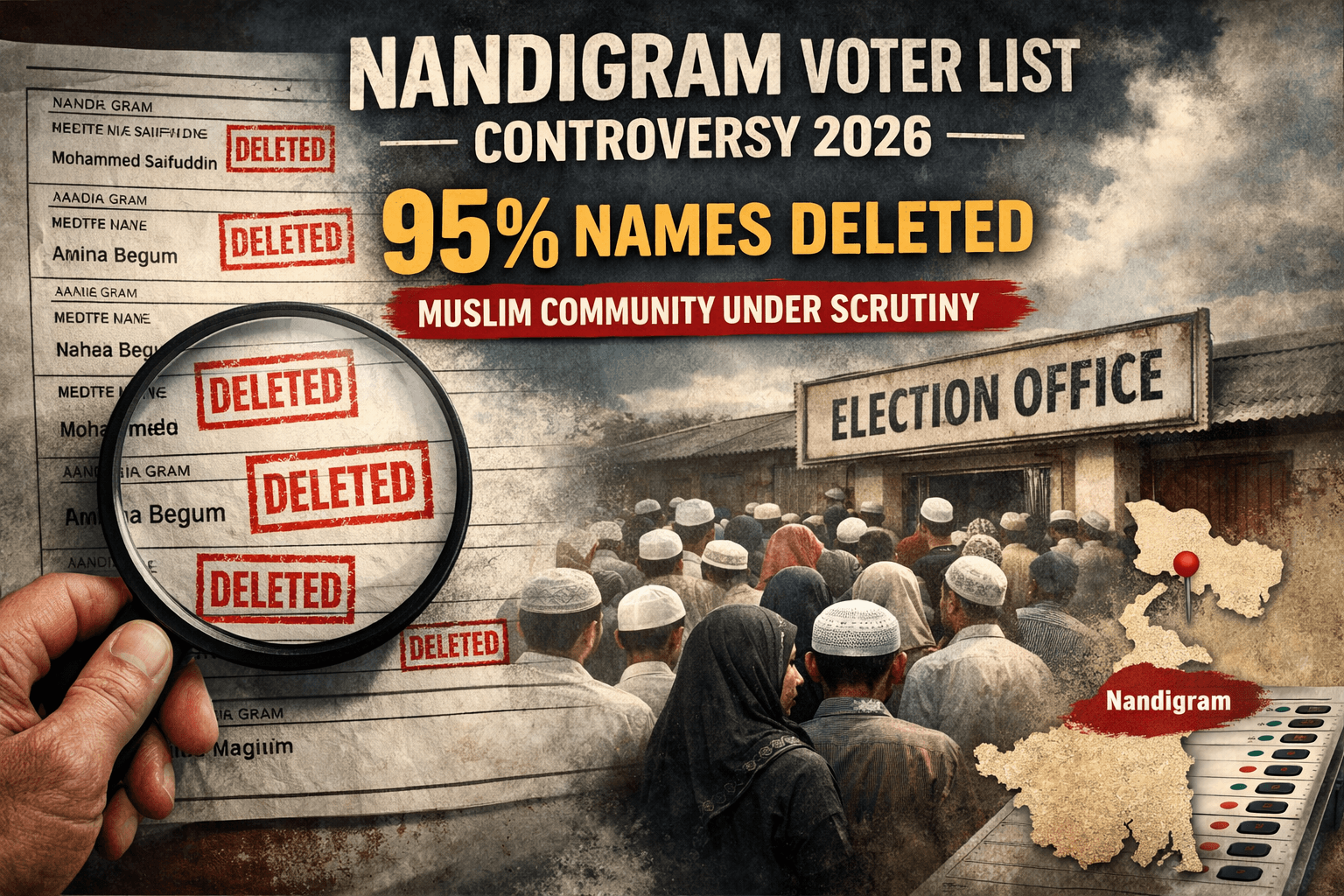
The Nandigram voter list controversy 2026 has emerged as one of the most debated electoral issues ahead of the West Bengal Assembly Elections 2026. A data-based analysis published by The Telegraph India has revealed that approximately 95% of voters deleted during the Special Intensive Revision (SIR) process in Nandigram belong to the Muslim community.
While the Election Commission of India (ECI) maintains that the revision exercise is routine and necessary for maintaining accurate electoral rolls, the scale and pattern of deletions in Nandigram have triggered political reactions and raised concerns about representation, transparency, and electoral fairness.
What Is the Nandigram Voter List Controversy 2026 and Why It Matters
The controversy revolves around the Special Intensive Revision (SIR) of electoral rolls conducted ahead of elections.
Purpose of the SIR Process
The Election Commission carries out SIR to:
- Remove names of deceased voters
- Eliminate duplicate entries
- Update records of migrated individuals
- Ensure that only eligible citizens remain on voter rolls
This process is legally mandated and conducted periodically across India.
However, the issue in Nandigram is not about deletion itself—but about the pattern of deletion and its disproportionate impact on a specific community.
Nandigram Voter List Controversy 2026 Data: What the Numbers Actually Show
According to the analysis reported:
- Total voters deleted in Nandigram: 2,826
- Deleted voters identified as Muslims: Around 2,700
- Percentage: Approximately 95%
- Muslim share in electorate (2021): Around 26%
Why This Data Has Sparked Debate
If a community constitutes roughly one-fourth of the electorate but accounts for almost all deletions, it creates a statistical imbalance.
However, it is important to clarify:
- The data is based on analysis of electoral rolls, not an official community-wise release by the Election Commission
- There is no official confirmation of targeted deletion
- The findings highlight a pattern that requires further explanation, not a proven conclusion
Nandigram Voter List Controversy 2026: Is This Happening Across West Bengal
The SIR process has resulted in large-scale voter deletions across West Bengal, but the community-wise breakdown is not officially available statewide.
What Is Verified
- Significant deletions have occurred across districts
- Some districts, including Murshidabad, have reported higher deletion numbers
What Is Not Fully Verified
- A statewide pattern similar to Nandigram’s 95% figure
- Uniform impact across all constituencies
This means that Nandigram remains a standout case, rather than confirmed evidence of a uniform trend across the state.
Nandigram Voter List Controversy 2026: Political Reactions Intensify
Trinamool Congress (TMC) Response
TMC leaders, including Chief Minister Mamata Banerjee, have raised concerns that:
- Names of voters from specific communities may have been disproportionately removed
- The issue could affect electoral representation
These statements are political allegations, not judicial findings.
Bharatiya Janata Party (BJP) Response
The BJP has defended the revision process, stating that:
- Electoral rolls must be accurate and free from ineligible entries
- The SIR process is a necessary administrative exercise
Nandigram Voter List Controversy 2026: Election Commission’s Official Position
The Election Commission of India has maintained that:
- The SIR process is standard and rule-based
- Deletions are based on objective criteria such as:
- Death
- Migration
- Duplicate registration
- Failure to verify details
The Commission has also emphasized that:
- Voters can file claims and objections
- Deleted names can be restored after verification
There has been no official acknowledgment of bias or targeted action.
Nandigram Voter List Controversy 2026: Ground-Level Concerns Among Voters
Reports from the ground suggest:
- Some individuals were unaware that their names had been deleted
- Others faced difficulties in:
- Submitting documents
- Navigating the verification process
However:
- These reports are localized and anecdotal
- There is no verified statewide data confirming systemic exclusion
Nandigram Voter List Controversy 2026: Understanding the Disproportion Debate
The key issue is disproportion, not deletion itself.
The Core Question
- Why does a community with ~26% voter share account for ~95% of deletions in one constituency?
Possible explanations (not officially confirmed) include:
- Migration patterns
- Documentation challenges
- Verification gaps
At present:
- There is no official explanation breaking down deletions by community
- The available insights come from independent analysis
Nandigram Voter List Controversy 2026: Why This Constituency Matters
Nandigram holds deep political significance in West Bengal.
Key Context
- It was the center of the 2007 land protest movement
- It remains a symbolic political battleground
- It witnessed a high-profile election contest in 2021
Because of this:
- Any electoral irregularity here gains statewide attention
Read more on Delhi Assembly Security Scare.
Nandigram Voter List Controversy 2026: Legal and Electoral Implications
India’s electoral system guarantees:
- Equal voting rights for all citizens
- Inclusion of every eligible voter
If a voter is wrongly removed:
- They can file claims for reinstatement
As of now:
- No court has ruled on the Nandigram voter deletion issue
- The matter remains administrative and political, not legally settled
Nandigram Voter List Controversy 2026: What Remains Unclear
Despite ongoing debate, several questions remain unanswered:
- No official community-wise deletion data release
- No formal audit explaining the 95% figure
- No judicial conclusion establishing bias or wrongdoing
This means:
- The issue is under scrutiny, not conclusively proven
Nandigram Voter List Controversy 2026: What Happens Next
As elections approach, the following steps are expected:
1. Claims and Objections Process
Voters can:
- Apply for correction
- Request re-inclusion
2. Final Electoral Roll Publication
After verification, final voter lists will be released.
3. Increased Political and Public Scrutiny
- Political parties will continue monitoring
- Pressure may grow for greater transparency
Conclusion
The Nandigram voter list controversy 2026 has brought attention to the integrity and transparency of electoral roll revisions ahead of a crucial election.
The key confirmed fact is:
- Around 95% of deleted voters in Nandigram belong to the Muslim community, based on independent analysis of electoral data
At the same time:
- There is no official confirmation of targeted deletion
- No judicial finding of wrongdoing
- No statewide data proving a consistent pattern
This makes the issue:
- A data-backed concern
- A political flashpoint
- A matter requiring greater transparency
As West Bengal prepares for elections, the focus will remain on ensuring that every eligible voter is included, and that the electoral process maintains both accuracy and public trust.