






Pakistan Defence Minister Kolkata Threat Draws Rajnath Singh’s 1971 Warning
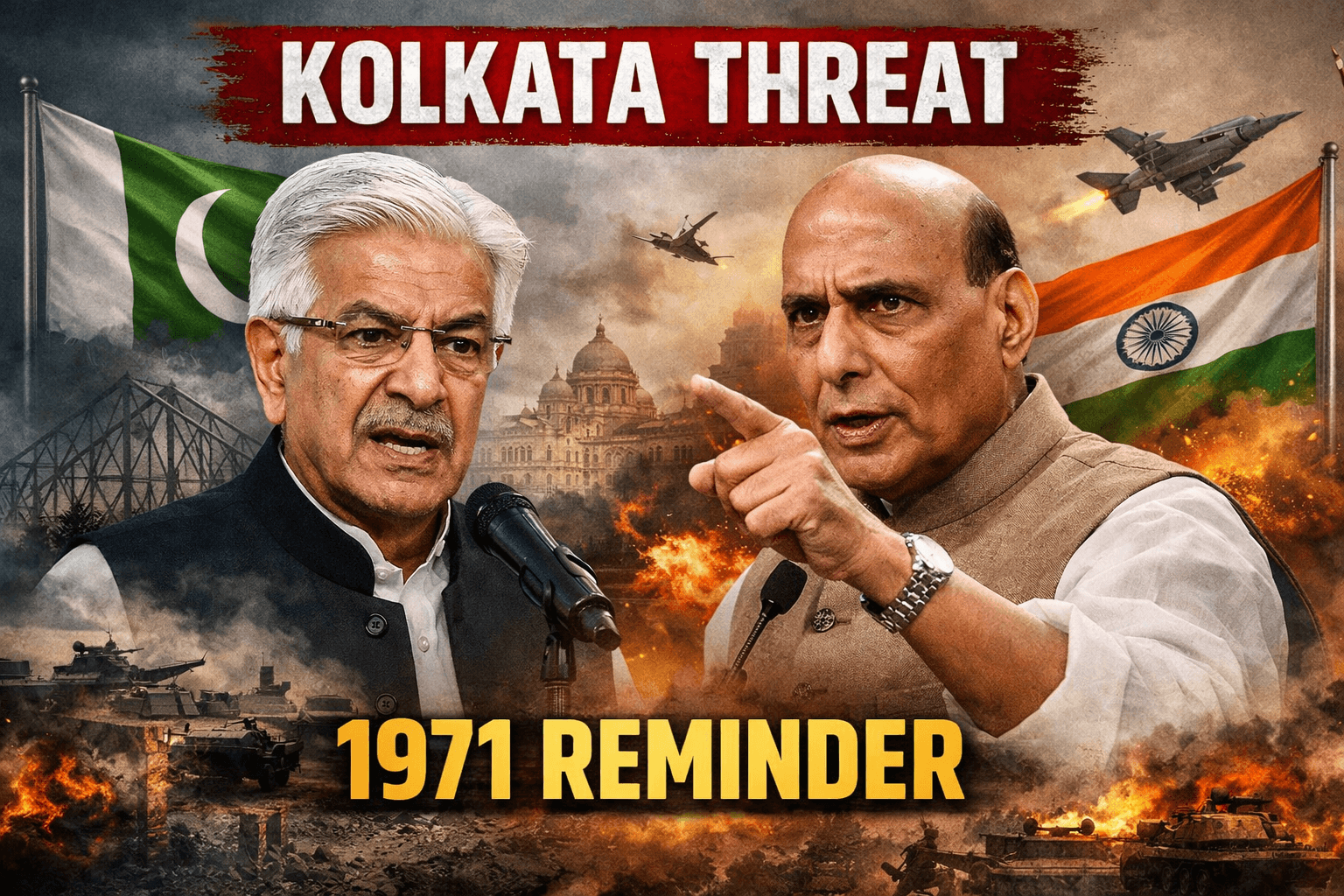
Fresh tensions have erupted between India and Pakistan after Pakistan’s Defence Minister Khawaja Asif said that if India attempted what he described as a “false flag operation,” Pakistan would “take it to Kolkata.” The remark, made in Sialkot on April 4, quickly triggered political and media attention in India because it named a major Indian city directly and was framed as retaliation in a future conflict scenario. Multiple reports also noted that Asif offered no evidence for his “false flag” allegation.
India’s response came on April 7, when Defence Minister Rajnath Singh hit back strongly during a rally in Barrackpore, West Bengal. Referring to Pakistan’s 1971 defeat and the creation of Bangladesh, Singh said Pakistan should remember what happened 55 years ago, adding that if it cast an eye on Bengal again, “only God knows how many parts Pakistan will be divided into this time.”
The controversy matters because it is not just another exchange of words. It comes against the backdrop of already heightened India-Pakistan tensions linked to the aftermath of the April 22, 2025 Pahalgam terror attack, in which 26 people were killed, and the subsequent Indian military action known as Operation Sindoor. Rajnath Singh had, just days earlier, warned that any fresh “misadventure” by Pakistan would invite an “unprecedented and decisive” response from India.
What Khawaja Asif actually said is important to state precisely. According to reports published on April 5, Asif said, “If India tries to stage any false flag operation this time, then God-willingly, we will take it to Kolkata.” India Today and NDTV both reported the statement and also noted that Asif went further by alleging, without proof, that India could stage an incident using “their own men” or Pakistanis in detention and then blame terrorism. That allegation remains unsubstantiated in the public domain.
That detail matters because some early write-ups and social media commentary treated the remark as if Pakistan had issued a concrete operational threat of an imminent strike on Kolkata. The available reporting does not support that stronger claim. What is supported is that Pakistan’s defence minister publicly used Kolkata as an example of how far Pakistan says it could extend retaliation in a hypothetical future conflict. The statement was provocative and escalatory, but the public record so far does not show evidence of a specific operational plan or imminent military action tied to Kolkata.
India’s rebuttal was equally pointed. At his Barrackpore rally, Rajnath Singh said Pakistan’s defence minister should not have made such a provocative statement. He explicitly referenced the 1971 war, saying Pakistan had already paid the price once when it was divided into two parts. The wording matters here too. Singh did not announce any new Indian military step in that speech; instead, he responded politically and symbolically, using 1971 as a warning against reckless rhetoric aimed at Bengal.
The 1971 reference is central to understanding the exchange. The India-Pakistan war of 1971 resulted in the breakup of Pakistan and the creation of Bangladesh. By invoking that history, Singh was not merely countering a verbal threat. He was reminding Pakistan that miscalculation in the eastern theatre has had historic consequences before. In the context of a rally in West Bengal, the symbolism became even sharper because Kolkata and Bengal carry direct historical memory of the 1971 conflict and the birth of Bangladesh.
The immediate trigger for this rhetorical escalation appears to be Rajnath Singh’s earlier warning from Kerala on April 2. There, he said that in the current geopolitical climate, India’s neighbour might attempt a “misadventure,” and if that happened, India’s response would be “firm,” “decisive,” and even “unprecedented.” He also referred to Operation Sindoor, launched in May 2025 after the Pahalgam terror attack, and said the operation was “not over yet,” signaling that India wanted to maintain deterrence against further attacks.
This is where the fact-check needs careful framing. It is accurate to say the Kolkata remark came after Rajnath Singh’s public warning and amid a tense post-Pahalgam security environment. It would not be accurate to say that either side has publicly shown new evidence of troop mobilization or an immediate march toward conflict because of these specific statements alone. The public reporting available right now documents escalatory rhetoric, not confirmed fresh battlefield movement.
Another point that needed correction from some early summaries is the timeline. Khawaja Asif’s Kolkata remark was reported on April 5, 2026, based on comments made in Sialkot on April 4. Rajnath Singh’s sharp 1971 response came later, on April 7, 2026, during a public event in Barrackpore. Framing the sequence correctly is important because the Indian response was reactive, not the initiating statement in this particular exchange.
There is also a political layer to the story inside India. Because the controversy directly involved Kolkata and came during West Bengal’s election season, it quickly entered domestic political debate. West Bengal Chief Minister Mamata Banerjee criticized Prime Minister Narendra Modi over what she called silence on the threat, arguing that Bengal could not be ignored when directly named in such remarks. That reaction shows how India-Pakistan security issues often become part of state-level electoral narratives when a specific region is invoked.
From a strategic standpoint, naming Kolkata was significant. Pakistan’s rhetoric has more often centered around the border, Kashmir, or broader Indian retaliation. Mentioning Kolkata shifted the frame eastward and gave the statement extra psychological weight. At the same time, the remark also seemed designed for signaling rather than for disclosing a real military target list. Public threats of this kind often serve domestic politics, deterrence messaging, and media impact all at once. That is why the comment should be treated seriously, but not sensationally.
The role of the “false flag” allegation must also be kept in perspective. Asif repeated a familiar Pakistani line suggesting India might engineer an incident and blame Pakistan. But in the reports currently available, he provided no evidence for that claim. That is an important fact-check point because unsupported allegations can quickly mutate into accepted “background” in fast-moving political coverage if they are not clearly labeled as unverified.
Read more on Nandigram Voter List Controversy.
The larger picture is that this episode reflects a familiar and dangerous cycle in India-Pakistan relations: a security warning from one side, a provocative escalation from the other, then a historically loaded counter-warning in reply. The risk in such exchanges is not only the words themselves, but the possibility that rhetoric hardens public opinion and narrows the space for de-escalation. With both countries possessing nuclear weapons and a long history of crises, verbal brinkmanship can have consequences even when no immediate military move follows. That concern is reinforced by the way both sides framed the issue in connection with past conflict and terrorism.
The most responsible conclusion, based on the currently available reporting, is this: Khawaja Asif did make the Kolkata remark; he did pair it with an unproven “false flag” allegation; Rajnath Singh did respond with a 1971 reminder and a warning tied to Bengal; and the exchange sits within a larger pattern of heightened India-Pakistan rhetoric after Pahalgam and Operation Sindoor. What cannot be responsibly claimed at this stage is that an actual strike on Kolkata is imminent or that either government has publicly disclosed evidence of a new operational crisis triggered solely by these remarks.
In that sense, the story is serious enough without exaggeration. Pakistan’s defence minister invoked Kolkata. India’s defence minister answered with 1971. The rhetoric is real, the tension is real, and the symbolism is powerful. But the facts, as of April 7, 2026, support a story of sharp escalation in words, not proof of immediate war