







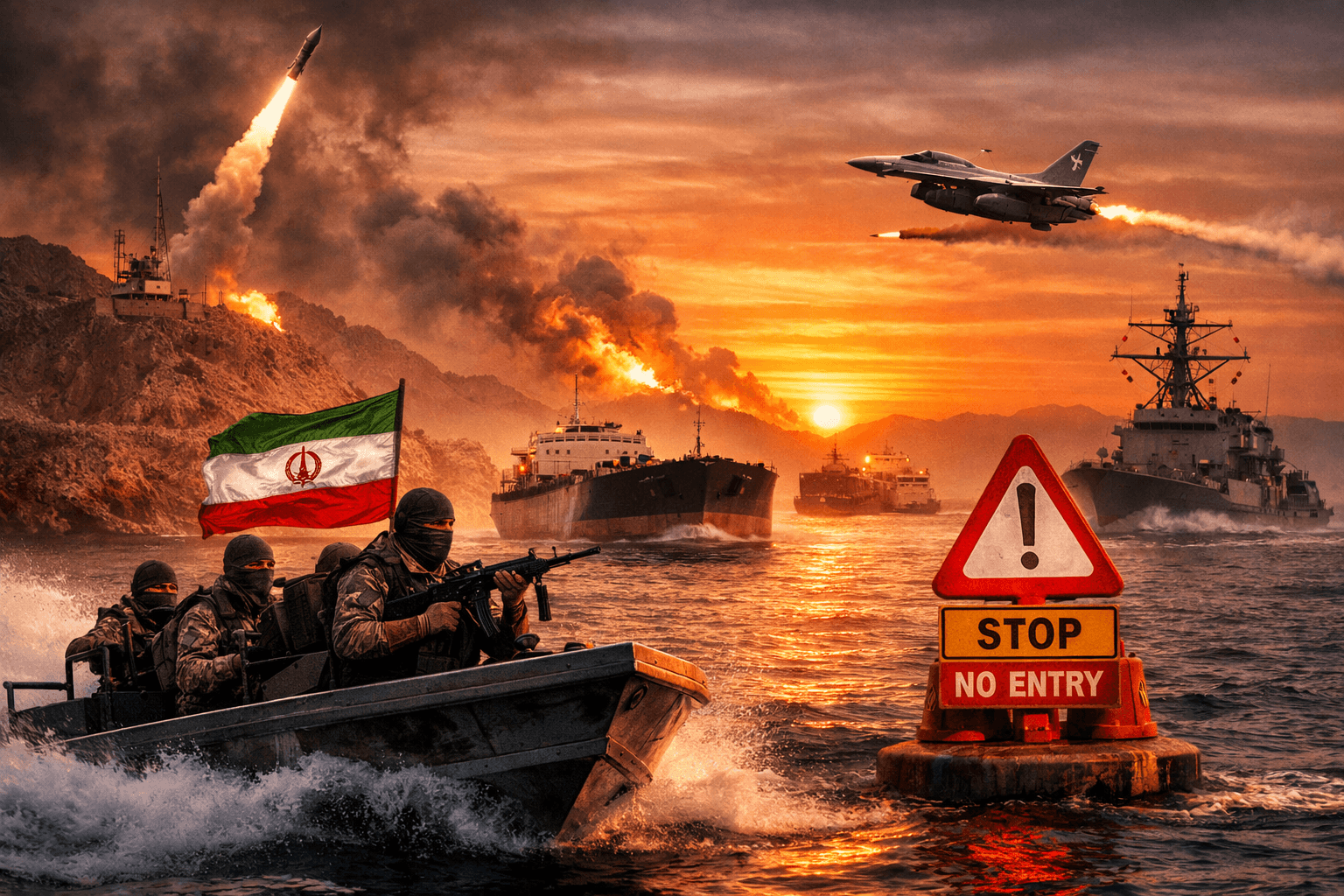
Strait of Hormuz Still Restricted Despite US-Iran Ceasefire as Lebanon Strikes Deepen Tensions
The Strait of Hormuz remains heavily restricted despite a recently announced US-Iran ceasefire, underlining how fragile the current pause in hostilities really is. While the ceasefire briefly raised hopes that commercial shipping would normalize, multiple reports now show that maritime traffic through the strategic waterway is still far from normal, with Iran continuing to demand prior coordination for vessel passage and warning that unauthorized movement could face military action.
The latest tension point is Lebanon. Iran has reacted angrily to Israeli strikes there, arguing that attacks on Lebanon undermine the spirit, and possibly the terms, of the ceasefire arrangement. Israel and the United States, however, have maintained that Lebanon was not covered by the ceasefire with Iran. That disagreement has emerged as one of the central reasons the truce is already under strain.
This matters far beyond the Middle East. The Strait of Hormuz is one of the world’s most important energy chokepoints, handling roughly a fifth of global oil and liquefied natural gas flows. Any disruption there can quickly affect crude prices, shipping insurance, freight schedules, and energy-importing economies, including India, China, Japan, and major European states.
What is actually happening in the Strait of Hormuz
The clearest correction to many early reports is this: the strait is not functioning as a fully open, normal shipping lane. But it is also not completely sealed in an absolute sense. Instead, the current reality appears to be a restricted transit regime in which only some vessels are being allowed through, often after Iranian approval or military coordination. Maritime experts say traffic remains sharply below pre-conflict levels.
Reuters reported that shippers are still seeking clarity on the rules for passage even after the ceasefire announcement. Iran has warned that vessels attempting unauthorized transit could be “targeted and destroyed,” a sign that the waterway remains under coercive control rather than normal commercial freedom of navigation. Reuters also reported that only a limited number of ships had resumed movement and that major container lines remained cautious.
The Guardian similarly reported that the ceasefire had changed little for shipping in practice. It said Iran still controls access conditions in the strait, requires prior permission for passage, and continues to allow only selected movement through a monitored corridor. That makes the current situation less a reopening and more a tightly controlled partial passage system.
Associated Press added another troubling layer by reporting that Iranian media linked to the Revolutionary Guard published material suggesting sea mines may have been positioned in the strait. Even if interpreted as signaling rather than confirmed deployment, that reporting underscores why shipping companies remain reluctant to rush back into the corridor.
Read more on the recent Air India Fuel Surcharge Hike here.
Why the ceasefire has not stabilized the region
The ceasefire itself appears to be narrow, conditional, and subject to sharply different interpretations. European leaders welcomed it as a step toward de-escalation, but those early hopes have quickly been overshadowed by renewed confrontation linked to Israel’s operations in Lebanon and Iran’s response in Hormuz.
The core dispute is whether Lebanon falls within the ceasefire framework. Iran has insisted that any meaningful cessation of hostilities must also include an end to Israeli military action in Lebanon, especially against Hezbollah. France has publicly pushed for that broader interpretation, with President Emmanuel Macron urging that the ceasefire be respected “across all conflict zones,” especially Lebanon.
On the other side, Israel and the United States have indicated that the ceasefire with Iran does not automatically halt Israel’s campaign in Lebanon. That difference is not a minor diplomatic quibble; it goes directly to whether the truce can survive even for the short term. If Tehran sees Lebanon strikes as a violation, it has every incentive to keep pressure on the maritime front.
Why the Strait of Hormuz matters so much
The Strait of Hormuz connects the Persian Gulf with the Gulf of Oman and the Arabian Sea. It is the exit route for a huge share of crude oil, petroleum products, and LNG exports from Gulf producers. That is why even a partial disruption instantly becomes a global market story, not merely a regional military one.
According to Reuters, around 20% of global oil and LNG moves through the strait. When that flow is threatened, refiners, traders, shipowners, insurers, and governments all react at once. Freight decisions become more conservative, insurance premiums rise, and crude markets begin pricing in geopolitical risk again.
For countries like India, which rely heavily on imported energy, this is especially important. A prolonged disruption in Hormuz can influence everything from fuel import bills to inflation expectations. Even when oil prices do not spike instantly, uncertainty alone can keep markets nervous and planning costs elevated. This is one reason global governments are watching the situation so closely.
Shipping companies are still not convinced
A key fact-check point is that commercial confidence has not returned. Major shipping players are not behaving as though the crisis is over. Reuters reported that Maersk and Hapag-Lloyd remain cautious, while one estimate suggested it could take up to two months for traffic to normalize.
That caution reflects more than headline risk. Reuters said 187 tankers remained inside the Gulf holding about 172 million barrels of crude and refined products. When that amount of energy is sitting in a conflict-affected maritime zone, every decision becomes a balance between opportunity and security.
The Guardian also reported that thousands of ships and tens of thousands of seafarers have been affected by the broader conflict disruption. Even if some vessels are moving, the system as a whole is still under pressure, and a return to normal shipping patterns will likely require more than a ceasefire announcement. It will require credible, stable enforcement and a reduction in military ambiguity.
The Lebanon factor is now central
The strike pattern in Lebanon has become the biggest threat to the ceasefire’s survival. Reuters reported that Macron urged both Washington and Tehran to respect a ceasefire “especially Lebanon,” showing that European diplomacy now sees the Lebanon front as inseparable from the maritime crisis.
AP reported that Israeli attacks in Lebanon have already put the ceasefire at risk, while Iran has linked the continued restriction of Hormuz to what it sees as ongoing aggression. The message from Tehran is straightforward: as long as the conflict expands or continues through regional allies and proxies, the maritime choke point will remain part of the leverage battle.
This is what makes the present crisis different from a simple shipping security issue. Hormuz is not just a trade route right now; it is a bargaining chip in a broader regional confrontation involving Iran, Israel, the US, Hezbollah, and outside mediators.
Could Iran impose tolls or special passage terms?
Another issue that has emerged is Iran’s suggestion that ships could face passage fees or toll-like conditions. Reuters reported Greek Prime Minister Kyriakos Mitsotakis calling such an idea unacceptable and a threat to freedom of navigation. That response matters because Greece is a major shipping power, and opposition from maritime states signals how seriously the industry views any attempt to formalize Iranian control over passage.
If tolls or enforced passage permissions become normalized, it would mark a major shift in how one of the world’s most strategic waterways is governed in practice. Even if those ideas do not become permanent policy, the fact that they are being discussed shows how far the crisis has moved beyond ordinary naval tension.
What happens next
In the near term, three outcomes are possible. The first is a limited stabilization in which diplomatic pressure succeeds, passage rules become clearer, and more vessels resume movement. Reuters and European statements suggest there is still active international effort to restore confidence and avoid a full energy shock.
The second is prolonged uncertainty. This currently looks the most plausible. Ships may continue moving only selectively, oil markets may stay sensitive, and the ceasefire may survive on paper while remaining vulnerable in practice because of Lebanon-related violence and unresolved disputes over its scope.
The third is renewed escalation. If Iran decides that the ceasefire has effectively been broken, or if more attacks in Lebanon trigger broader retaliation, the strait could face even tighter restrictions. AP’s reporting about possible mine signaling and Reuters’ reporting on warnings to unauthorized vessels show that the risks are still very real.
Conclusion
The corrected picture is more nuanced than a simple claim that the Strait of Hormuz is either open or shut. It remains restricted, tense, and far from normal despite the US-Iran ceasefire. A small amount of shipping has resumed, but only under conditions shaped heavily by Iranian control and continuing military risk.
The deeper problem is that the ceasefire has not resolved the broader regional conflict. Iran believes Lebanon must be part of any real truce; Israel and the US do not fully accept that framing. As long as that dispute continues, the Strait of Hormuz will remain a pressure point for global energy markets and international diplomacy.