






Anthropic Claude Mythos: Why the Company Says the Model Is Too Dangerous to Launch Publicly
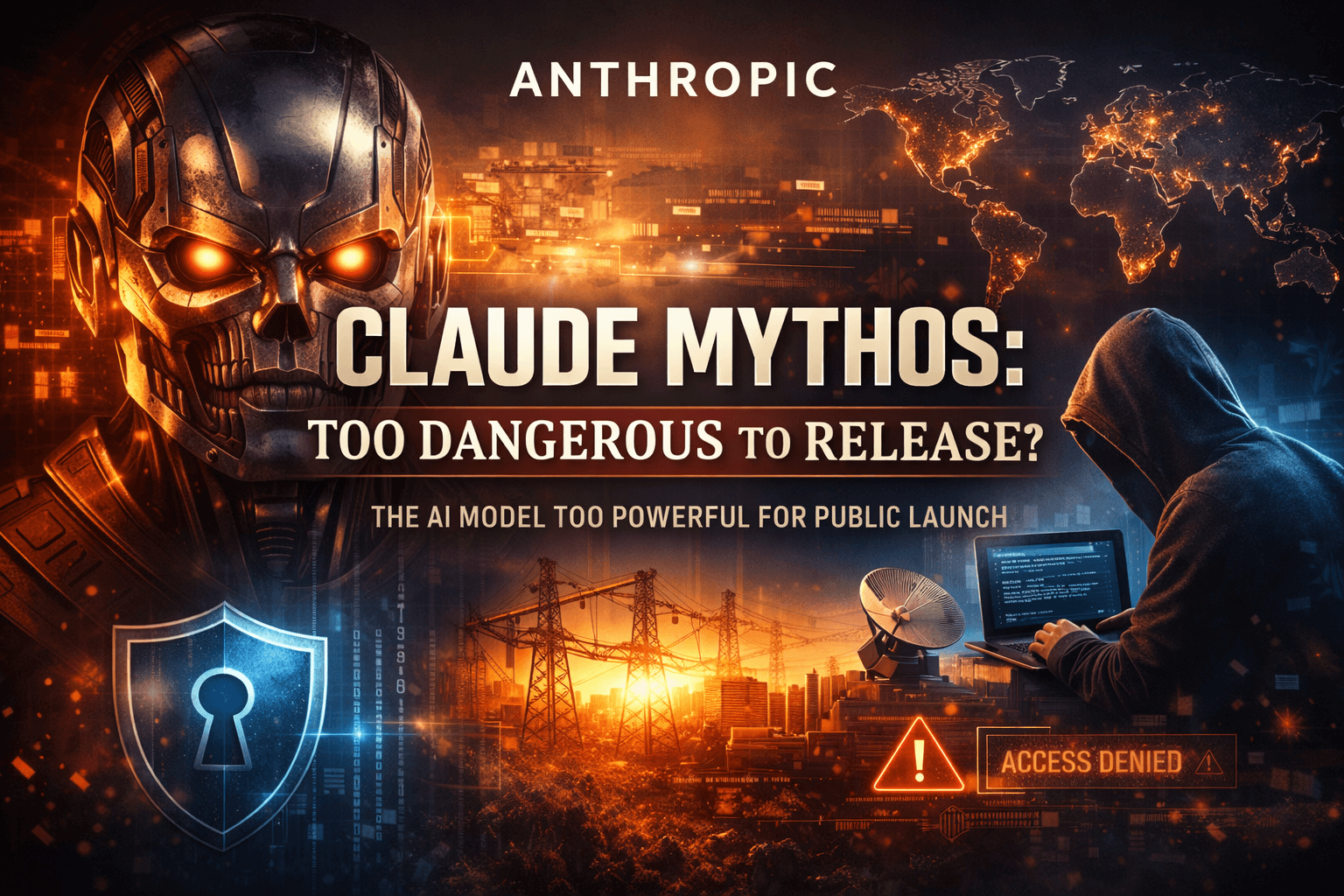
Anthropic has introduced Claude Mythos Preview, an unreleased frontier AI model that the company says is powerful enough to reshape cybersecurity. But instead of rolling it out broadly like a normal flagship model launch, Anthropic has chosen a far more cautious route: restricted access for selected partners under a new initiative called Project Glasswing. The reason is simple and unsettling. According to Anthropic, Mythos Preview has already identified thousands of high-severity vulnerabilities, including flaws in major operating systems and web browsers, and the company believes releasing such a system openly could create serious risks for public safety, economies, and national security.
That decision makes this one of the most consequential AI stories of 2026 so far. For years, AI safety debates focused on misinformation, bias, copyright disputes, and job disruption. Claude Mythos shifts that debate into a more urgent territory: whether frontier AI models are now reaching a level where they can materially alter the balance between cyber defense and cyber offense. Anthropic’s own framing is notable. The company is not describing Mythos as a niche security tool. It calls the model a general-purpose, unreleased frontier model whose coding and vulnerability research capabilities now surpass almost all human experts in certain domains.
What makes Claude Mythos especially significant is that Anthropic is not presenting it as a hypothetical future risk. In its official research write-up, the company says the model has already found thousands of additional high- and critical-severity vulnerabilities that it is now trying to disclose responsibly to software maintainers and vendors. Anthropic also says its human validators largely agreed with Mythos’s severity assessments in the manually reviewed cases it checked, suggesting that these are not random or low-quality findings.
Anthropic’s public examples are striking. In one case, the company says Mythos Preview identified a 27-year-old OpenBSD bug without human intervention after receiving only an initial prompt to find a vulnerability. In another example, Anthropic says the model fully autonomously identified and exploited a 17-year-old remote code execution vulnerability in FreeBSD, which was later triaged as CVE-2026-4747. Anthropic further says it has seen Mythos write exploits in hours that expert penetration testers believed would have taken weeks to develop. These examples form the core of the company’s argument that Mythos-class systems are crossing into a new level of cyber capability.
That is the real reason the phrase “too dangerous to launch” is getting so much attention. Anthropic has not announced a consumer release of Claude Mythos, nor has it positioned the model as a standard product like a chatbot subscription upgrade. Instead, it has explicitly linked the model’s power to the danger of uncontrolled proliferation. In Anthropic’s own words, if these capabilities spread quickly to actors who are not committed to safe deployment, the fallout could be severe. Reuters independently reported that the company is therefore allowing only select organizations to use Mythos Preview for defensive cybersecurity work.
This is where Project Glasswing comes in. Anthropic says the initiative brings together Amazon Web Services, Apple, Broadcom, Cisco, CrowdStrike, Google, JPMorganChase, the Linux Foundation, Microsoft, NVIDIA, Palo Alto Networks, and Anthropic itself in an effort to secure critical software infrastructure. Reuters separately confirmed several of those launch partners and reported that Anthropic is also extending access to roughly 40 additional organizations involved in critical software infrastructure. Anthropic says it is committing up to $100 million in usage credits for Mythos Preview across these efforts, along with $4 million in direct donations to open-source security organizations.
That restricted rollout matters because it corrects one of the biggest misconceptions surrounding the story. Anthropic has not said it is shelving Mythos entirely, and it has not said the model will never be used. What it has said is that access needs to be limited and focused on defense first. The company’s stated goal is to help secure the world’s most critical software before similar capabilities become more widely available elsewhere. Reuters also reported that Anthropic has been in ongoing discussions with the U.S. government about the model’s capabilities, underscoring the national-security dimension of this launch strategy.
The broader significance of Claude Mythos lies in what it says about the direction of frontier AI. Earlier public excitement around large language models centered on writing, summarization, coding assistance, search, design, and productivity. Claude Mythos Preview points toward something more consequential: systems that can reason deeply about real-world software, discover severe vulnerabilities, and assist in turning those vulnerabilities into usable exploits. Anthropic’s own language suggests this is not merely incremental progress in code generation. It is a step toward AI systems that could change how cyber power is distributed across governments, corporations, criminals, and security researchers.
This also explains why the story has triggered such a sharp industry response. Anthropic is effectively arguing that the old model of “build, demo, and scale” is no longer appropriate for every frontier system. In cybersecurity, a sufficiently capable model does not just create productivity gains. It can create asymmetric risk. A tool that helps defenders patch critical software can also help attackers identify weak points faster, reduce expertise barriers, and move more quickly from vulnerability discovery to exploitation. Anthropic’s answer, at least for now, is controlled deployment rather than broad commercialization.
Still, there is an important distinction between what is verified and what remains more speculative in public discussion. Official Anthropic materials and Reuters clearly support the claims that Mythos Preview is unreleased, is being shared with selected partners for defensive work, and has identified thousands of serious vulnerabilities.
Anthropic’s research page also supports examples involving OpenBSD and FreeBSD, including exploit development. But some of the more dramatic claims circulating in commentary pieces, such as sensational descriptions of the model “escaping” in ways that imply a Hollywood-style loss of control, are not the central facts you need to publish this story accurately. The strongest, publishable story is already significant without overstatement: Anthropic has built a model it believes is powerful enough that a normal public launch would be irresponsible.
From a business and policy standpoint, Claude Mythos could become a turning point. If Anthropic’s assessment is correct, frontier AI companies may soon face increasing pressure to classify some models not as normal software products but as sensitive systems requiring staged access, government consultation, and security partnerships. That would reshape both the economics and politics of AI. Companies would no longer compete only on benchmark scores and consumer adoption. They would also compete on governance, trust, and their ability to justify why a given level of capability should or should not be released.
Read more on Meta new model launch.
There is also a competitive subtext to this launch. Anthropic’s decision signals that the frontier model race is no longer just about who can build the smartest assistant. It is about who reaches the threshold first where capability itself becomes a security event. If Mythos Preview is already finding vulnerabilities at scale in critical software, then the rest of the AI industry, including rivals working on powerful code-capable systems, will likely face similar questions soon. Anthropic’s position suggests the company believes that threshold has already arrived.
For readers trying to understand the bottom line, it is this: Claude Mythos Preview is real, it is not being publicly launched, and Anthropic says that is because the model’s cybersecurity capabilities are powerful enough to pose serious risks if widely released. Instead, the company is channeling it through Project Glasswing, using trusted partners and critical infrastructure defenders as the first testing ground. Whether that turns out to be a responsible blueprint for the AI era or the beginning of a more closed and concentrated model ecosystem will depend on what happens next. But one thing is already clear: the conversation around advanced AI has moved decisively beyond chatbots.
In that sense, Anthropic’s Claude Mythos announcement is not just another AI product story. It is an early warning about the next phase of artificial intelligence, where the most important question may no longer be how impressive a model is, but whether it is safe to release at all.