






25 Vultures Found Dead Near Dudhwa Tiger Reserve: Why the Suspected Poisoning Case Matters
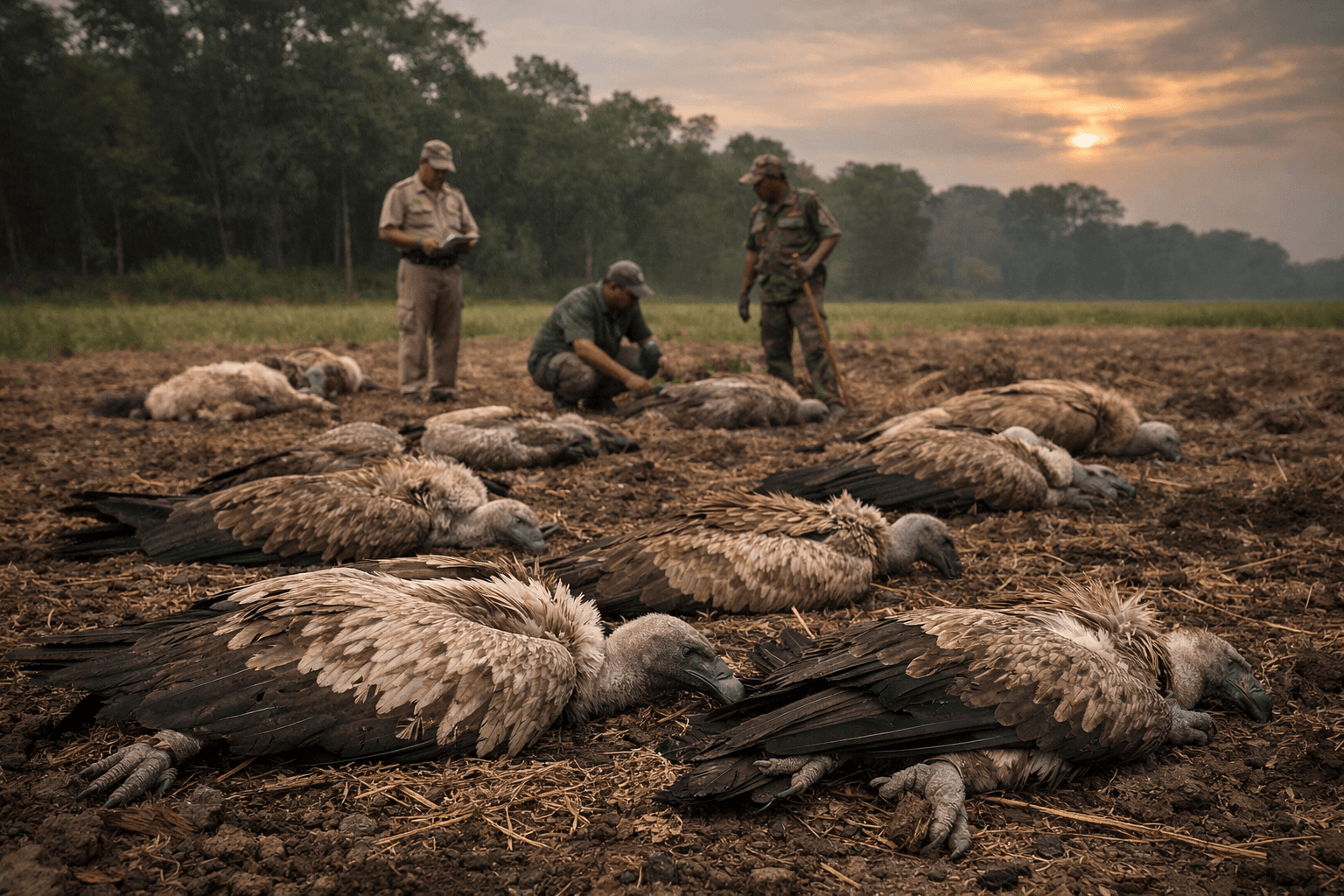
The discovery of 25 dead vultures in Uttar Pradesh’s Lakhimpur Kheri district has triggered alarm among forest officials, wildlife experts, and conservationists. The birds were found in an agricultural field in the Bhira range of the Dudhwa buffer zone, and the incident has quickly become one of the most disturbing wildlife deaths reported in the region this year. Officials have said the vultures were found near carcasses of dogs, and the working suspicion is that the birds may have died after feeding on contaminated carcasses. However, the exact cause of death is still being examined by the Indian Veterinary Research Institute, Bareilly.
The vultures were recovered from Semarai village in the Dudhwa buffer zone. According to officials quoted by PTI and other newspapers, 25 vultures were found dead in the field, while several others were discovered in an unconscious condition and were treated. Reports differ slightly on the number of rescued birds, with some citing five and others six, so the safest fact-based description is that multiple vultures were found alive but incapacitated and were given medical attention.
That distinction matters because the case is still developing. Some initial coverage stated bluntly that the vultures died after consuming a poisoned carcass. But the more careful and better-supported version is this: forest authorities suspect the birds may have died from secondary poisoning after feeding on dog carcasses found nearby, while final confirmation is awaited from laboratory testing. Two carcasses and viscera samples from the dead vultures were sent to IVRI Bareilly for forensic examination, while a panel of veterinarians conducted post-mortems on the other birds.
The incident has drawn even more attention because the vultures are believed to be mostly Himalayan Griffons, a large scavenging raptor species that is listed as Near Threatened on the IUCN Red List. That is another important correction to make. Some reports loosely described the birds as “critically endangered,” but species-specific reporting in Indian Express identified them as Himalayan Griffons and noted their IUCN category as Near Threatened. They are nonetheless legally protected birds in India, and any incident involving their mass death is serious from both ecological and legal standpoints.
What appears to have happened, based on the current reporting, is a possible chain of poisoning through the food web. Dog carcasses were found in the same field at some distance from the dead vultures. Officials said the vultures were suspected to have consumed those carcasses. The New Indian Express, citing Dudhwa sources, reported that the case may involve stray dogs eating pesticide-laced food and the vultures later feeding on those dead dogs. That account fits the pattern of secondary poisoning, but it still should be treated as a strong working hypothesis rather than a closed conclusion until the toxicology report is public.
Even with that caution, the ecological significance of the case is clear. Vultures are among nature’s most important scavengers. They remove carcasses quickly from the landscape, limiting opportunities for disease to spread among stray animals, livestock, and humans. When vultures disappear, dead animal remains persist longer, and that can alter local disease dynamics. India has already lived through a catastrophic vulture decline over the past few decades, so any fresh mortality event involving dozens of birds immediately raises red flags for wildlife managers.
The Dudhwa incident also underlines a larger conservation problem in India: poisoning events can affect far more than their intended targets. Whether poison is used against stray animals, crop-raiding wildlife, or predators, scavengers often become the unseen victims. A carcass left in an open field can turn into a toxic trap for birds that perform a crucial sanitation role in the ecosystem. That is why the suspected cause in this case has drawn such concern. If poisoning is confirmed, it would point not only to a wildlife tragedy but also to a preventable environmental failure.
Another reason this incident stands out is timing. Reports in the past few days suggest that the area had recently been seeing notable vulture activity, making the sudden sight of multiple birds collapsing especially shocking to local observers and officials. Indian Express reported that a villager near the reserve first noticed a large group of Himalayan Griffons circling before they began dropping. That image captures the scale of the event: not a single isolated death, but a sudden collapse affecting a large cluster of scavengers in one location.
The response from authorities has so far focused on investigation and containment. Forest officials collected the carcasses, veterinary teams conducted post-mortems, and samples were dispatched to IVRI Bareilly. These are standard but essential steps, because establishing whether the deaths were due to pesticide poisoning, disease, or another toxic agent is critical for what happens next. In fact, the incident briefly also raised fears of avian influenza in the district, showing how mass bird deaths can trigger multiple lines of inquiry before evidence narrows the cause.
For readers and publishers, this is where fact-checking becomes especially important. It is accurate to say that 25 vultures were found dead in the Dudhwa buffer zone in Lakhimpur Kheri. It is accurate to say that dog carcasses were found nearby. It is accurate to say that officials suspect secondary poisoning and have sent samples to IVRI for final analysis. It is not yet fully accurate to present the poisoning mechanism as conclusively established unless a final toxicology result has been released. That difference may seem small in a headline-driven news cycle, but it matters for credibility.
The case has also revived attention on how India treats scavenging birds in public discourse. Vultures are often overlooked until a crisis occurs, despite being essential to ecological health. Their role is deeply practical: they clean landscapes, reduce decay, and help prevent secondary spread from carcasses. When a large number of vultures dies together, the loss is not symbolic alone. It is functional. It affects the local ecosystem’s ability to process animal remains safely and efficiently.
For Uttar Pradesh, and particularly for the wider landscape around Dudhwa, the incident is also a reminder that conservation cannot stop at protected area boundaries. The vultures were found in the buffer zone, an interface where wildlife, villages, domestic animals, and agricultural practices overlap. That is often where toxic exposure risks rise. Conservation in such areas depends not just on forest policing, but on awareness, veterinary oversight, safe disposal practices, and strict control over how toxic substances are used in rural settings.
Read more on Melania Leaving Donald Trump ?
There is also a policy lesson here. India’s wildlife protection efforts have often focused on charismatic mammals, but scavenging birds need equally serious attention. The country’s earlier vulture crisis showed how quickly populations can collapse when toxic exposure becomes widespread. That history is exactly why even a single mortality cluster of this size is significant. A response limited to local shock would be too narrow; the bigger need is surveillance, enforcement, and rapid forensic follow-up whenever unexplained wildlife deaths occur.
What happens next will depend on the laboratory findings. If toxicology confirms poisoning, the investigation may have to move beyond wildlife mortality into questions of culpability and regulation. If another cause is identified, that too will matter, especially given the initial concern over possible avian disease. Until then, the strongest publishable version of the story is one rooted in confirmed facts and cautious wording: 25 vultures were found dead in Dudhwa’s buffer zone, several others were rescued, dog carcasses were present nearby, and forest authorities suspect secondary poisoning while waiting for final lab confirmation.
The tragedy has already done one thing: it has forced a wider conversation about how fragile India’s scavenger populations remain, and how quickly local actions can trigger ecological damage. Whether the final report confirms pesticide-related secondary poisoning or another cause, the message is already stark. A landscape that loses its scavengers becomes more vulnerable, less healthy, and harder to protect. That is why the deaths near Dudhwa are not just a local wildlife story. They are a warning about the hidden consequences of toxic exposure in shared ecosystems