





Introduction
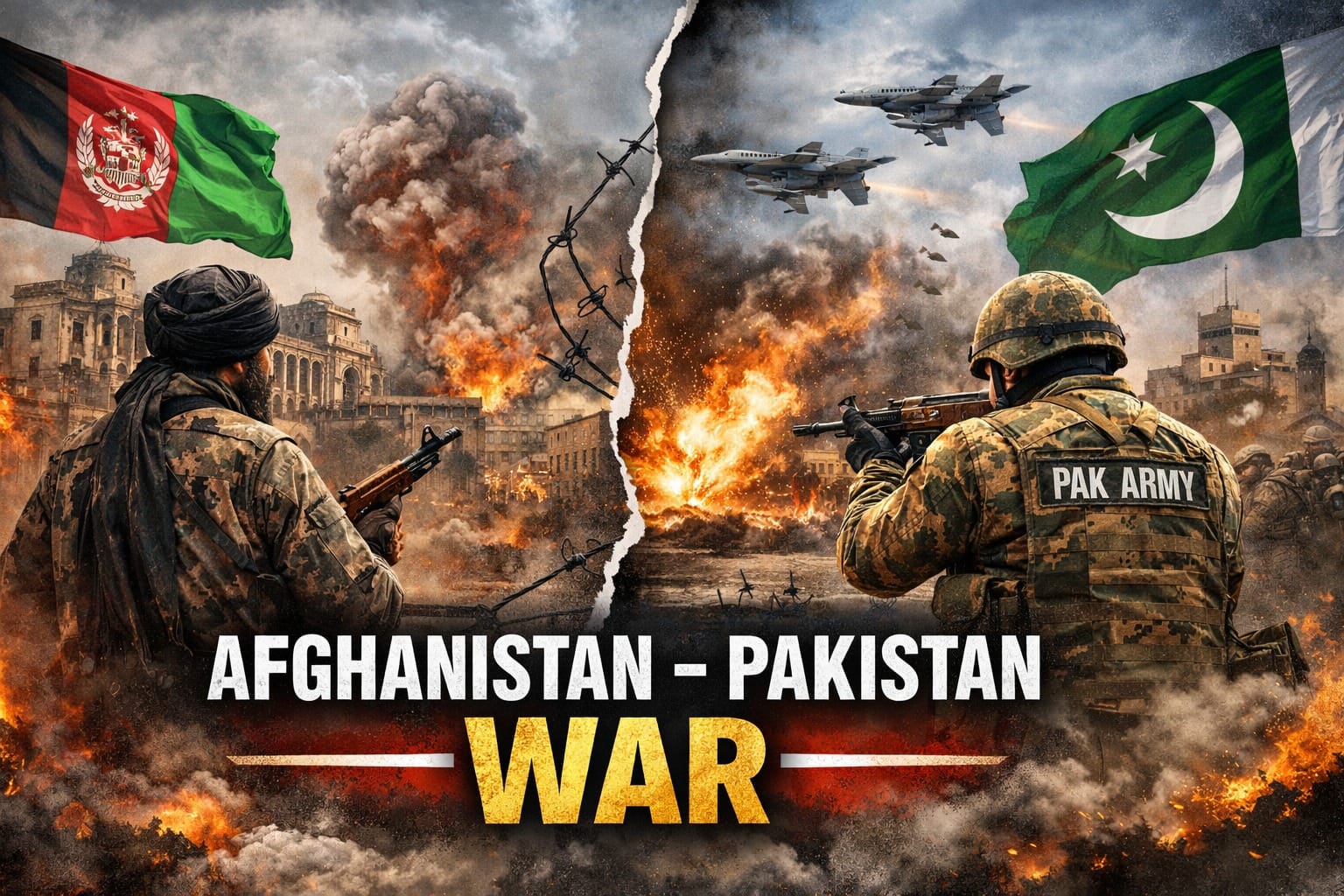
The Afghanistan-Pakistan War conflict has entered one of its most dangerous phases in decades, with February 2026 witnessing what Pakistani officials described as an “open war” following airstrikes on Kabul and escalating cross-border battles. Pakistan launched strikes on Afghan cities after retaliatory attacks by Afghan forces along the border, marking a dramatic shift from sporadic skirmishes to full military confrontation.
The current war is not a sudden event but the culmination of longstanding geopolitical tensions, militant violence, competing narratives of terrorism, and unresolved border disputes. This article provides a comprehensive, SEO-centric breakdown of:
- Latest war developments
- How and why the conflict started
- Timeline of escalation in the last month
- Responsibility based on facts
- Pakistan’s claim of India-backed proxy war
- Future trajectory and possible solutions
Latest Updates: Open War Declaration and Kabul Bombing
The latest escalation occurred on 27 February 2026, when Pakistan declared an open war with Afghanistan’s Taliban government after explosions were reported in Kabul and border clashes intensified.
Key developments include:
- Pakistan launched airstrikes on Kabul and other cities following Afghan attacks on Pakistani border troops.
- Pakistani leaders stated their “patience has run out,” indicating a shift from limited retaliation to sustained military operations.
- Afghan forces reportedly retaliated after earlier Pakistani airstrikes targeting eastern Afghan provinces.
- Military operations expanded across the Durand Line, a historically disputed border between both nations.
These events effectively transformed a low-intensity conflict into a direct interstate confrontation.
Timeline of Escalation (February 2026)
1. Terror Attacks Inside Pakistan
The immediate trigger was a wave of militant attacks inside Pakistan:
- A suicide bombing at a mosque in Islamabad killed dozens and intensified national security concerns.
- A Bajaur attack near the Afghan border killed Pakistani security personnel and civilians, claimed by Tehreek-e-Taliban Pakistan (TTP).
Pakistan blamed militants allegedly operating from Afghan territory, particularly the TTP.
2. Pakistani Airstrikes in Afghanistan
On 22 February 2026, Pakistan carried out airstrikes in Nangarhar and Paktika provinces, targeting alleged militant camps.
Pakistan’s narrative:
- Strikes were intelligence-based operations against TTP and IS-Khorasan militants.
- The attack was retaliation for suicide bombings and cross-border attacks.
Afghanistan’s narrative:
- Airstrikes killed civilians and targeted homes and religious sites.
- Kabul called the strikes a violation of sovereignty and international law.
3. Afghan Retaliation
Afghanistan responded with military operations and cross-border attacks against Pakistani positions, escalating tensions further.
Pakistan then launched Operation Ghazab Lil Haq, a broader military campaign aimed at Afghan and militant targets along the border.
4. Open War Phase
The conflict escalated dramatically on 27 February 2026:
- Pakistani warplanes bombed Kabul and other Afghan cities.
- Pakistan formally declared the conflict an “open war.”
- Cross-border artillery and air combat intensified across multiple provinces.
Historical Roots of the Conflict
To understand the war, one must examine structural causes that predate 2026.
1. Durand Line Dispute
The Durand Line border between Afghanistan and Pakistan has remained contested for decades:
- Afghanistan historically refused to formally recognize the border.
- Ethnic Pashtun communities straddle both sides, fueling cross-border insurgencies.
This unresolved border issue remains the geopolitical backbone of tensions.
2. Taliban-Pakistan Relations Breakdown
Pakistan was once a key supporter of the Taliban but relations deteriorated after the Taliban’s return to power in 2021.
Pakistan’s concern:
- Afghan soil allegedly used by TTP militants to attack Pakistan.
Afghanistan’s response:
- Taliban denies harboring militants and accuses Pakistan of violating sovereignty.
3. Rise of Militancy
The presence of multiple militant groups complicates the conflict:
- Tehreek-e-Taliban Pakistan (TTP)
- Islamic State-Khorasan (IS-K)
- Haqqani network and other factions
Pakistan views Afghan territory as a safe haven for militants, while Afghanistan claims Pakistan exaggerates these threats.
Who Is Responsible? Fact-Based Analysis
Determining responsibility requires separating narratives from verified facts.
Pakistan’s Position
Pakistan argues:
- Terror attacks inside Pakistan were planned from Afghan territory.
- Afghan Taliban failed to prevent militant activity.
- Airstrikes were defensive counterterrorism actions.
These claims stem from Pakistan’s longstanding accusations that Afghan soil hosts TTP militants.
ALSO READ
Afghanistan’s Position
Afghanistan counters:
- Pakistan violated sovereignty with airstrikes.
- Civilian casualties occurred during Pakistani operations.
- Pakistan’s actions triggered retaliatory responses.
Neutral Analysis
Fact-based assessment suggests:
- Terror attacks inside Pakistan did occur and triggered retaliation.
- Pakistani airstrikes preceded Afghan retaliation.
- Both countries engaged in cross-border military operations.
- Civilian casualties and militant involvement complicate accountability.
Thus, responsibility appears shared, driven by security fears, mistrust, and retaliatory logic rather than a single aggressor.
Strategic Drivers Behind Escalation
1. Security Dilemma
Each side views its actions as defensive, but the other interprets them as aggression — classic security dilemma dynamics.
2. Collapse of Diplomatic Mechanisms
Previous ceasefire attempts failed because:
- Pakistan demanded Taliban crackdown on militants.
- Afghanistan denied militant presence.
- Trust deficit prevented verification mechanisms.
3. Domestic Political Pressures
Both governments face internal pressure:
- Pakistan dealing with rising terrorism and public outrage
- Taliban seeking legitimacy and sovereignty recognition
This incentivizes strong military responses.
Regional and Global Implications
The war has broader geopolitical implications:
- Risk of refugee crisis and humanitarian disaster
- Potential militant expansion across South Asia
- Impact on China-Pakistan Economic Corridor security
- Strategic concern for India and Central Asia
- Threat to regional trade and connectivity routes
Why the Conflict Matters Globally
The Afghanistan-Pakistan war is not just a bilateral conflict:
- Both countries possess nuclear and strategic military capabilities (Pakistan).
- The region hosts multiple extremist networks.
- Instability could reshape South Asian security architecture.
- Major powers like China, India, Russia, and the US have strategic stakes.
Afghanistan-Pakistan War 2026: India Angle, Future Scenarios, Solutions & Strategic Outlook (Part 2)
Pakistan’s Claim: India Creating a Proxy War
One of the most controversial aspects of the Afghanistan-Pakistan war is Pakistan’s claim that India is indirectly involved through a proxy war strategy.
Pakistan’s defence minister Khawaja Asif publicly accused the Afghan Taliban of acting as an “India proxy”, alleging that Kabul was exporting terrorism into Pakistan after NATO’s withdrawal.
These claims emerged alongside escalating border clashes, airstrikes, and militant attacks within Pakistan.
Pakistan’s Narrative
Pakistan’s argument rests on several points:
- Militant attacks inside Pakistan
- Pakistan has linked several attacks, including the Islamabad mosque bombing, to networks allegedly supported by India and operating from Afghanistan.
- Baloch insurgency
- Pakistani authorities have repeatedly claimed that Baloch militants are “Indian-backed terrorists.”
- Strategic encirclement theory
- Islamabad argues that India’s diplomatic and development presence in Afghanistan is aimed at encircling Pakistan geopolitically.
Afghanistan and India’s Response
Both Afghanistan and India have rejected Pakistan’s allegations:
- Afghanistan has denied allowing its territory to be used against any neighboring country.
- India condemned Pakistan’s airstrikes and supported Afghanistan’s sovereignty rather than engaging militarily.
Thus, available evidence suggests the proxy war claim remains political rhetoric rather than proven fact, commonly seen in South Asian security narratives.
ALSO READ – NITHARI CASE EXPLAINED WITH TIMELINE
Neutral Strategic Assessment of the India Angle
Security analysts broadly agree on three realities:
1. Information warfare and blame politics
Pakistan’s proxy war claims reflect:
- Domestic political pressure after terror attacks
- Strategic messaging to justify military actions
- Efforts to internationalize the conflict
2. India’s limited role
India’s involvement appears primarily diplomatic:
- Humanitarian and development assistance in Afghanistan
- Political support for Kabul’s sovereignty
- Strategic balancing against Pakistan
There is no widely verified evidence of direct Indian military involvement in the conflict.
Where Is the War Headed?
The Afghanistan-Pakistan war may evolve into several scenarios.
Scenario 1: Prolonged Border War
The most likely trajectory is a sustained low-intensity conflict characterized by:
- Cross-border artillery exchanges
- Airstrikes targeting militant camps
- Militant retaliation and terrorist attacks
This pattern already exists in the region and could continue for years.
Scenario 2: Taliban-Pakistan Direct War
If escalation continues:
- Larger military offensives may occur
- Territorial clashes along the Durand Line could intensify
- Afghan Taliban may mobilize conventional forces
This would mark the first major interstate war between Taliban-led Afghanistan and Pakistan.
Scenario 3: Militant Proxy War Expansion
The conflict may shift toward indirect warfare involving:
- TTP and IS-K activities
- Baloch insurgent attacks
- Cross-border militant safe havens
Such a scenario would make the war harder to resolve.
Scenario 4: International Mediation and Ceasefire
Global pressure could lead to:
- Ceasefire agreements
- Joint counterterrorism mechanisms
- Border security arrangements
This remains the best outcome but requires political trust.
Humanitarian Impact of the War
The conflict has already created serious humanitarian consequences.
1. Civilian casualties
Airstrikes in Afghan provinces reportedly killed civilians, including women and children, according to Afghan authorities.
2. Refugee crisis risk
Escalation may trigger:
- Cross-border displacement
- Internal displacement in Afghanistan
- Pressure on Pakistan’s already strained refugee infrastructure
3. Economic disruption
The war threatens:
- Trade corridors
- Regional connectivity projects
- Local economies dependent on cross-border trade
Geopolitical Implications
The Afghanistan-Pakistan war has wider regional consequences.
China
China fears instability affecting:
- Belt and Road investments
- China-Pakistan Economic Corridor security
- Uyghur militant networks
Russia and Central Asia
Instability may create:
- Security risks in Central Asian republics
- Potential militant spillover
- Strategic realignment in Eurasia
United States
Although withdrawn from Afghanistan, the US remains concerned about:
- Terrorist safe havens
- Regional stability
- Nuclear escalation risks involving Pakistan
India
India’s concerns include:
- Terrorist spillover into Kashmir
- Regional instability affecting trade routes
- Pakistan’s narrative framing India as a participant
Root Causes Preventing Peace
The conflict persists due to structural problems.
1. Sanctuary politics
Pakistan claims militants operate from Afghanistan, while Afghanistan denies it — a classic safe-haven dispute.
2. Durand Line dispute
Unresolved border recognition fuels cross-border tensions and military clashes.
3. Lack of trust
Diplomatic attempts failed due to:
- Mutual accusations
- Verification challenges
- Political instability
4. Militant ecosystem
Multiple militant groups create a complex battlefield where state and non-state actors overlap.
Possible Solutions to the War
A sustainable peace requires multi-layered solutions.
1. Joint counterterrorism mechanism
Both nations must establish:
- Intelligence sharing
- Joint border patrols
- Monitoring of militant safe havens
2. Border settlement framework
A long-term solution requires:
- Recognition or renegotiation of the Durand Line
- Demilitarized buffer zones
- Cross-border tribal cooperation
3. International mediation
Neutral mediators like:
- Qatar
- China
- UN
- Turkey
could facilitate dialogue.
4. Economic cooperation
Economic incentives may reduce conflict:
- Trade corridors
- Infrastructure development
- Regional energy projects
5. Counter-radicalization programs
Long-term peace depends on:
- Addressing militant recruitment
- Development in border regions
- Education and governance reforms
Strategic Conclusion
The Afghanistan-Pakistan war of 2026 represents a dangerous convergence of:
- Historical border disputes
- Militant insurgencies
- Security paranoia
- Domestic political pressures
- Geopolitical rivalry
Pakistan’s proxy war narrative involving India remains largely unverified and appears tied to strategic messaging rather than concrete evidence.
Responsibility for the war is shared, driven by retaliatory cycles and mistrust rather than a single aggressor.
Without diplomatic intervention, the conflict risks evolving into:
- Prolonged border war
- Proxy insurgency battlefield
- Regional destabilization crisis
However, with international mediation, counterterror cooperation, and border agreements, a fragile but achievable peace remains possible.
SUBSCRIBE TO OUR YOUTUBE CHANNEL THE LOGIC STICK FOR MORE VIDEO INSIGHTS