







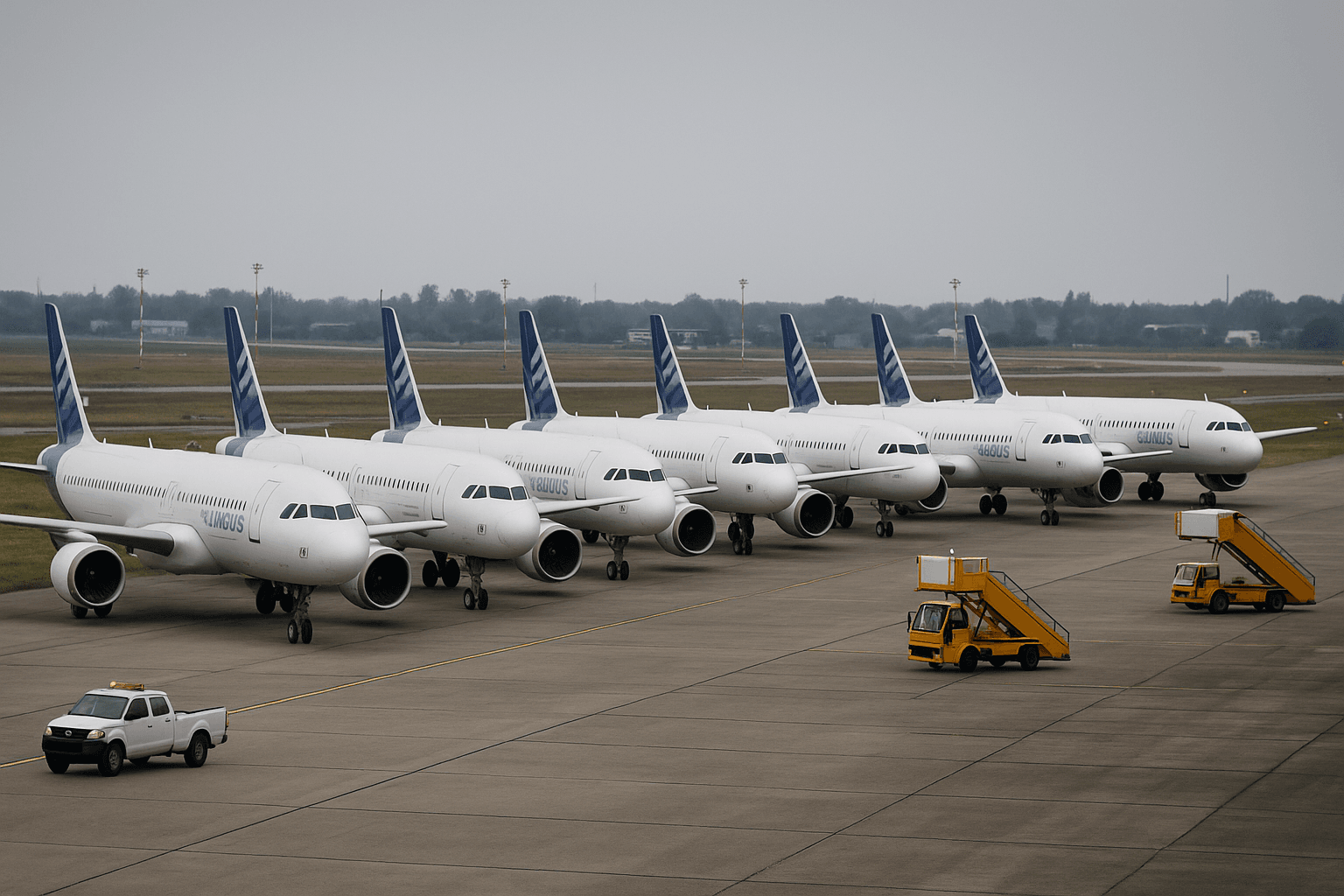
Planes Grounded Worldwide After Airbus Warns Solar Radiation Could Corrupt Flight-Control Systems
A sweeping safety order involving up to 6,000 Airbus A320-family jets has triggered one of the largest aircraft recalls in the company’s 55-year history, forcing airlines across the world to ground planes for urgent software – and in some cases hardware – fixes. The problem: intense solar radiation has been found capable of corrupting data in a key flight-control computer, raising the risk of sudden, uncommanded movements of the aircraft. Sky News+1
The alert follows a late-October incident involving a JetBlue A320 flying from Cancun to Newark, which experienced a sharp, uncommanded loss of altitude and diverted to Tampa. Investigators later concluded that solar activity may have interfered with a flight-control system known as the ELAC (Elevator and Aileron Computer), prompting Airbus and regulators to act. Reuters+1
Airbus has ordered that affected aircraft receive the fix before their next routine flight, effectively grounding thousands of workhorse jets that form the backbone of short- and medium-haul travel worldwide. Reuters+1
What exactly did Airbus discover?
According to a bulletin sent to airlines and later confirmed by Airbus, analysis of the JetBlue incident and other data showed that “intense solar radiation” – particularly solar flares – could corrupt data critical to the functioning of the A320’s fly-by-wire flight controls. Sky News+1
The focus is on the ELAC, the computer that translates pilots’ side-stick inputs into commands to the elevators and ailerons (the surfaces that control pitch and roll). If data inside this system is altered unexpectedly, the computer can send incorrect commands to the control surfaces, potentially causing abrupt pitch changes or structural stress on the airframe. Reuters
This kind of issue is consistent with what engineers call single-event upsets (SEUs) – bit-flips in electronic circuits caused by high-energy particles from cosmic rays or solar storms. These particles can flip a “0” to a “1” in computer memory without physically damaging the hardware, but that one flipped bit can translate into wrong commands. SEUs are a known risk in avionics at cruising altitudes, where radiation levels can be hundreds of times higher than at sea level. Wikipedia+2icas.org+2
Although aircraft systems are designed with redundancy and radiation-tolerant hardware, the Airbus and regulator analysis concluded that, in a specific software configuration now in widespread use on the A320 family, the protection against these rare events was not robust enough. Hence the emergency directive to roll back to an earlier software version and apply additional safeguards. Reuters+1
Also read – Epstein Files, New Emails, And Trump: 10 Explosive Revelations
How big is the recall?
The scale is enormous:
- Airbus estimates around 6,000 A320-family jets need immediate repairs – more than half the global A320 fleet. Reuters+1
- When the bulletin went out to over 350 operators, about 3,000 A320s were in the air at that very moment, highlighting how ubiquitous the type has become. Reuters+1
- The A320 family (A319, A320, A321 and variants) now numbers roughly 11,300 aircraft in service worldwide, having recently overtaken the Boeing 737 as the most-produced jetliner. Reuters+1
Most affected aircraft will only need a software rollback, which Airbus says is a relatively simple two-hour job per jet. However, more than 1,000 aircraft may also require a hardware modification, which will take longer and depend heavily on hangar capacity and the availability of parts and engineers. Reuters+1
Regulators including the European Union Aviation Safety Agency (EASA) have made the fix mandatory before the next commercial flight, which is why airlines have been forced into short-notice groundings and schedule reshuffles. Reuters+1
Which airlines are hit the hardest?
The A320 family is the single most important aircraft type for many low-cost carriers and a large chunk of legacy airlines’ short-haul fleets, so the impact is very uneven: airlines heavily reliant on Airbus narrow-bodies are feeling the shock more acutely than those operating mixed fleets or Boeing-only short-haul networks.
United States
- American Airlines
American is the world’s largest A320 operator. It has said about 340 of its 480 A320-family aircraft need the software fix. The airline expects the majority of these updates to be completed within roughly a day, with each jet requiring around two hours of work, but the sheer number means tight scheduling and a risk of delays around busy travel days. Reuters+1 - Delta Air Lines & JetBlue
Delta has confirmed that a subset of its A320 family – particularly A321neo aircraft – is affected, though it expects only limited disruptions. JetBlue, whose October incident triggered the investigation, is also part of the recall, but detailed numbers haven’t been made public. Both carriers have indicated they will slot the repairs into overnight maintenance where possible. Gulf News+1 - United Airlines & Hawaiian Airlines
United has stated that it is not impacted by the Airbus directive, reflecting its fleet mix and specific software baselines. Hawaiian has likewise reported no significant effect. Gulf News+1
Europe
- easyJet
As one of Europe’s largest all-A320 operators, easyJet has a heavy technical workload. However, the airline says it has already completed the software update on many aircraft and expects to run its Saturday schedule largely as normal, asking passengers only to keep an eye on flight status. Sky News+1 - Lufthansa
German carrier Lufthansa has acknowledged that part of its A320-family fleet is affected and warned of “a small number” of cancellations or delays over the weekend while it implements the Airbus measures. Sky News+1 - Air France & British Airways
Air France has cancelled around 35 flights – roughly 5% of its daily schedule – while it grounds aircraft for inspection and updates. Reuters+1 British Airways, by contrast, says only three A320s are affected and that fixes are being done overnight, with no significant disruption expected. Sky News - Wizz Air, Aer Lingus, Turkish Airlines
Wizz Air and Aer Lingus each report a limited number of affected jets, with some weekend delays expected as maintenance slots are arranged. Turkish Airlines says eight A320s in its fleet require action but insists its overall operations remain largely uninterrupted. Sky News
Latin America
- Avianca
Colombian carrier Avianca is among the worst hit globally. The recall affects more than 70% of its fleet, forcing the airline to announce “significant” disruption for at least 10 days and to temporarily suspend ticket sales for travel through 8 December. Reuters+1 - Volaris
Mexican low-cost carrier Volaris has warned of delays and cancellations for up to 72 hours while it cycles aircraft through the update process. Reuters
Asia–Pacific and Middle East
- India: IndiGo, Air India & Air India Express
India is a major A320 market, and its airlines are feeling a serious but short-term pinch.- IndiGo operates around 370 A320-family jets,
- Air India has 127,
- Air India Express operates roughly 40 more. The Indian Express
- Air New Zealand
Air New Zealand has warned passengers that several flights may be disrupted and that a number of cancellations are expected while the Airbus work is done on its Airbus narrow-body fleet. Sky News+1 - Flynas and other Gulf carriers
Saudi budget carrier Flynas has confirmed that part of its A320 fleet needs software and technical recalibration, which will cause some schedule delays after the recall. Other Middle Eastern carriers with A320s are undertaking similar checks, though most expect manageable disruption. Sky News+1
How long will the grounding last?
There isn’t a single global timeline, but the available evidence gives a fairly clear picture of what to expect.
1. Software-only fixes: 1–3 days of intense disruption
For roughly two-thirds of the 6,000 affected jets, the fix consists mainly of rolling back to an earlier, tested version of the ELAC software. Airbus says this takes about two hours per aircraft, and many airlines are trying to perform the work overnight or in between scheduled flights. Reuters+1
- American Airlines expects to complete most of its 340 aircraft by Saturday, implying a 1–2 day intensive maintenance blitz. Reuters+1
- Indian carriers estimate that updates on affected jets will be finished in two to three days, assuming good access to hangars and technicians. The Indian Express+1
- easyJet says it has already updated “many” of its aircraft and intends to run a near-normal schedule, suggesting a similarly compressed window for the bulk of its work. Sky News
Because narrow-body jets like the A320 often fly 5–7 sectors per day, even a short grounding can cause knock-on delays that ripple through the network. So passengers are likely to see the heaviest wave of cancellations and delays over the first 3–5 days, especially on short-haul routes where A320s are dominant.
2. Hardware changes: weeks of tail-end disruption
For more than 1,000 jets, software alone is not sufficient; they will also require a hardware modification to further reduce the risk of radiation-induced data corruption. Reuters+1
These aircraft face longer stays in maintenance because:
- Hardware work is more labour-intensive and may require specialised tools or parts.
- Global MRO (maintenance, repair and overhaul) capacity is already stretched by ongoing engine-related groundings on other Airbus types. Reuters
- Airlines must juggle these longer visits around peak travel seasons and existing maintenance commitments.
Avianca’s expectation of “significant” disruption for about 10 days, along with Volaris’s warning of a three-day window of delays, provides some concrete early benchmarks. Reuters+1
Realistically, aviation analysts expect:
- Acute disruption: first 3–7 days, as airlines scramble to update software on all affected aircraft.
- Moderate but persistent disruption: over several weeks, especially for carriers with a high proportion of hardware-change aircraft or limited hangar capacity.
The good news is that, unlike past crises such as the Boeing 737 MAX grounding, these A320s are not being removed from service indefinitely; each aircraft can return to operation as soon as its update is complete and logged.
Is it still safe to fly?
Regulators and Airbus have stressed that the recall is a preventive safety action taken after a serious but non-fatal incident. Reuters+1
Key points for passengers:
- The JetBlue event exposed a vulnerability under rare conditions of high solar activity and in a particular software configuration; once the fix is applied, that risk is greatly reduced. Reuters+1
- A320-family aircraft have logged tens of millions of flight hours since the 1980s and have an excellent safety record.
- Aircraft will only be released back into service after their software and, if needed, hardware changes are complete and signed off by engineers under regulatory oversight. Reuters+1
From a technical standpoint, the Airbus recall is another reminder that space weather is no longer an abstract concern: modern airliners depend heavily on complex digital systems, and rare cosmic-ray-induced bit-flips are a known phenomenon that aviation authorities have been studying for years. Wikipedia+2American Meteorological Society+2
Key facts at a glance
- Trigger: A JetBlue A320 flight on 30 October experienced an uncommanded loss of altitude; investigation linked it to solar-radiation-induced corruption of flight-control data. Reuters+1
- Scope: Up to 6,000 A320-family jets worldwide must be updated – around half of all A320s in service. Reuters+1
- Primary fix: Rollback to a previous ELAC software version; ~2 hours per aircraft for software-only cases. Reuters+1
- Secondary fix: Hardware changes needed on more than 1,000 jets, leading to longer groundings. Reuters
- Most affected airlines (by scale of impact):
- American Airlines – 340 aircraft need updates. Reuters+1
- IndiGo, Air India group – large A320 fleets, with 200–250 Indian aircraft needing work. The Indian Express+1
- Avianca – issue affects over 70% of fleet, with disruption forecast for at least 10 days. Reuters+1
- Passenger impact window: Worst disruption expected over the first 3–7 days, with a tail of schedule disturbances in the following weeks as hardware changes and late-scheduled updates are completed (based on airline statements and analyst projections). Reuters+1
For now, travellers booked on A320-family flights are being advised to monitor their airline apps and email closely, as last-minute aircraft swaps, delays and cancellations are likely while Airbus and operators race to make the world’s most common jet safe against an invisible, but very real, storm from the Sun.
FOR LATEST UPDATES AND VIDEOS SUBSCRIBE TO THE LOGIC STICK ON YOUTUBE