





ANI vs OpenAI case latest update: What the Delhi High Court hearing means for AI, copyright and ChatGPT in India
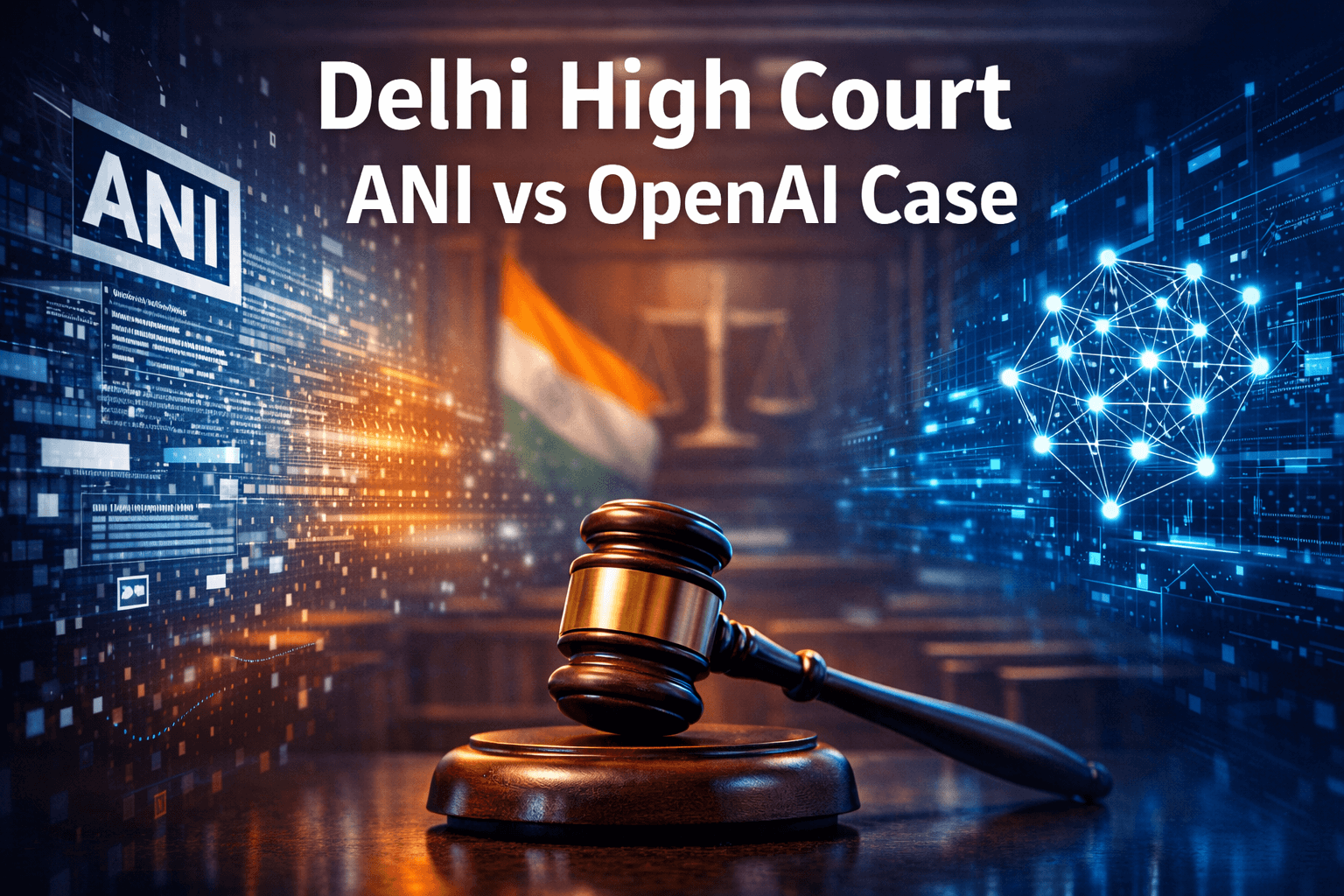
The ANI vs OpenAI case has become one of the most closely watched technology and copyright disputes in India, with the Delhi High Court now reserving its order on ANI’s interim plea against the maker of ChatGPT. The case is significant because it could shape how Indian law treats the use of copyrighted material for training generative AI systems. As of early April 2026, the court has not delivered a verdict; it has only reserved its order after hearing arguments.
At the heart of the dispute is a question now being debated across the world: Can AI companies train large language models on copyrighted content without permission, payment, or licensing agreements? In India, ANI has argued that OpenAI used its news material without authorization to train ChatGPT, while OpenAI has denied wrongdoing and challenged several aspects of ANI’s claims.
How the ANI vs OpenAI case began
The legal battle began in November 2024, when Asian News International (ANI) sued OpenAI in the Delhi High Court. ANI alleged that OpenAI had used its published news content without permission to help train ChatGPT. ANI also said that ChatGPT had, in some instances, produced false or fabricated material and attributed it to ANI, raising both copyright and reputational concerns.
Over time, the case drew broader attention because it was no longer seen as a routine copyright suit. It quickly emerged as a test case for how Indian courts may interpret the Copyright Act in the context of generative AI, text-and-data use, and machine learning. Multiple hearings followed over many months, and the matter attracted legal commentary because of its implications for publishers, authors, AI developers, and users in India.
What ANI has alleged against OpenAI
ANI’s central allegation is that OpenAI used its copyrighted reports without a license to train ChatGPT. According to ANI, this use was unauthorized and commercially harmful because ChatGPT is a commercial AI service, not a purely academic or private research tool. ANI has argued that OpenAI’s use of its news content should not be treated as a protected exception under Indian copyright law.
ANI has also claimed that the issue is not just about training data in the abstract. It has argued that its content can surface through AI-generated responses in ways that may dilute the value of original journalism, reduce traffic to publishers, and potentially create confusion if the AI output mirrors or paraphrases protected reporting. In earlier reporting around the suit, ANI also raised concerns about fabricated outputs being attributed to it, which it says can damage credibility.
In its court action, ANI sought relief to restrain OpenAI from storing, reproducing, publishing, or otherwise using its content through ChatGPT and related systems. It also sought directions that could limit ChatGPT’s access to ANI’s published works.
OpenAI’s response and legal defense
OpenAI has denied ANI’s allegations and argued that its use of publicly available material is lawful. In court filings reported earlier in 2025, the company said it does not need to enter into licensing arrangements for all publicly available content and argued that such use is permissible under the legal principles it relies on. It also pushed back against claims from Indian media groups seeking to join the case.
OpenAI has also challenged the maintainability of the case in India by arguing that it is a foreign defendant and that its infrastructure and servers are outside India. That jurisdiction argument became an important part of the proceedings, though amici curiae appointed in the case reportedly argued that Indian courts can hear the dispute because the alleged harm and accessibility of the service extend to India, including Delhi.
Another major part of OpenAI’s defense concerns data removal. In January 2025, Reuters reported that OpenAI told the Delhi High Court that removing training data as sought by ANI would conflict with its legal obligations in the United States, where preservation duties may apply during ongoing litigation. That argument matters because it goes beyond copyright and enters the territory of cross-border litigation compliance and evidence preservation.
What happened in the Delhi High Court now
The latest and most important factual update is this: the Delhi High Court has reserved its order on ANI’s interim application. That means hearings on this stage of the case have concluded, but the court has not yet issued its decision. Several recent reports, including Business Standard, India Today, Exchange4Media, and Bar & Bench, all indicate the same current position.
This distinction matters. Many readers may assume that “order reserved” means the court has ruled. It has not. At this stage, the court is considering whether any interim restrictions or directions should be imposed while the broader suit continues. The final determination of all copyright issues in the case will likely take longer.
Read more on childhood cancer being the top 10 reasons of death in children in India.
Why the ANI vs OpenAI case matters so much
The reason this case is drawing national and international attention is simple: India does not yet have a settled judicial answer on how copyright law applies to generative AI training. The ANI vs OpenAI case is therefore being seen as one of India’s first major judicial tests on whether copyrighted digital content can be used to train AI systems like ChatGPT without explicit authorization.
For the news industry, the stakes are enormous. Publishers invest money, time, and labor into original reporting. If AI systems can absorb, summarize, and repurpose that work at scale without permission, media organizations fear an erosion of both revenue and relevance. That concern is not unique to India. Similar battles have been unfolding internationally, including lawsuits by news organizations, authors, and publishers against AI companies.
For AI companies, however, the stakes are equally high. If courts begin requiring licenses for vast categories of training material, it could increase the cost of building and maintaining advanced AI systems. It may also push policymakers to define new rules around data sourcing, opt-outs, archives, and compensation.
The wider publisher and media backlash in India
The ANI suit did not stay isolated for long. Reuters reported in early 2025 that India’s major media organizations, including groups linked to some of the country’s biggest business houses, sought to join or influence the broader copyright fight against OpenAI. Book publishers also launched related legal action in India, reflecting a widening backlash against the use of copyrighted text for AI training without negotiated permission.
That widening front matters because it shows the dispute is no longer just about one news agency versus one AI company. It is increasingly about whether the content economy in India wants a licensing-based model for AI, a fair-use-style model, or an entirely new legal framework. In May 2025, Reuters also reported that India had set up a panel to review whether existing copyright law is adequate to deal with AI-related disputes, underlining how policy pressure has grown beyond the courtroom.
The legal questions the court’s order could influence
Even though the current reserved order is only on interim relief, the court’s reasoning could still influence the future shape of AI copyright litigation in India. The key questions include whether scraping or ingesting copyrighted news reports for model training amounts to infringement, whether AI training can be treated like research or fair dealing under Indian law, and whether foreign AI companies can be effectively regulated by Indian courts when their products are offered in India.
Another underlying question is how courts should treat AI outputs that are similar to existing journalistic work. If outputs are too close to source material, publishers may argue that the model has reproduced or repackaged protected expression. If outputs are more general, AI companies may argue that the system learned patterns rather than copied expression. That tension sits at the center of global AI copyright disputes, and India is now confronting it directly.
What happens next
For now, the most accurate update is that the Delhi High Court has reserved its order and the legal and technology sectors are waiting for the court’s next move. When the order is delivered, it could either grant some interim relief to ANI, decline to impose major restrictions at this stage, or craft a narrower, balanced approach that leaves the larger legal questions open for trial.
Whatever the immediate outcome, the ANI vs OpenAI case has already become a milestone in India’s AI law debate. It has forced courts, companies, publishers, and policymakers to confront a difficult question: in the age of generative AI, how should the law balance innovation with the rights of content creators?
Conclusion
The ANI vs OpenAI case is now one of the most important legal battles in India’s technology landscape. ANI says its copyrighted journalism was used without permission to train ChatGPT. OpenAI denies infringement, challenges the scope of the claims, and says its data practices are lawful. The Delhi High Court has completed hearings on ANI’s interim plea and reserved its order, but no verdict has yet been issued.
For publishers, the case is about protecting the value of original reporting. For AI companies, it is about preserving the ability to build and improve language models. For India, it may become the case that helps define the country’s approach to AI, copyright, digital publishing, and innovation for years to come.