







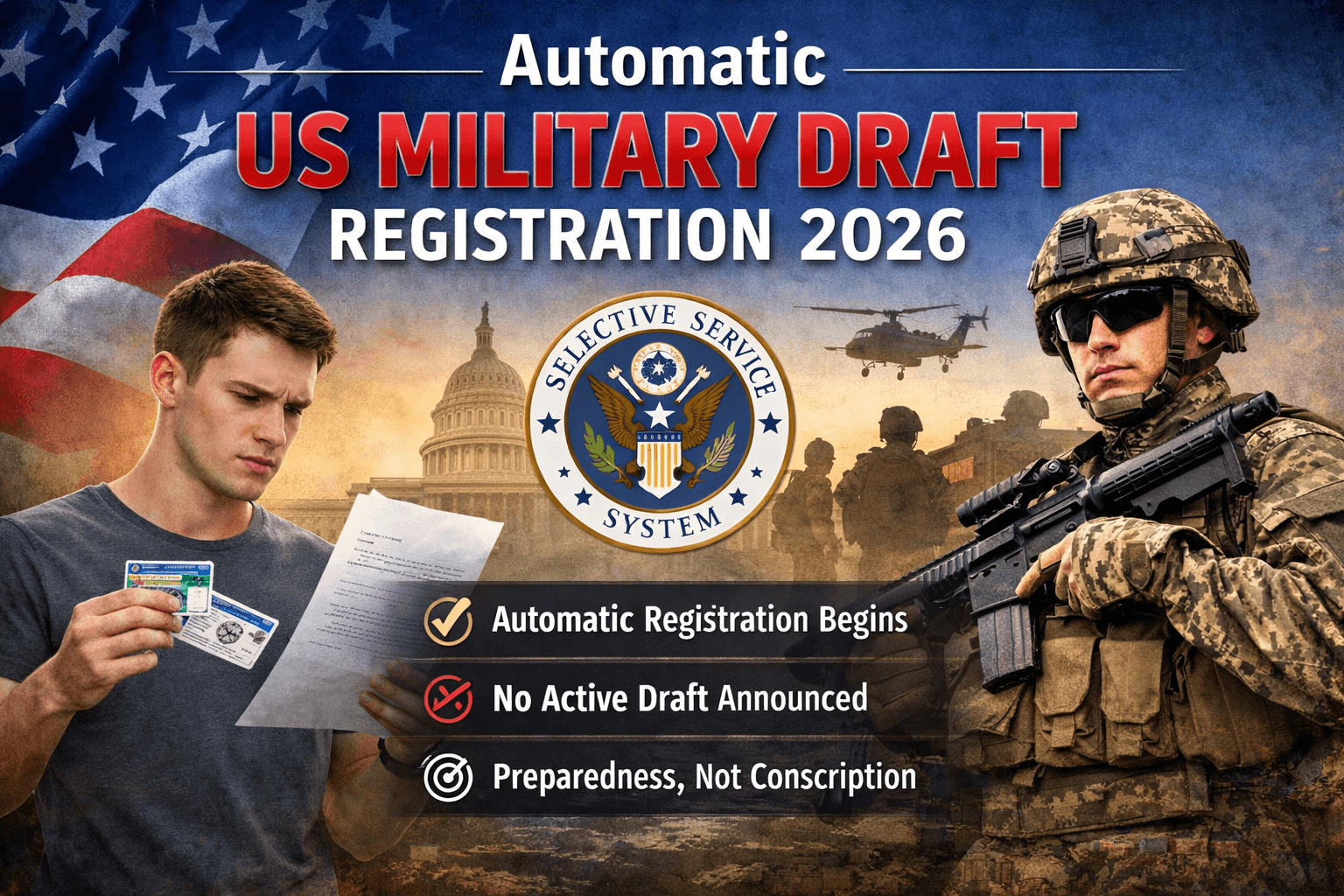
Automatic US Military Draft Registration 2026: What the New Law Really Means
The United States is preparing to introduce automatic registration for the Selective Service System, a move that could significantly change how young men are enrolled into the country’s military preparedness framework.
Set to begin no earlier than late 2026 (subject to final implementation timelines), this policy has sparked widespread discussion across media, social platforms, and policy circles. Many headlines have suggested that the US is “bringing back the draft,” but the reality is far more nuanced.
This article breaks down the verified facts, removes misinformation, and explains exactly what automatic draft registration means—and what it does not mean.
What Is the Selective Service System?
The Selective Service System (SSS) is a US government agency responsible for maintaining a list of individuals who could be drafted into military service during a national emergency.
Key facts:
- Applies to men aged 18–25
- Registration has been mandatory since 1980
- The US has not conducted an active draft since 1973 (Vietnam War era)
Registration does not mean enlistment. It simply means being part of a database in case Congress authorizes a draft in the future.
What Is Actually Changing?
Confirmed Change: Move Toward Automatic Registration
The US government has been working toward automating the registration process instead of relying on individuals to sign up manually.
Currently:
- Young men must register themselves within 30 days of turning 18
Under the proposed/approved reform:
- The government will automatically register eligible individuals using existing federal and state data
However, here’s the critical clarification:
There is no universally confirmed single fixed nationwide launch date like “December 2026” across all official federal sources.
Instead:
- The policy is tied to defense authorization legislation and administrative rollout plans
- Implementation depends on system readiness, inter-agency coordination, and rulemaking processes
What Law Is Behind This Change?
The move toward automatic registration has been included in recent versions of the National Defense Authorization Act (NDAA)—the annual US defense policy bill.
Important clarification:
- The NDAA has authorized and supported automatic registration mechanisms
- But implementation is phased and administrative, not a single overnight switch
This means:
- It is policy-backed, but rollout details are still evolving
- Some media reports have oversimplified timelines
Does This Mean the US Is Bringing Back the Draft?
No. There is currently no active military draft in the United States.
For a draft to happen:
- Congress must pass legislation approving it
- The President must sign and authorize it
- The Selective Service System must activate the process
None of these steps have occurred.
Key Reality:
- Automatic registration = preparedness system upgrade
- It does NOT equal conscription
Why Is the US Moving to Automatic Registration?
1. Incomplete Registration Data
While registration is mandatory, compliance is not perfect.
- Many individuals fail to register on time
- This creates gaps in the national database
Automatic registration aims to ensure near-complete coverage.
2. Administrative Efficiency
The current system requires:
- Public awareness campaigns
- Manual compliance tracking
- Penalty enforcement
Automation reduces:
- Operational costs
- Bureaucratic delays
- Human error
3. Modern Data Infrastructure
Today, the government already holds relevant data through:
- Driver’s license systems
- Social Security records
- Federal databases
The reform simply connects these systems to streamline registration.
How Will Automatic Registration Work?
While final operational details are still being refined, the general process is expected to include:
- Data collection from federal and state agencies
- Automatic enrollment of eligible individuals
- Possible notification or verification mechanisms
Some US states already have partial automation through:
- DMV (driver’s license) registration systems
The new framework expands this concept nationwide.
Who Will Be Affected?
Included:
- Men aged 18–25
- US citizens and certain male immigrants residing in the US
Not Included (as of now):
- Women
- Temporary visa holders (in most cases)
What About Women and the Draft?
This remains an ongoing policy debate.
There have been multiple proposals to:
- Include women in the Selective Service System
- Make the system gender-neutral
However:
- No law has been passed to include women yet
- The current system still applies only to men
What Happens If Someone Doesn’t Register?
Under current law, failure to register can lead to:
- Ineligibility for federal student aid
- Ineligibility for certain federal jobs
- Possible legal penalties (rarely enforced criminally)
With automatic registration:
- The burden shifts from the individual to the government
- Non-registration penalties may become less relevant in practice
Read more on Anthropic Claude Newest release.
Why This Change Matters
1. Major Policy Shift
This is one of the biggest structural changes to the Selective Service System in decades.
It moves from:
- Citizen-driven compliance → Government-driven enrollment
2. Improved Military Readiness
A complete and accurate database ensures:
- Faster mobilization (if ever needed)
- Better planning for national emergencies
3. Reduced Legal Burden on Individuals
Young men will no longer have to:
- Remember deadlines
- Risk penalties for non-compliance
Is This Linked to Global Conflicts?
While the US government has not officially tied this reform to any specific conflict, the broader context includes:
- Rising geopolitical tensions
- Military recruitment challenges
- Strategic competition with global powers
However, experts emphasize:
This is a long-term preparedness measure—not a reaction to an immediate war scenario.
Public Reaction: Mixed but Intense
Supporters argue:
- It simplifies compliance
- It ensures fairness
- It modernizes outdated systems
Critics worry:
- Increased government data control
- Potential pathway to future conscription
- Lack of public awareness about the change
Common Misconceptions (Fact-Checked)
Myth 1: “The US is bringing back the draft in 2026”
False
There is no active draft.
Myth 2: “Everyone will be forced into the military”
False
Registration ≠ conscription.
Myth 3: “December 2026 is a confirmed nationwide launch date”
Partially Misleading
There is no universally confirmed fixed date across all official channels. Implementation is phased.
What Happens Next?
Before full implementation, the government must:
- Finalize regulations
- Build integrated data systems
- Coordinate across agencies
This means:
- The rollout may happen gradually
- Public updates are expected as systems are finalized
Key Takeaways
- The US is moving toward automatic draft registration
- It applies to men aged 18–25
- It is part of broader defense policy reforms
- No active draft has been announced
- Implementation timelines are not a single fixed nationwide date
Final Verdict
The shift to automatic registration for the Selective Service System is a modernization effort—not a military escalation.
While headlines may suggest a return to conscription, the facts tell a different story:
This is about efficiency, data accuracy, and preparedness—not war.
For now, the US remains a volunteer-based military system, with the draft existing only as a contingency.