







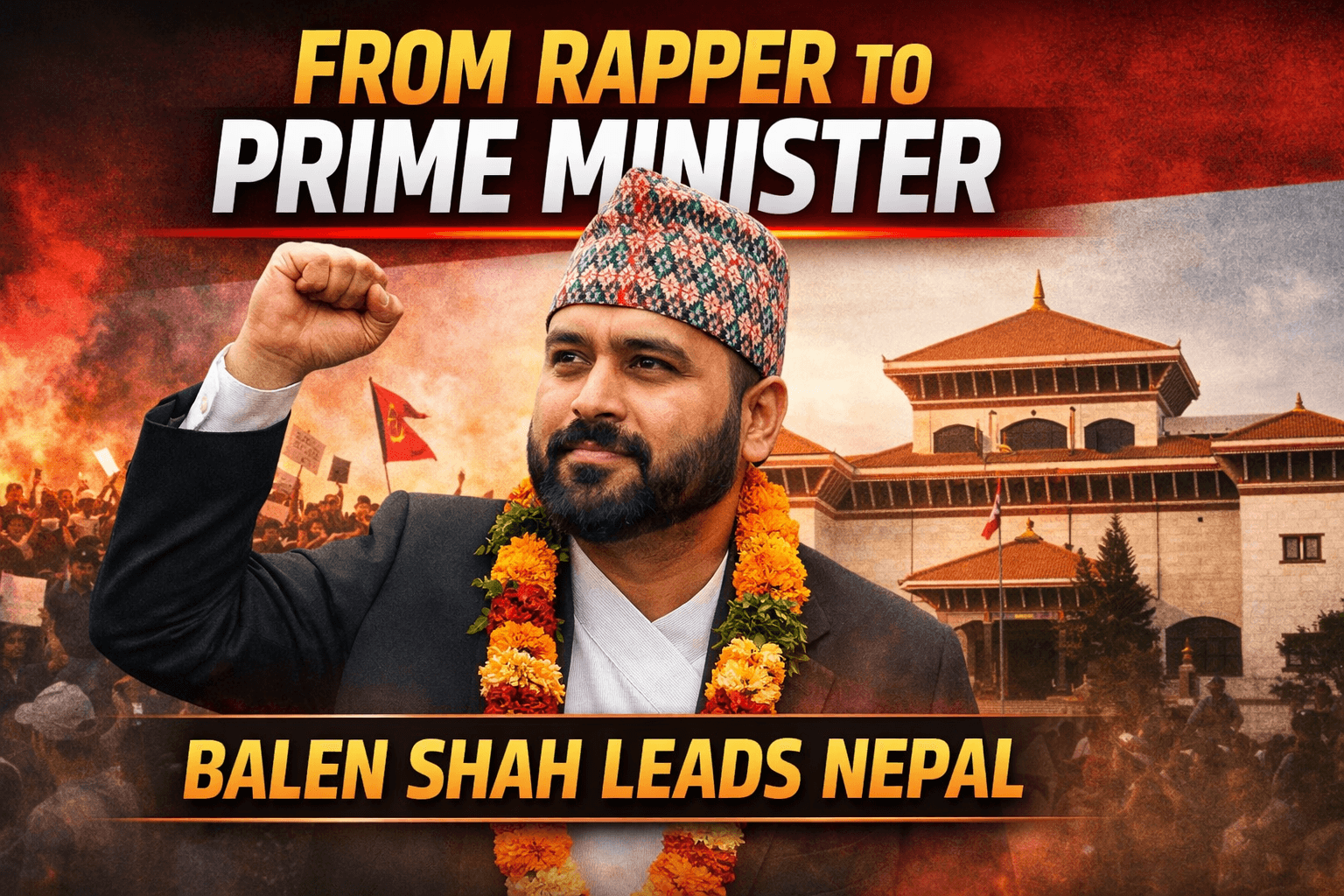
Balen Shah becomes Nepal prime minister as youth-driven anger reshapes the country’s politics
Balendra “Balen” Shah’s rise to the top of Nepali politics is one of South Asia’s most striking political stories of 2026. Once known primarily as a rapper, engineer, and then the surprise independent mayor of Kathmandu, Shah has now taken the oath as Nepal’s prime minister, becoming the country’s youngest premier in decades at age 35. His ascent is being widely read not just as a personal political triumph, but as a sign of deep public frustration with Nepal’s old political establishment and a broader generational shift in the country.
For many Nepalis, Balen Shah represents something rare in national politics: a leader who emerged from outside the traditional party machinery, built a following among younger voters, and converted public anger over corruption, instability, and weak governance into electoral momentum. Reuters reported that Shah’s Rastriya Swatantra Party scored a decisive victory in the March 5, 2026 election, winning 182 of 275 parliamentary seats. AP likewise described his swearing-in as a landmark moment following a landslide victory and months of youth-led unrest that had shaken Nepal’s political order.
Who is Balen Shah?
Balendra Shah, widely known as Balen, is not a conventional career politician. Before entering public office, he built a profile in Nepal as a rapper whose lyrics often touched on social and political themes. He also trained as an engineer, a background that helped shape his image as a practical, problem-solving outsider rather than a party insider. Reuters described him as a former rapper and ex-mayor of Kathmandu, while AP called him a political newcomer whose popularity surged after his mayoral tenure and the broader anti-establishment wave that followed.
His first major political breakthrough came in 2022, when he won the Kathmandu mayoral election as an independent candidate. That victory itself was seen as extraordinary because it showed that a younger, media-savvy figure could defeat candidates backed by long-dominant political parties. AP noted that Shah gained prominence nationally through his work as Kathmandu mayor, while Reuters and other reports describe him as a symbol of a public hungry for something different from Nepal’s revolving-door leadership.
Why Balen Shah’s rise matters
Shah’s elevation to the prime minister’s office matters far beyond the novelty of an ex-rapper becoming head of government. Nepal has struggled with chronic political instability for decades. Reuters noted that the country has seen 32 governments since 1990, and none completed a full five-year term. That record has fed a widespread perception that traditional leaders are more skilled at coalition bargaining than long-term governance.
Against that backdrop, Shah’s success appears to reflect a deeper mood in Nepal: impatience with corruption, frustration over unemployment, and exhaustion with elite politics. AP reported that his rise followed a youth-led uprising in 2025 that ousted the previous government. Reuters said public dissatisfaction over corruption and unemployment played a central role in the political shift that helped bring Shah to power.
This is why Balen Shah’s swearing-in is being framed not simply as a change of prime minister, but as a structural political moment. It suggests that Nepal’s younger voters are no longer content to merely criticize the system from outside. They are now reshaping it from within.
Read more on the Iran Israel War here.
The protests that changed Nepal’s politics
A major part of the story behind Balen Shah’s rise is the wave of youth-led unrest that convulsed Nepal in 2025. Reuters reported that deadly anti-corruption protests last year left 76 people dead, becoming a defining rupture in Nepal’s politics. AP similarly said Shah’s rise followed a youth-led uprising that toppled the previous government amid anger at corruption and instability.
Those protests created both a moral and political vacuum. Traditional parties appeared unable to credibly answer public anger, while Shah’s outsider brand aligned naturally with calls for accountability. Reuters reported that one of Shah’s first major challenges as prime minister would be implementing recommendations from an investigative panel examining the 2025 protest violence, including possible prosecutions of former officials. The urgency of that issue became even clearer when Reuters reported on March 28 that former Prime Minister K.P. Sharma Oli was arrested in connection with the deaths during those protests.
That means Balen Shah begins his premiership under intense pressure. He is not just inheriting a country that wants reform. He is leading a country that wants answers.
The election victory that changed everything
Reuters reported that Shah’s party, the three-year-old Rastriya Swatantra Party, won 182 of the 275 seats in parliament in the March 5, 2026 election. That is an extraordinary result in a country long accustomed to fractured mandates and unstable coalition governments. AP described the result as a landslide and noted that Shah was appointed prime minister by President Ram Chandra Paudel.
The size of the victory matters because it gives Shah something most Nepali prime ministers have lacked: room to govern. A commanding parliamentary majority reduces immediate dependence on fragile coalition deals and gives the new government a real chance to push reforms in areas like governance, service delivery, jobs, education, and healthcare. AP reported that Shah is expected to focus on economic reform and expansion in healthcare and education, while Reuters said he had already signaled a leaner style of administration by appointing a relatively small cabinet.
The oath ceremony and symbolic shift
Shah was sworn in on March 27, 2026. Reuters reported that he wore traditional attire at the ceremony, where more than 200 priests and lamas performed prayers. AP noted that the oath-taking took place on Ram Navami and that the ceremony combined Hindu and Buddhist rituals, reflecting Nepal’s religious and cultural traditions.
The symbolism was powerful. Here was a figure associated with rap music, social media, anti-establishment politics, and urban youth culture stepping into one of Nepal’s most tradition-bound institutions. Yet the ceremony also suggested continuity as well as change. Shah’s rise may be disruptive politically, but he is clearly presenting himself as a national leader rather than merely a protest figure.
Why younger voters connect with him
Balen Shah’s appeal among younger Nepalis is central to his political success. Reuters said his youthful image and patriotic campaign connected with a population frustrated by corruption and instability. AP similarly noted that he is widely seen as a voice for younger citizens and for those tired of the old order.
Part of Shah’s appeal comes from biography. He is young, urban, media literate, and not shaped by the traditional patronage networks that dominate older parties. Part of it also comes from timing. After years of political churn, many voters appear ready to bet on someone who feels culturally closer to a new generation.
That does not mean all concerns about him have vanished. AP noted that while Shah was praised for tackling civic issues as Kathmandu mayor, he was also criticized in some quarters for acting without enough planning. That tension may define his prime ministership too: supporters see energy and honesty; critics may see inexperience and improvisation.
Challenges facing Prime Minister Balen Shah
The excitement around Shah’s rise is real, but so are the obstacles ahead. Nepal’s economy, governance structure, and political culture will not transform overnight. Reuters pointed to his immediate challenge of addressing accountability for the 2025 protest violence. AP suggested his government will also be judged on whether it can respond to the needs of young citizens demanding jobs, stability, and cleaner governance.
There are at least five major tests in front of him.
The first is accountability. If his government fails to deliver justice over the protest deaths, the moral force behind his rise could weaken quickly.
The second is governance delivery. It is easier to symbolize change than to administer it.
The third is economic reform. Public anger around unemployment and stagnation helped create the conditions for his victory. Voters will want practical results.
The fourth is institutional resistance. Nepal’s entrenched political and bureaucratic structures may not easily accept a leader built on outsider legitimacy.
The fifth is foreign relations. Reuters reported that leaders from India and China congratulated Shah after his swearing-in, showing that regional powers are watching his government closely. Nepal’s foreign policy balance remains strategically important.
A historic first, but not a finished story
Reuters reported that Shah is the first Madhesi to lead Nepal, adding another historic dimension to his rise. That matters in a country where representation and regional identity have long shaped political debate. Combined with his age and nontraditional background, his premiership marks multiple breaks with precedent.
Still, history will judge Balen Shah less by the symbolism of his rise than by the substance of his rule. Can a former rapper turn a protest-era mandate into stable governance? Can a youth-backed outsider change institutions without being absorbed by them? Can public anger be converted into durable reform?
Those are now Nepal’s central political questions.
Conclusion
Balen Shah’s journey from rapper to Kathmandu mayor to Nepal prime minister is one of the most remarkable political transformations in the region this year. He was sworn in on March 27, 2026, after a sweeping election victory that reflected a powerful rejection of Nepal’s old political order. His rise was shaped by youth anger, anti-corruption sentiment, and a growing hunger for accountability and generational change.
For now, Shah stands as both a person and a political symbol: a 35-year-old outsider who has captured the public imagination and inherited an enormous burden of expectation. Nepal has not merely chosen a new prime minister. It has placed a risky, hopeful bet on a different kind of future.