







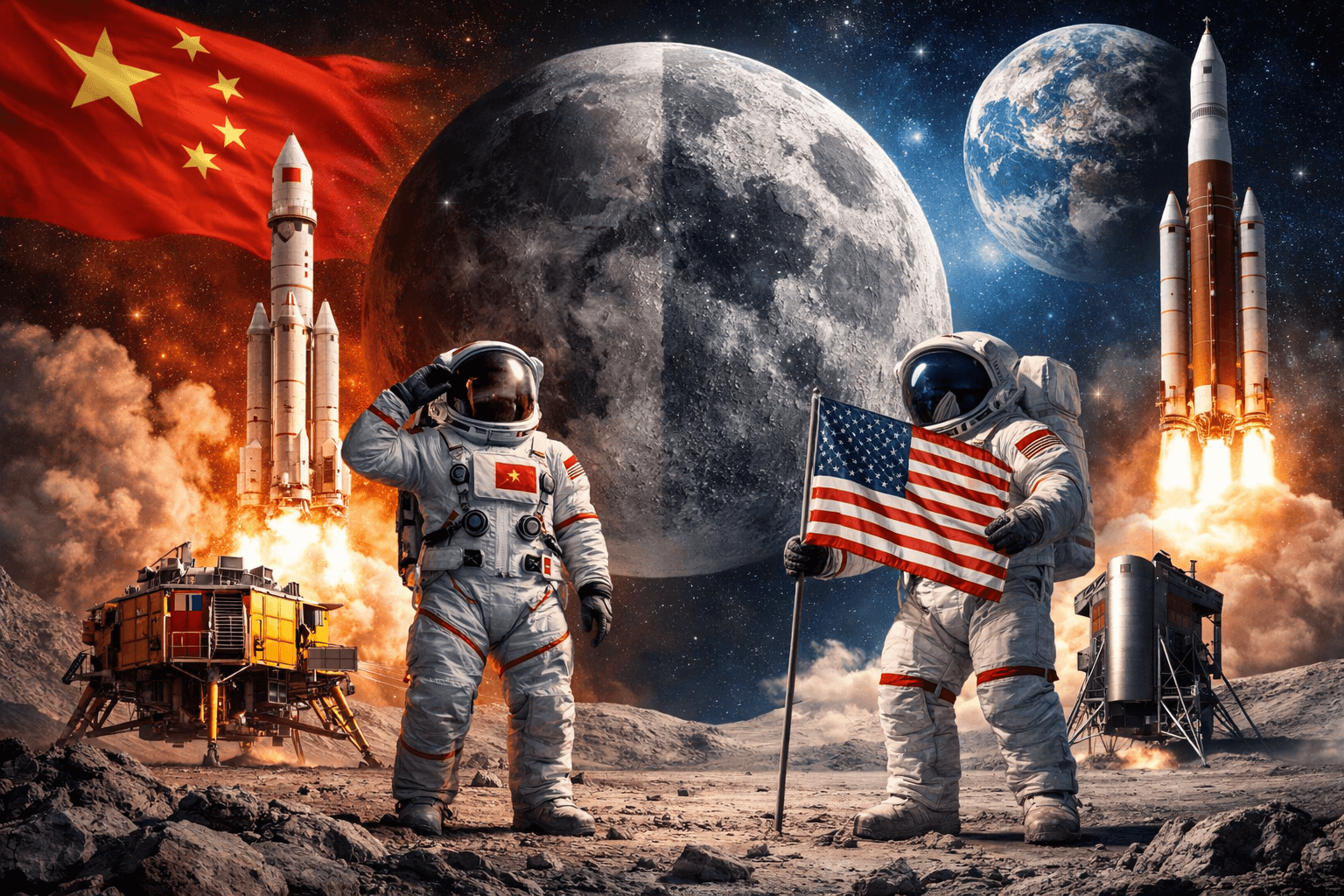
China’s push toward a crewed landing before 2030 is sharpening a new-era Moon race with the United States
The modern Moon race is no longer theoretical. It is already underway, and the latest developments suggest that the competition between China and the United States is entering a decisive phase. China accelerates Moon mission efforts as it reiterates its goal of landing astronauts on the Moon before 2030, while NASA has updated its Artemis architecture and is now targeting early 2028 for the first Artemis lunar landing. That means the gap between the world’s two biggest lunar programs has narrowed into a short, high-stakes window that could reshape the future of space exploration.
At the center of this story is more than national prestige. The Moon has become a strategic destination because it is viewed as a launch point for future Mars missions, a site for scientific discovery, and a possible source of key resources such as water ice. The lunar south pole, in particular, has become a prime target because water there could support human crews and be processed into fuel. Both China and the United States are now building long-term lunar strategies around that reality.
China’s lunar program has been gaining momentum in visible and measurable ways. In a February 2026 update, China’s Manned Space Agency said work tied to its crewed lunar exploration program was progressing steadily, with the country still aimed at achieving its first crewed Moon landing before 2030. The same update said development was advancing on the Long March-10 launch vehicle, the Mengzhou crew spacecraft, and the Lanyue lunar lander, and noted that several large-scale tests had already been completed.
China is also moving forward on the robotic side of its lunar roadmap. On April 10, 2026, Chinese authorities said the Chang’e-7 probe had safely arrived at the Wenchang launch site and was planned for launch in the second half of 2026. Chinese officials and state-linked reports have described Chang’e-7 as a mission focused on the lunar south pole, where it will search for evidence of water ice and study the local environment, terrain, and composition.
That matters because Chang’e-7 is not just another robotic mission. It is part of a larger sequence intended to prepare for sustained Chinese activity on and around the Moon. Beijing has also promoted the idea of an International Lunar Research Station, a long-term project often discussed in cooperation with Russia and other international partners. The broad direction is clear: China is not pursuing a one-off flag-and-footprints mission. It is building toward an enduring lunar presence.
On the American side, NASA has also made major progress, but the timeline has changed in a way that many casual readers may have missed. Earlier coverage often described Artemis III as the mission that would return astronauts to the lunar surface. However, NASA’s updated architecture released in February 2026 changed that plan. NASA now says Artemis III, scheduled for 2027, will be a low-Earth-orbit demonstration mission designed to test systems and operations, including rendezvous and docking capabilities involving commercial lunar landing systems. The first Artemis lunar landing is now associated with Artemis IV, which NASA says it is targeting for early 2028.
That correction is critical because it changes how the US-China timeline should be understood. The race is no longer framed as a 2027 US landing versus a 2030 Chinese landing. Instead, NASA is now aiming for a landing in 2028, while China still says it is aiming for one before 2030. Reuters reported this week that analysts see China’s 2030 goal as plausible, which means the competition is tighter than many earlier summaries suggested.
NASA’s momentum is still substantial. The Artemis II mission, which flew astronauts around the Moon and back, marked the first crewed lunar mission of the Artemis era and the first human journey to the Moon’s vicinity in more than 50 years. NASA said the crewed mission was a major step toward future lunar operations, and reporting this week described the astronauts as having completed a historic lunar flyby before returning toward Earth. The mission’s success strengthens confidence in the Orion spacecraft and broader Artemis framework, even as the landing sequence has been restructured.
Read more on NASA Artemis image captured.
The United States still retains several major advantages. NASA has extensive deep-space operational experience, established partnerships with multiple private-sector companies, and a layered architecture that includes Orion, the Space Launch System, commercial human landing systems, and broader Moon-to-Mars planning. NASA’s Artemis pages say the agency’s goal remains a sustained lunar presence, not just a symbolic return.
China, however, has built its own strengths. Its space program benefits from centralized planning, a long-term state framework, and a step-by-step record of successful lunar missions. Recent official updates suggest that China is methodically reducing technical risk by testing systems in advance, including escape systems, lander functions, and rocket-related demonstrations. That kind of sequencing is exactly what observers look for when judging whether a crewed lunar target date is credible.
This is why the phrase “lunar race” is being used more often again. Reporting from Reuters and El País this week both frame the current moment as a sharpened competition between two major powers whose timelines now overlap enough to matter politically as well as scientifically. For NASA, China is a serious competitor in returning astronauts to the Moon and establishing a durable foothold there. For China, the Moon is part of a broader strategy to expand national capability, prestige, and influence in space.
The Moon’s strategic importance helps explain why this competition carries global implications. Countries that help shape lunar infrastructure may also shape future rules on resource use, interoperability, communications, navigation, and international participation. NASA has rallied support around the Artemis Accords, while China has been developing its own coalition-building approach through its lunar station concept and other partnerships. The result is not just a technological contest, but a contest over leadership in the next phase of human space activity.
The south pole is likely to be the symbolic and practical center of that contest. NASA says Artemis lunar surface missions will focus on the region near the lunar south pole, while Chinese reporting around Chang’e-7 has made clear that China also sees the south pole as central to its next steps. The reason is straightforward: permanently shadowed areas near the pole may hold water ice, one of the most valuable resources for sustained exploration.
There is also a deeper narrative unfolding beneath the headlines. The Cold War space race was largely about proving which political system could achieve a dramatic first. The new lunar contest is more complex. It is about who can build the more resilient architecture, who can maintain a longer-term presence, and who can turn technical milestones into durable strategic advantage. A single lunar landing will matter, but what follows that landing may matter even more.
That is why recent milestones deserve careful interpretation. It would be incorrect now to say NASA will land astronauts on the Moon with Artemis III, because NASA’s own 2026 update says Artemis III is a systems demonstration in low Earth orbit. It would also be incomplete to describe China’s lunar effort as merely aspirational, because official Chinese updates describe concrete hardware development and completed tests tied to a before-2030 landing goal. A fact-checked reading of the current situation shows that both programs are active, credible, and moving on timelines close enough to intensify scrutiny of every milestone.
In the near term, several developments will be worth watching. China’s Chang’e-7 launch campaign in 2026 will be one of the clearest indicators of how quickly its robotic groundwork is advancing. On the US side, follow-through on the revised Artemis architecture, including the 2027 Artemis III demonstration and preparations for Artemis IV, will determine whether NASA can hold its early-2028 target. Those dates do not guarantee outcomes, but they do define the competitive map.
What happens next will shape more than headlines. It will influence international alliances, scientific access, and the long-term structure of exploration beyond Earth orbit. The new Moon race is no longer about whether humans will return to the lunar surface. It is about which nation will get there first in this new era, who will stay longer, and who will set the pace for what comes after. Right now, the United States and China are both still in that race, and the finish line is close enough to make every launch, test, and schedule revision matter.
Conclusion
China’s accelerated Moon program and NASA’s revised Artemis roadmap have brought the lunar race into much sharper focus. The corrected picture is not one of a distant, abstract rivalry. It is a real contest unfolding across the second half of this decade. China says it is pushing for a crewed Moon landing before 2030. NASA, after revising its architecture, is targeting Artemis IV for a lunar landing in early 2028. That makes the coming years potentially decisive for the future of lunar exploration and global space leadership.