






Global Mourning After Supreme Leader Khamenei’s Death
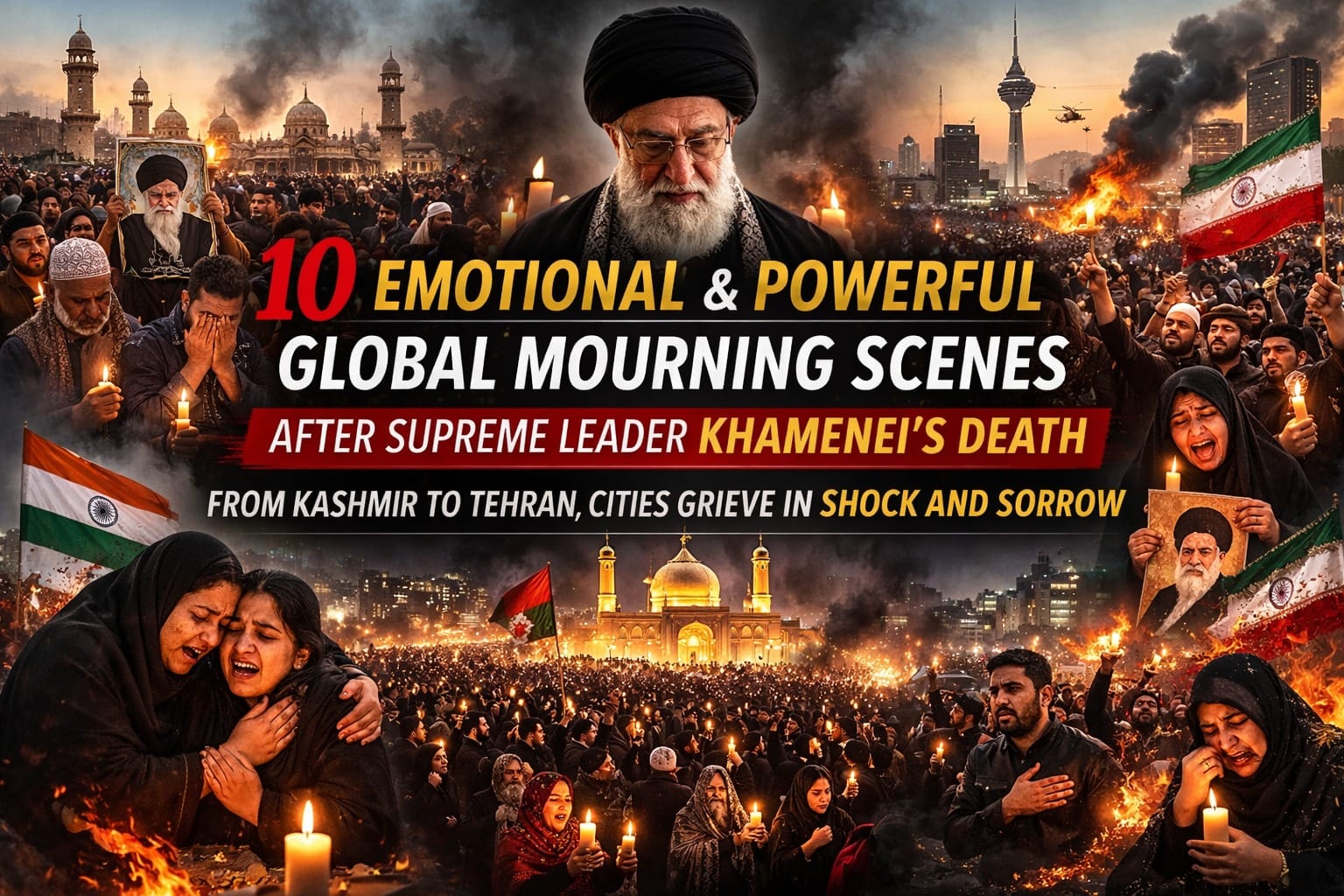
The sudden death of Iran’s Supreme Leader Ayatollah Ali Khamenei following U.S. and Israeli strikes on 28 February 2026 has sent shockwaves across the globe. His death marked the end of a 36-year rule and triggered contrasting reactions — from profound mourning and grief in some communities to celebration in others. As news spread across countries, cities in India and around the world saw emotional public gatherings, mourning processions, protest marches and solidarity demonstrations.
This article explores where people are mourning, the emotional atmosphere on city streets, and how communities are grappling with the moment’s gravity.
Mourning in Indian Cities — Kashmir to UP and Beyond
Although Ayatollah Khamenei was a foreign leader, his influence among many Shia Muslims in India led to spontaneous mourning and protest gatherings in several cities across the country.
1. Alipur (Karnataka) — Three Days of Mourning
In Alipur, a predominantly Shia village near Bengaluru, residents declared a three-day mourning period. Shops shut down and people wore black as a sign of grief. Many locals held photos of Khamenei and recalled his visit to inaugurate a hospital decades earlier, highlighting the deep emotional and cultural ties felt by some here.
The procession was peaceful, with about 3,000 participants offering prayers, chanting mournful slogans and showing solidarity with Iran in the wake of his death.
2. Uttar Pradesh Cities — Agra, Aligarh, Muzaffarnagar & More
Across western Uttar Pradesh, cities such as Agra, Aligarh, Amroha, Muzaffarnagar, Shamli, and Saharanpur witnessed large mourning gatherings. People dressed in black carried banners condemning the killing and expressing shock and grief.
In Muzaffarnagar, mourners walked from the Kidwai Nagar imambara to public squares, raising voices not just of grief but of protest and a call for international accountability. In many places, members of both the Shia and Sunni communities stood together, reflecting emotional solidarity.
3. Lucknow — Prayer Programs & Mournful Vigils
In Lucknow, Muslim organisations announced gatherings for mourning and prayer, offering spaces for public grief and solidarity. These events focused on expressing sorrow while calling for peaceful remembrance of the late leader.
4. Jammu & Kashmir — Srinagar & Other Towns
In Indian-administered Kashmir, cities including Srinagar (Lal Chowk), Budgam, Bandipora, Anantnag and Pulwama saw emotional demonstrations and mourning rituals. Protesters held portraits of Khamenei, chanted slogans against the U.S. and Israel, and engaged in traditional mourning practices such as chest beating and marsiya recitations.
These scenes showcased intense emotional engagement among sections of Kashmir’s Shia community, with calls both for dignity in mourning and respect for their grief.
5. Other Indian Cities — Punjab, Rajasthan, Delhi & Beyond
Additional mourning events and protest gatherings were reported in parts of Punjab (Ludhiana), Rajasthan (Ajmer, Jodhpur), New Delhi, Bihar, Jharkhand and Telangana, where participants voiced grief and solidarity while condemning the violence that led to Khamenei’s death. These gatherings reflected a broader sense of shock and outrage among affected communities.
Global Mourning & Divided Global Reactions
The emotional impact of Khamenei’s death was not limited to South Asia. Across the world, cities saw both mourning vigils and divided public sentiment.
1. Iran — Tehran, Mashhad, Isfahan & More
Within Iran itself, thousands took to the streets in grief. Major cities such as Tehran, Mashhad and Isfahan were scenes of mournful gatherings. State media footage showed many—even weeping openly—while chanting and waving portraits of Khamenei, reflecting deep reverence among his supporters.
Public mourning was particularly visible near important religious sites like the Imam Reza Shrine in Mashhad, while citizens in Yasuj and Shiraz also gathered in sorrow.
2. Pakistan and Iraq — Protests and Mourning
In Karachi (Pakistan), mourning turned into violent clashes when hundreds of protesters attempted to storm the U.S. consulate, resulting in at least nine deaths and dozens of injuries. Similar demonstrations occurred in Lahore, Islamabad and Multan, combining grief with outrage and anti-Western slogans.
In Baghdad (Iraq), pro-Iranian demonstrators gathered outside the Green Zone, confronting security forces. Although tear gas was used to disperse crowds, the sentiment expressed was one of deep solidarity with Iran and grief for the deceased leader.
Also read – UAE Cities hit by missiles during the war
3. United States — Protests Across Major Cities
Across major U.S. cities, pro-Iran demonstrations emerged. Protesters gathered in Washington D.C. near the White House, as well as in New York City (Times Square), Chicago, San Francisco, Los Angeles, Miami, Philadelphia and other urban centers. These crowds called for an end to the conflict, highlighted mourning for the leader, and condemned the strikes that led to his death.
4. Australia — Celebrations and Divided Sentiments
In contrast to mourning in many regions, Iranian diaspora communities in Australia saw celebrations in cities like Canberra, Sydney and Melbourne. Some residents celebrated what they viewed as the end of an era of repression, waving pre-revolutionary Iranian flags alongside U.S. and Israeli flags.
In Brisbane, crowds gathered in Queens Gardens with emotional displays ranging from joyful dances to tearful embraces, reflecting a belief among some that Khamenei’s death might open a path toward a more democratic future in Iran.
The Emotional Landscape: Mourning, Anger & Complex Sentiments
These global gatherings reveal a deeply polarized emotional landscape:
▪ Mourning and Reverence
In Iran and among Shia communities in South Asia and parts of the Middle East, people mourned Khamenei as a symbolic religious and political figure. Their grief reflected loyalty, religious sentiment, and deep historical ties to the Islamic Republic’s leadership.
▪ Protest and Outrage
In Pakistan, Kashmir, and parts of India, public gatherings combined grief with political protest, condemning Western actions and expressing solidarity with Iran. Protestors voiced anger over perceived injustice and called for respect of sovereignty.
▪ Celebration and Relief
Among some Iranian diaspora communities—especially in Australia—the reaction was celebratory, reflecting hope for political change and an end to decades of authoritarian governance.
Conclusion: A Global Moment of Mourning and Division
The death of Supreme Leader Ayatollah Ali Khamenei has become a global event felt far beyond Iran’s borders. From mourning marches in Indian cities — including Alipur in Karnataka, multiple towns in Uttar Pradesh, Kashmir’s Srinagar, Lucknow and more — to mass gatherings in Tehran and Baghdad, and even celebrations in Australia, the emotional reactions reflect the profound and complex impact of his passing.
Communities everywhere are grappling with grief, anger, hope and political judgment — a testament to the far-reaching influence of a leader whose rule shaped decades of Middle East geopolitics.
Subscribe to our YouTube Channel The Logic Stick for more video insights