




Social Media Ban for Teens Under 16
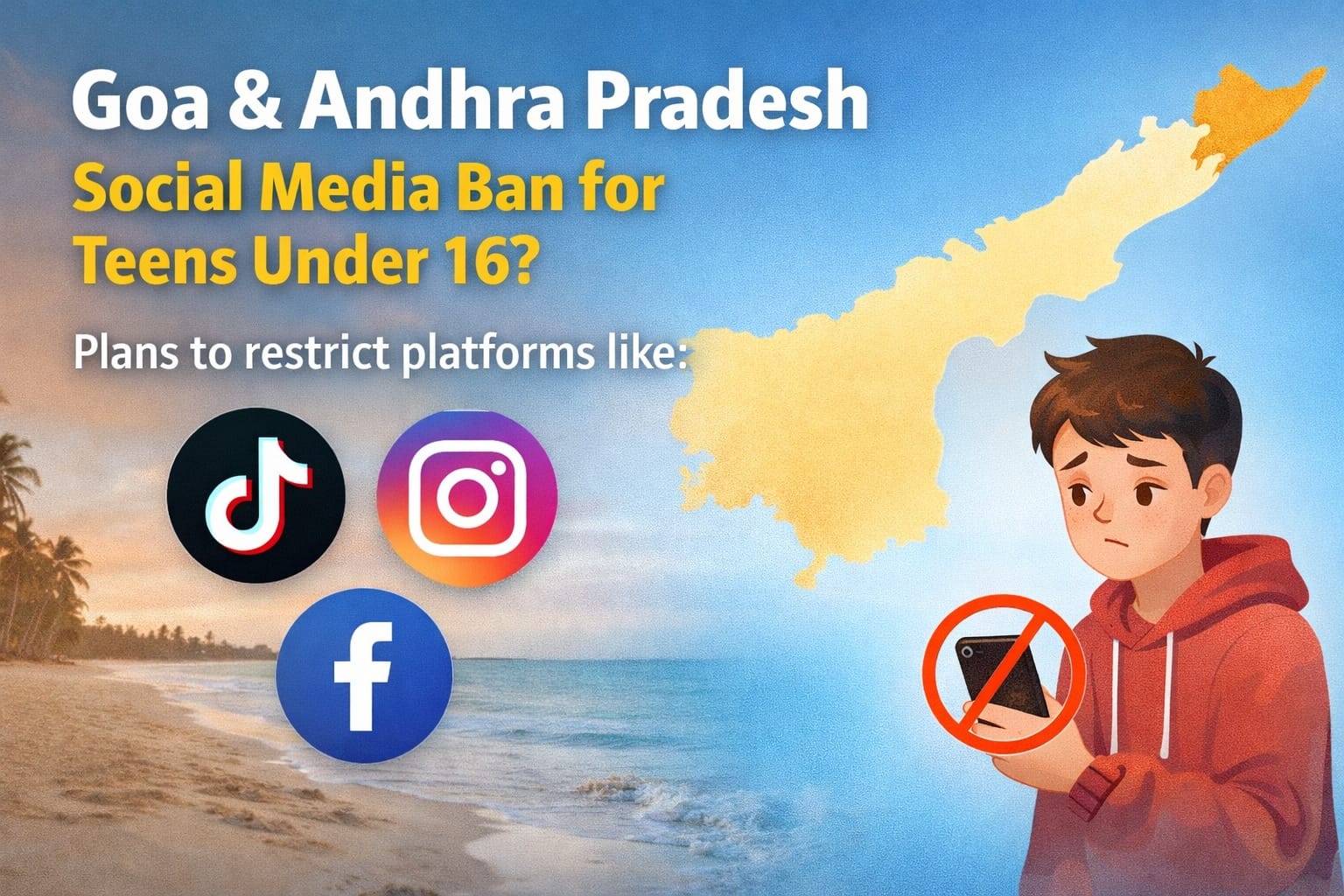
In early 2026, Indian states Goa and Andhra Pradesh have taken the first steps toward a potential social media ban for teens under 16. These proposals, inspired by recent legislation in Australia, have triggered widespread public discussion and debate about online safety, mental health, digital freedom, legal feasibility, and the future of internet governance in India.
This article examines what the proposals entail, the reasons behind them, how they compare with international models like Australia’s law, the arguments for and against such regulation, what it means for tech platforms and families, and the possible social, legal, and economic implications. It also delves into key questions about enforcement, rights, and digital citizenship for Indian youths.
1. What Are the Proposed Bans in Goa and Andhra Pradesh?
Goa’s Proposal
The Goa government has publicly stated that it is studying the feasibility of implementing a ban that would prohibit children under 16 years of age from accessing social media platforms. This consideration is explicitly modeled on a similar law introduced recently by the Australian government.
Goa’s Tourism and Information Technology Minister Rohan Khaunte has explained that the state’s IT department is reviewing policy papers and legal possibilities to assess whether such a ban can be legally and practically implemented at the state level. Concerns raised include excessive mobile and social media usage by minors, distraction from education, and broader social impacts on children’s behaviour and family interactions.
The minister has emphasised the need for children to focus on education and productive technology use as they grow into adults capable of contributing meaningfully to society.
Andhra Pradesh’s Approach
In Andhra Pradesh, the government has already constituted a Group of Ministers (GoM) to examine the issue. The panel, led by IT Minister Nara Lokesh, includes other key ministers and is tasked with studying various global regulatory models, including Australia’s age restriction law. The panel is expected to prepare recommendations within a month and then consult with the Chief Minister and possibly the central government.
The Andhra Pradesh initiative highlights a proactive stance in exploring how to improve online safety for minors, although the exact form—whether a total ban, restrictions, or regulatory guidelines—has not been finalized.
2. Why Are These Proposals Taking Shape?
Growing Safety and Mental Health Concerns
Both governments have pointed to parental complaints, educational concerns, and rising awareness of mental health issues as motivations. Ministers have cited that children spending excessive time on social media often remain glued to devices “even during family time,” potentially affecting social skills, academic performance, and emotional well-being.
Digital Distraction and Behavioural Impact
Officials have argued that today’s children increasingly prioritise social media engagement over constructive activities, including study and interpersonal communication. Critics of unfettered access point to cyberbullying, online abuse, addictive usage patterns, and exposure to inappropriate content as major risks.
Trying International Models for Youth Protection
The proposals in Goa and Andhra Pradesh draw explicitly on the Australian Online Safety Amendment (Social Media Minimum Age) Act, which bans social media accounts for users under 16, requiring platforms to take “reasonable steps” to identify and deactivate accounts operated by minors.
In Australia, the law also requires safeguards to ensure accounts are not wrongly removed, balancing protection with fairness.
Also read – Everthing you need to know about the deadly Nipah Virus
3. Australia’s Minimum Age Law: A Snapshot
Understanding the Australian model is central to understanding the proposals in India:
- The Online Safety Amendment (Social Media Minimum Age) Act 2024 was passed by the Australian Parliament and came into effect in late 2025.
- The law prohibits minors under 16 from holding accounts on certain social media platforms.
- It mandates that platforms undertake reasonable measures to block account creation and deactivate existing under-16 accounts.
- Platforms can face significant fines if they fail to comply, stressing the responsibility on tech companies rather than children or their parents.
- Certain services like educational platforms, messaging apps, and health-focused services are exempted in some provisions to prevent over-broad restrictions.
Australia’s legislation emerged from concerns about youth mental health, exposure to harmful content, cyberbullying, and social media addiction, and represents one of the first national laws of its kind.
4. How Might a Ban Work in India’s States?
Although both Goa and Andhra Pradesh are exploring similar laws, their exact mechanisms are still under study. Key questions in the Indian context include:
Age Verification Challenges
To enforce an age-based social media ban, platforms would need reliable and secure systems to verify users’ ages—a complex process given privacy concerns and the ease of creating fake profiles.
Legal Authority of States vs. Federal Government
In India, internet regulation and information technology law are largely under central jurisdiction (IT and Electronics Rules under the Ministry of Electronics and IT). Whether a state government can independently impose such a ban without central government cooperation remains legally complex and potentially contentious.
Potential Enforcement Mechanisms
If enacted, measures could include:
- Mandating platforms to block under-16 account creation
- Requiring age verification during sign-up
- Penalising non-compliance by social media companies
- Coordinating with device manufacturers and internet service providers
However, such measures raise questions about enforceability, digital rights, and data privacy.
5. Who Supports These Proposals?
Parents and Educators
Many parents and educators support stronger regulation, citing concerns about:
- Disrupted learning
- Increased anxiety and depression among teens
- Online bullying and harmful content
- Addiction to social validation and peer pressure
Some teachers argue that reduced social media access could improve academic focus and social interactions outside the digital realm.
Some Child Safety Advocates
Child welfare advocates note that children under 16 may lack the maturity and judgment to navigate complex online environments responsibly, making them vulnerable to exploitation, grooming, and cybercrime.
Supporters also argue that younger teens may benefit from more controlled and supervised introduction to digital platforms.
6. What Are the Opposition and Concerns?
Despite the stated motivations, there are strong arguments against broad bans.
Digital Rights and Freedom of Expression
Critics argue that a blanket ban could infringe on young people’s rights to information, communication, and learning opportunities. Social media, while fraught with risks, also serves as a space for learning, creativity, collaboration, and expression.
Practical Challenges and Enforcement
A fundamental issue is whether age verification can be implemented effectively without compromising user privacy or leading to false positives that unfairly block legitimate users.
Moreover, clever workarounds—like VPNs, fake profiles, or use of others’ credentials—could render blanket bans less effective.
Impact on Education and Social Inclusion
For many students, social media platforms are not just modes of entertainment but also tools for group study, peer networking, and educational content dissemination. A ban might inadvertently restrict access to these benefits.
Potential for Unintended Consequences
Some experts argue that focusing solely on bans may overlook deeper issues like:
- Lack of digital literacy among children
- Absence of parental guidance and monitoring
- Insufficient school-based education on online safety
Such critics suggest that laws alone cannot solve systemic issues of online wellbeing.
7. Broader Social and Psychological Impacts
Mental Health Considerations
Excessive social media use among youth has been linked to:
- Anxiety and depression
- Self-esteem issues tied to social comparison
- Sleep disruption
- Reduced real-world social interaction
A ban could reduce exposure, yet without complementary education and support, young users may still migrate to unregulated online spaces.
Academic Focus and Productivity
Proponents believe that limiting social media could improve concentration on academics, reading, and skill development.
However, the impact would vary across individuals depending on context, parental support, and alternative offline activities.
8. Economic and Technology Sector Implications
If implemented, such bans could pose challenges for social media companies operating in India—the world’s largest internet user market—by shrinking their youth user base and requiring investments in age verification systems.
Platforms may need to:
- Develop stronger age-verification technology
- Enhance privacy protections around age data
- Navigate compliance with multiple regional rules if states adopt differing standards
Such changes could increase operating costs and compliance burdens, potentially affecting business strategies in India.
9. Future Possibilities and Next Steps
Policy Development and Consultations
Both states are in early stages of consultation. Goa may present a formal position before its next legislative session, while Andhra Pradesh is expected to finalise its committee report soon.
Whether these proposals evolve into binding laws, advisory guidelines, or cooperative initiatives with the central government remains to be seen.
Potential Role of Central Government
Given the overlap with national IT and digital governance rules, the Government of India may eventually need to provide overarching guidelines or legislation if several states pursue similar paths.
Digital Literacy and Safety Education
Experts argue that policy measures should be accompanied by:
- School-based digital safety curricula
- Parental education and supervision tools
- Public awareness campaigns about cyberbullying and online risks
10. Conclusion: Balancing Protection and Freedom
The discussions in Goa and Andhra Pradesh are among the first serious state-level explorations in India of age-based social media restrictions. By considering models like Australia’s Online Safety Amendment, policymakers are signalling urgency around child welfare in the digital age.
However, implementing such bans presents complex legal, technical, and ethical challenges. Striking the right balance between protecting children and preserving digital rights and educational opportunities will require careful deliberation, broad stakeholder engagement, and robust frameworks that go beyond simple prohibition. The debates unfolding in these states may well inform future national policy on online safety and digital citizenship for Indian youth.
Subscribe to our YouTube Channel The Logic Stick for more Video Insights