






Google Gemma 4 launch brings open multimodal AI to data centres, developer machines and smartphones
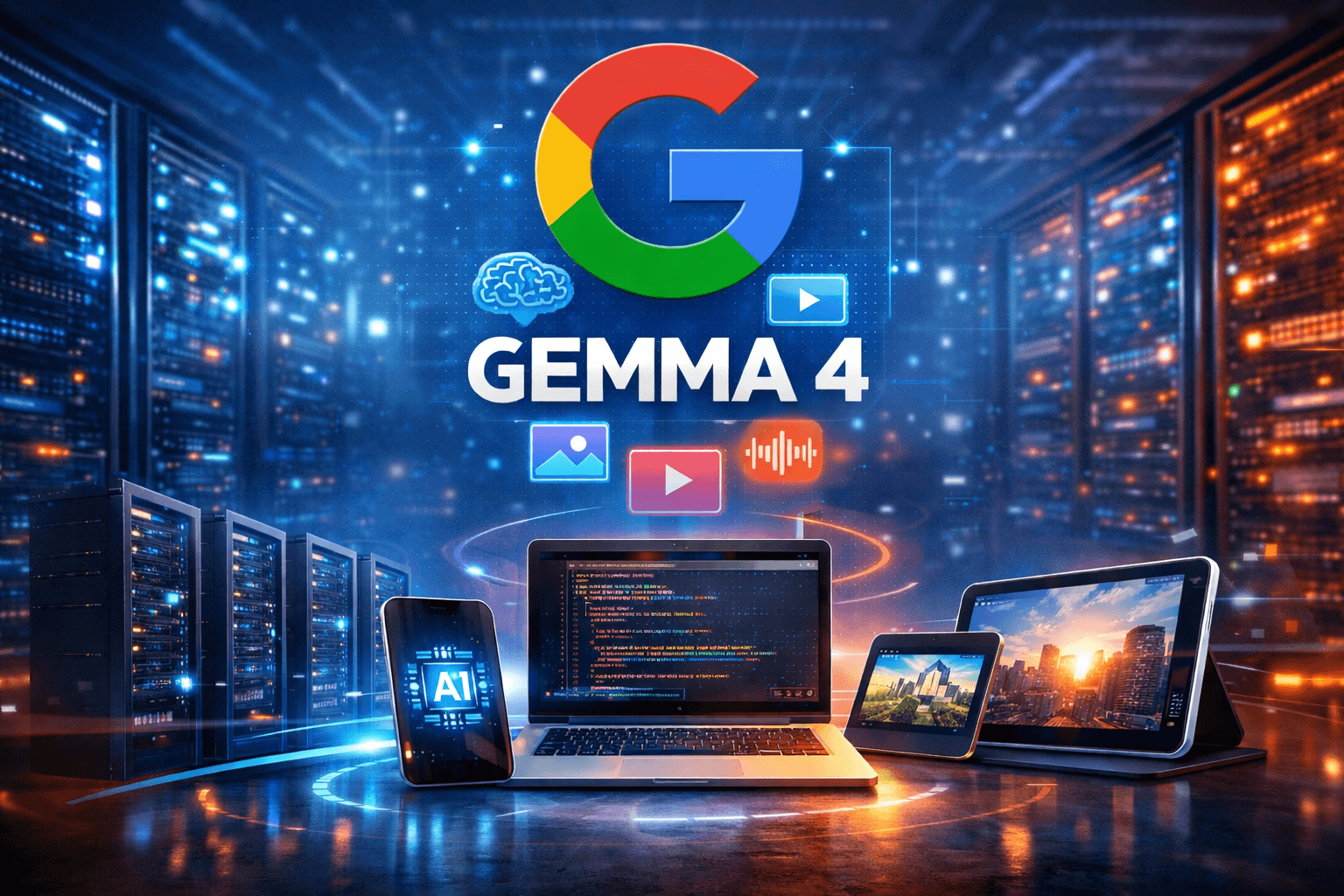
Google has officially launched Gemma 4, the newest generation of its open AI model family, in a move that could significantly expand how advanced artificial intelligence is used across devices. The company says Gemma 4 is its most capable open model family yet, designed to run across a wide range of hardware, from cloud infrastructure and developer workstations to laptops and smartphones.
The launch matters because it shows Google is not only focusing on large, proprietary AI systems like Gemini, but is also investing heavily in smaller, more accessible models that developers can build on directly. Google has released Gemma 4 under an Apache 2.0 license, making it commercially permissive and easier for developers, researchers and companies to use, modify and fine-tune for their own purposes.
According to Google, Gemma has already built strong momentum since its earlier releases. The company says developers have downloaded Gemma models more than 400 million times, and that the ecosystem has produced over 100,000 variants. That scale of adoption gives Gemma 4 a strong starting point in an increasingly competitive open-model market.
What exactly is Google Gemma 4?
Gemma 4 is a family of open-weight multimodal AI models built by Google DeepMind. Google describes it as being built from the same world-class research and technology as Gemini 3, but positioned differently: Gemini remains Google’s flagship proprietary model line, while Gemma is meant to be the open family developers can run on their own hardware and adapt for specific use cases.
The biggest headline from the launch is that Gemma 4 is designed to work across computing environments. Google says the models are sized to run efficiently on hardware ranging from billions of Android devices, to laptop GPUs, to developer workstations and accelerators. That makes Gemma 4 notable not just as a research release, but as a practical toolkit for building AI applications that do not always need to depend on a remote cloud model.
The four Gemma 4 models
Google has released Gemma 4 in four sizes:
- E2B
- E4B
- 26B Mixture-of-Experts
- 31B Dense
The smaller E2B and E4B models are intended for edge and on-device use, while the larger 26B MoE and 31B Dense variants are aimed at more demanding workloads on stronger hardware. Google says the 31B model is currently ranked #3 open model on the Arena AI text leaderboard, while the 26B model holds the #6 spot. Google also says Gemma 4 can outperform models 20 times its size on that benchmark, which it presents as evidence of strong “intelligence-per-parameter.”
That claim is important because the current AI race is no longer just about building the biggest model. Efficiency matters. If a model can deliver stronger reasoning and multimodal performance without needing massive infrastructure, it becomes much more useful to developers, startups and enterprises operating under budget or hardware constraints.
What Gemma 4 can do
Gemma 4 is not being pitched as a simple chatbot model. Google says the family is built for advanced reasoning and agentic workflows, with capabilities that go well beyond basic Q&A. Official documentation highlights several major upgrades.
First, Google says Gemma 4 is better at multi-step reasoning, logic-heavy tasks, mathematics and instruction following. This positions it for more complex AI-assisted workflows, where the model has to understand layered prompts rather than simply generate surface-level answers.
Second, the models support agentic features such as function calling, structured JSON output, and native system instructions. In practical terms, this means developers can use Gemma 4 to build AI agents that interact with tools, APIs and software systems in more reliable ways.
Third, Google says Gemma 4 has stronger coding capabilities, including support for high-quality offline code generation. That could make the model useful as a local-first coding assistant, particularly for users who want more privacy or want to avoid sending sensitive code to external services.
Fourth, Gemma 4 is multimodal. According to Google’s model card, the models handle text and image input, while the smaller models also support audio. Google’s launch blog additionally says all models can natively process video and images, with the E2B and E4B models featuring native audio input.
Finally, Gemma 4 supports a significantly larger context window. Google says the edge models offer 128K context, while the larger models go up to 256K context, allowing developers to pass large documents, long conversations or code repositories into a single workflow. The company also says the family supports more than 140 languages.
Read more on Russia offering oil and LNG to India.
Why the smartphone angle matters
One of the most important parts of the Gemma 4 launch is the way Google is emphasizing local and edge deployment. The smaller E2B and E4B models are positioned as models that can run efficiently on personal and mobile hardware rather than only in data centres. Google says these smaller models are optimized for low-latency performance and on-device utility.
This matters for a few reasons.
The first is speed. On-device AI can reduce the delay that comes from sending every request to a remote server. The second is privacy. If more processing happens locally, users and companies gain more control over where data stays. The third is cost and accessibility. Not every developer or business can afford heavy cloud inference bills, but lightweight local models open new doors for experimentation and product development.
The smartphone angle also shows where the AI industry is heading. The future is not only about giant cloud models answering prompts in a browser tab. It is increasingly about AI embedded into everyday tools, operating systems, assistants, cameras, productivity apps and offline workflows.
What Sundar Pichai and Demis Hassabis said
The public messaging around Gemma 4 was straightforward and strategic. According to the Times of India report quoting their posts, Google CEO Sundar Pichai said Gemma 4 is “packing an incredible amount of intelligence per parameter,” while Google DeepMind CEO Demis Hassabis described it as “the best open models in the world for their respective sizes.”
That phrasing fits the product’s positioning. Google is not claiming Gemma 4 replaces Gemini. Instead, it is presenting Gemma 4 as a best-in-class open family for developers who need capability, flexibility and efficiency in one package. The message is also competitive: Google wants to be seen not only as a leader in closed, premium AI systems, but also as a serious player in open-model ecosystems.
Why Gemma 4 matters for developers and businesses
For developers, Gemma 4 offers a useful middle path between fully proprietary cloud models and smaller open models that are cheaper but less capable. Because it is open-weight and permissively licensed, developers can build products around it with fewer restrictions than they might face elsewhere.
For startups, that could mean creating local assistants, private coding tools, multilingual chat interfaces, document analysis systems or AI agents without depending entirely on API-based pricing from third-party vendors.
For larger enterprises, Gemma 4 may be attractive because it offers a path to stronger control over deployment. Google Cloud has already said Gemma 4 is available on Google Cloud and highlighted the value of running these models while keeping data inside secure organizational boundaries.
For researchers, the release is also important because open models accelerate experimentation. Google’s own launch material points to examples such as Bulgarian language modeling and biomedical research as evidence that smaller, adaptable open models can drive meaningful work outside consumer chat interfaces.
A more accurate way to understand Gemma 4
It is important to be precise about what Gemma 4 is and is not.
Gemma 4 is not simply “Google’s ChatGPT rival for phones.” It is a broader open model family with multimodal, coding, reasoning and agentic capabilities. It is also more accurate to describe Gemma 4 as open-weight and Apache 2.0 licensed rather than casually reducing it to a generic “open-source chatbot.” The release is about enabling deployment and customization across environments, not just launching another consumer-facing assistant.
It is also worth noting that while Google is pushing the smartphone angle, the official materials describe deployment across phones, laptops, workstations, servers and cloud infrastructure. So the story is bigger than mobile AI alone. It is really about building one model family that can stretch from the edge to the data centre.
Final takeaway
Google Gemma 4 is one of the company’s most important AI releases of 2026 so far because it reflects a wider shift in the AI industry: toward efficient, multimodal, open models that can run across many kinds of hardware. With four model sizes, support for reasoning, agentic workflows, long context windows, image and audio capabilities, and a commercially permissive Apache 2.0 license, Gemma 4 gives developers a powerful new option in the fast-moving open AI landscape.
For Google, the message is clear. The future of AI is not only about giant proprietary models in the cloud. It is also about giving developers high-performance open models that can live on laptops, in data centres and eventually in the phones people carry every day.