







Tejas Fighter Jet Crashes
Introduction
For over two decades, the HAL Tejas fighter jet represented one of India’s most ambitious indigenous defence achievements — a lightweight multirole combat aircraft symbolising technological self-reliance and aerospace maturity.
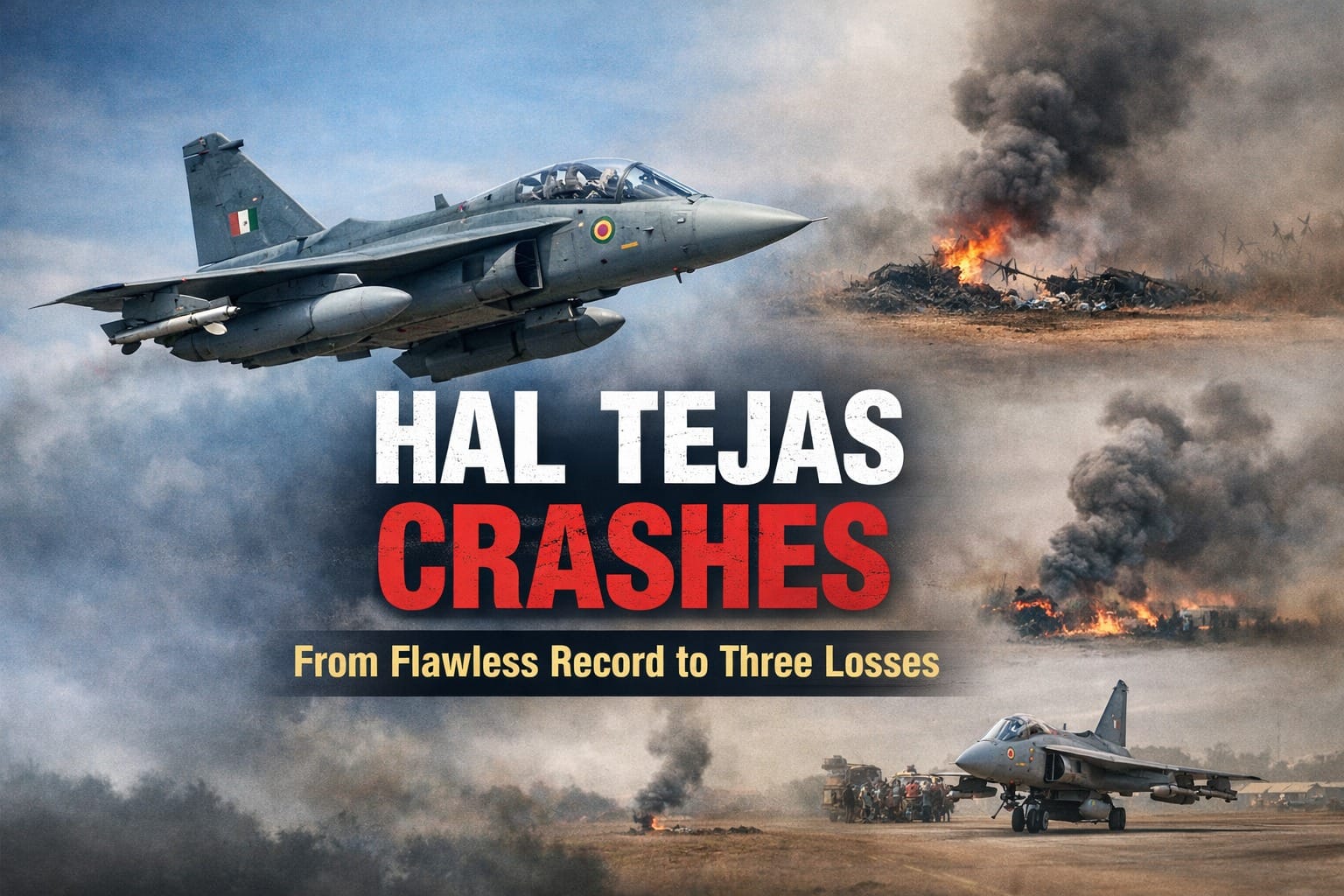
From its first flight in 2001 until 2024, the Tejas enjoyed a flawless safety record with no crashes, a rare milestone for a new-generation fighter program. However, a series of three aircraft losses between 2024 and 2026 has raised questions about reliability, operational challenges, and program maturity.
This article examines the recent HAL Tejas crashes, their causes, safety implications, and what these incidents mean for India’s air power and defence manufacturing ecosystem.
HAL Tejas Fighter Jet: Program Overview
The HAL Tejas (Light Combat Aircraft) is India’s indigenous 4.5-generation fighter developed by the Aeronautical Development Agency (ADA) and manufactured by Hindustan Aeronautics Limited (HAL).
Key characteristics
- Lightweight multirole fighter
- Fly-by-wire digital flight control system
- Composite airframe for weight reduction
- Advanced avionics and radar integration
- Designed for air defence, ground attack, and reconnaissance
The aircraft was conceived to replace ageing MiG-21 fighters and strengthen India’s domestic defence manufacturing capability.
A Flawless Safety Record Until 2024
One of the most notable aspects of the Tejas program was its absence of crashes for more than two decades after its first flight.
This was significant because:
- Early-stage fighter programs typically experience accidents
- Indigenous development often faces integration risks
- Advanced systems like fly-by-wire can create testing challenges
The Tejas defied these trends, building confidence among defence planners and aviation analysts.
Also read – Pakistan Strikes Afghanistan: Latest Updates & Casualties
HAL Tejas Crashes in the Past Decade
In the past decade, India has lost three HAL Tejas aircraft, all occurring after 2024.
1. March 12, 2024 Crash Near Jaisalmer
The first-ever crash in the Tejas program occurred during a routine training sortie near Jaisalmer, Rajasthan.
Key details
- Aircraft destroyed
- Pilot ejected safely
- Training mission
- No civilian casualties
This incident marked a turning point, ending the program’s perfect safety record.
2. November 21, 2025 Crash at Dubai Air Show
The second accident occurred during an aerial display at the Dubai Air Show.
Key details
- First fatality in Tejas program
- Aircraft lost during demonstration manoeuvres
- Raised concerns about airshow operational risks
Airshow flights typically involve high-performance manoeuvres, increasing risk compared to routine missions.
3. February 2026 Landing Accident
The third loss occurred during landing after a training flight at a key air base.
Key details
- Pilot escaped without serious injury
- Aircraft severely damaged and likely written off
- Incident occurred during landing phase
Landing and take-off phases account for a significant portion of aviation accidents globally.
Why Fighter Jets Crash: Contextual Analysis
It is important to understand that fighter aircraft accidents can occur due to multiple factors.
Possible contributing factors
- Mechanical failure
- Human error
- Environmental conditions
- High-performance manoeuvres
- Maintenance issues
- Software or avionics integration challenges
Experts emphasize that isolated incidents do not necessarily indicate systemic design flaws.
Aviation Experts’ View: Safety Record Still Strong
Despite recent losses, aviation analysts highlight that the Tejas safety record remains statistically strong.
Reasons
- Over two decades without accidents
- Limited number of losses relative to flight hours
- Comparable or better performance than many global fighter programs during early service years
Historically, aircraft like the F-16, Gripen, and Rafale experienced early-stage incidents before achieving mature operational safety levels.
Operational Expansion and Risk Exposure
One reason for increased incidents may be the expanding operational envelope of the Tejas.
Factors increasing risk
- Larger fleet induction
- Intensive training cycles
- Airshow demonstrations
- Diverse mission profiles
- Increased flight hours
As fleet size grows, statistical probability of incidents also rises.
Impact on India’s Defence Strategy
The Tejas program is central to India’s defence modernization and self-reliance goals.
Strategic importance
- Replacement of legacy fighters
- Strengthening domestic aerospace industry
- Export potential
- Technology development platform
- Foundation for Tejas Mk2 and AMCA programs
Recent accidents have triggered reviews but have not altered long-term strategic commitment.
HAL Tejas Mk1A and Mk2: Future Outlook
India continues to expand Tejas production, including advanced variants.
Upcoming developments
- Tejas Mk1A with upgraded avionics and radar
- Tejas Mk2 medium-weight fighter
- Integration of indigenous weapons and sensors
- Improved maintenance and reliability systems
These upgrades aim to enhance operational capability and safety.
Investigations and Safety Enhancements
Each accident has triggered detailed investigations focusing on:
- Flight data analysis
- Engine and avionics review
- Pilot inputs
- Maintenance records
- Operational procedures
Such investigations are standard in aviation and often lead to design and procedural improvements.
Public Perception vs Operational Reality
Media coverage of crashes can create perception challenges, but experts caution against drawing premature conclusions.
Important perspective
- Fighter jets operate in high-risk environments
- Accidents are not uncommon globally
- Safety trends must be evaluated over time
- Statistical context is crucial
The Tejas program remains one of India’s most successful indigenous defence initiatives.
Lessons Learned for Indigenous Fighter Programs
The recent incidents highlight broader lessons:
Key takeaways
- Continuous testing is essential
- Operational maturity takes time
- Safety evolves with experience
- Fleet expansion increases incident probability
- Investigations drive improvement
These lessons contribute to strengthening India’s aerospace ecosystem.
Conclusion
The HAL Tejas fighter jet program has transitioned from a flawless safety record to experiencing three aircraft losses in recent years. While these incidents have raised concerns, they must be viewed within the broader context of fighter aviation risks and program maturity.
With ongoing upgrades, safety investigations, and fleet expansion, the Tejas remains a cornerstone of India’s defence strategy and a symbol of indigenous aerospace capability.
Rather than indicating systemic weakness, the recent losses reflect the realities of operational expansion and high-performance military aviation. As the program evolves through Tejas Mk1A and Mk2 variants, lessons from these incidents are expected to strengthen reliability and safety.
The story of the Tejas is therefore not one of decline, but of maturation — a program navigating the challenges inherent in building and operating a world-class fighter aircraft.
FAQs
How many HAL Tejas aircraft has India lost?
India has lost three HAL Tejas aircraft between 2024 and 2026.
When did the first Tejas crash occur?
The first crash occurred on March 12, 2024 near Jaisalmer during a training sortie.
Did the Tejas have a flawless safety record?
Yes, the Tejas had no crashes from its first flight in 2001 until 2024.
Was there any fatality in Tejas crashes?
The first fatality occurred during the November 2025 Dubai Air Show crash.
Is the Tejas considered safe?
Aviation experts state the Tejas maintains a strong safety record relative to global fighter programs.
Subscribe to our YouTube Channel The Logic Stick for more video insights