





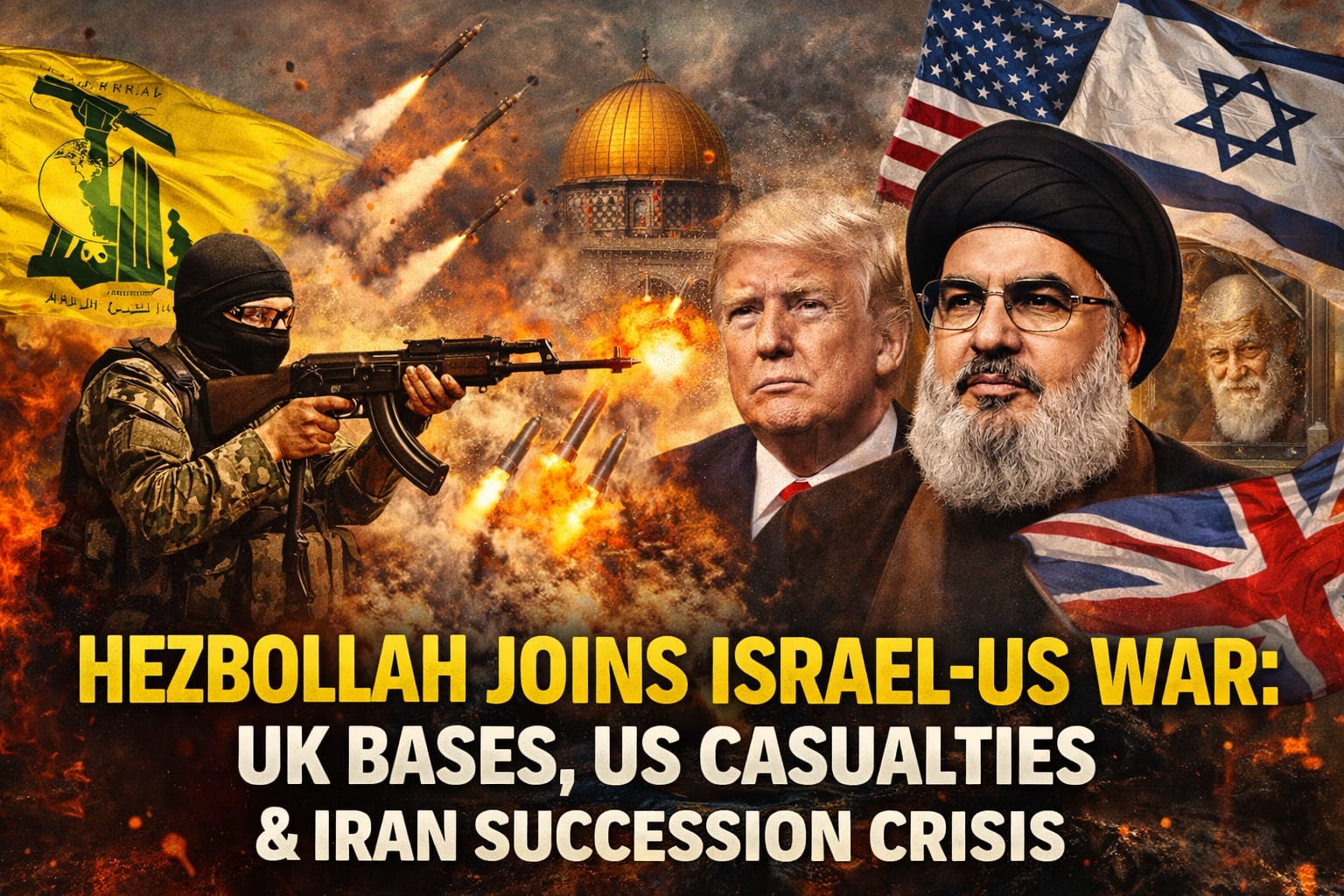
Hezbollah Joins the Israel-US-Iran War
On 2 March 2026 (India time), the Middle East conflict entered a new, dangerous phase as Hezbollah — the Lebanese armed group backed by Iran — formally pledged to confront both Israel and the United States. This escalation follows the Israel–US strikes on Iran, which killed Supreme Leader Ayatollah Ali Khamenei and senior clerics, triggering regional outrage, retaliatory missile attacks and now a widening battlefield.
In this first part of our comprehensive update, we will explain:
- What Hezbollah has announced
- The broader context of their entry into the war
- Latest battlefield updates
- Reactions from Iran, including the role of Khamenei’s family
- Immediate effects on regional security and global markets
1. Hezbollah’s Declaration: What Happened Today
According to reporting from Al Jazeera and multiple regional sources, Hezbollah publicly promised “to confront US and Israeli forces” in response to the killing of Iran’s Supreme Leader.
In a rare televised address, Hezbollah’s leadership stated:
“We cannot remain passive as the body of our leader is desecrated. Today we confront the US and Israel — all of them.”
This marks one of the most explicit, public commitments by a major non-state actor to join the conflict beyond Iranian territory.
Also Read – UAE hit by missiles as regional conflict escalates
2. Why Hezbollah’s Involvement Matters
Hezbollah is not a fringe militia. It is:
- A powerful Lebanese group with thousands of fighters
- Equipped with tens of thousands of missiles and rockets
- Strategically positioned on Israel’s northern border
Its involvement dramatically expands the battlefield from Iran and Israel to Lebanon, potentially drawing multiple states into a wider war.
A Hezbollah strike against Israel would likely trigger one of the most intense northern front conflicts in recent history, compounding Israel’s existing engagements and stretching military resources.
3. What Hezbollah’s Statement Means for the War’s Geography
Until now, the main fronts of the conflict included:
- Iran’s counter-attacks toward Israel and US bases across the Gulf
- Regional missile exchanges involving Iraq, Kuwait, Bahrain and UAE airspace
- Proxy actions by militia groups in Iraq and Syria
Hezbollah’s entry adds:
- Lebanon’s southern border as a new, large front
- Possible escalation in urban areas near Beirut and Tyre
- A risk of dual-axis war — north (Lebanon) and south (Gaza/Israel/West Bank)
This significantly increases the scope and scale of potential hostilities.
4. Latest Updates on the War as of 2 March 2026
4.1 Missile Exchanges and Retaliation
Iran has continued to launch missiles and drones at Israel, with Israeli interceptors claiming many shoot-downs over northern and central regions. Civilians in Tel Aviv and Haifa experienced repeated air-raid sirens throughout the past 48 hours.
4.2 U.S. Military Assets Targeted
Several U.S. military bases in the region — including in Qatar, Bahrain and Kuwait — have reported intercepting ballistic threats. No confirmed large-scale damage has yet been independently verified, but U.S. defense conditions remain high.
4.3 Impact on Flight Paths & Civil Airspace
Due to escalating exchanges, Gulf airspace remains restricted. Numerous commercial carriers have suspended flights over or near conflict zones, affecting international travel and cargo routes.
5. Iran’s Reaction: Succession and the Role of Khamenei’s Family
The death of Supreme Leader Ayatollah Ali Khamenei has triggered a leadership crisis in Iran’s theocratic hierarchy. His passing destabilized the nation’s command structure amid war. Multiple developments include:
5.1 Reported Involvement of Khamenei’s Sons
Iran’s state media and diplomatic reporting suggest that Khamenei’s sons — especially Mostafa and Mojtaba Khamenei — are heavily involved in succession consultations with the Iranian Assembly of Experts and the Guardian Council.
Though official confirmations remain limited, leaks and analyst reports indicate:
- Mostafa Khamenei has significant influence within the IRGC and intelligence circles
- Mojtaba Khamenei is associated with security policy discussions and internal power networks
This internal jockeying comes as Iran continues counter-attacks and manages external diplomacy. A potential successor from within the Khamenei family could shift Iran’s strategic priorities, risk tolerance, and negotiation openness.
6. Domestic Iranian Sentiment
Across Iran, reactions have been deeply emotional:
- Massive mourning rallies in major cities like Tehran, Mashhad and Isfahan
- Government-organized marches combined with anti-US and anti-Israel slogans
- Life in many cities marked by grief overlapped with calls for revenge and justice
These sentiments are important because they shape public support for leadership decisions and willingness to endure ongoing conflict.
7. Broader Reactions: Arab World and Muslim Nations
Hezbollah’s declaration has energized some regional actors, while prompting caution in others:
- Iraq and Syria’s pro-Iranian militias have reiterated solidarity with Hezbollah and Iran
- Gulf Cooperation Council (GCC) states have condemned any expansion of conflict, urging restraint
- Arab League officials have called for urgent diplomacy to avoid a full-regional war
This polarizing environment complicates diplomatic efforts.
8. Worldwide Diplomatic Messages on 2 March 2026
8.1 United States
U.S. government spokespeople have reiterated:
“We will not tolerate attacks on U.S. forces or allies.”
The U.S. defense posture includes forward deployments, anti-missile defense coordination with Israel, and heightened force readiness across the Middle East.
8.2 European Union and Western Allies
European capitals have urged de-escalation and expressed deep concern over civilian risks. Most European leaders emphasize that a broader regional war would be catastrophic for global security and economic stability.
8.3 United Nations
UN diplomats have called for emergency sessions to discuss humanitarian corridors, ceasefire frameworks, and protection of civilian infrastructure.
9. Humanitarian Impact So Far
The widening conflict has already resulted in:
- Disrupted essential services in parts of southern Israel
- Civilian evacuations in areas near Hezbollah’s potential launch zones
- Humanitarian response challenges in war-affected Iranian provinces
International aid agencies are mobilizing assistance, though security conditions constrain access to some regions.
10. Economic & Global Security Ripples (as of Today)
10.1 Oil Market Volatility
Oil prices remain highly unstable due to:
- Perceived risk of supply disruption from the Gulf
- Spikes in crude futures and trader risk premiums
- Strained Strait of Hormuz routes affecting tanker traffic
10.2 Global Stock Market Response
Equity markets in Asia, Europe and North America show increased volatility — especially energy sector stocks, defense contractors, and regional bank equities.
Hezbollah’s entry into the escalating Israel–US–Iran conflict is no longer just rhetoric. On 2 March 2026 (India time), events moved fast: Hezbollah fired rockets, Israel struck Beirut, the US confirmed casualties, and the UK approved use of British bases for US defensive strikes—signals that the war is expanding into a multi-front regional conflict.
This Part 2 brings together the most important updates you should know today—battlefield developments, Iran’s leadership succession question after Khamenei’s killing, what Washington is saying now, and what the UK decision really means.
1) Hezbollah crosses the line from warning to action
Al Jazeera reported that Hezbollah promised to confront the US and Israel after Khamenei’s killing, while also noting that Lebanon’s leadership stressed that decisions of war and peace should rest with the state.
But by 2 March, the situation escalated further: Hezbollah fired rockets, and Israel responded with major strikes.
Why this matters: Hezbollah is one of the region’s most capable non-state armed actors. Any sustained Hezbollah-Israel exchange opens the “northern front” and risks drawing Lebanon deeper into a conflict it may not be able to contain—especially if strikes expand toward dense urban areas.
2) Israel hits Beirut after Hezbollah attacks
Reuters reported that Israel struck Hezbollah targets in Lebanon following Hezbollah missile/drone attacks, with explosions rocking Beirut and evacuations reported.
Al Jazeera separately reported “Israel bombs Beirut after Hezbollah launches rocket attack,” describing the strike as part of a widening confrontation linked to Khamenei’s killing.
What this signals: Israel is messaging that Hezbollah’s retaliation will carry direct costs inside Lebanon. That kind of deterrence strategy can quickly escalate—especially if there are high-profile casualties or strikes near symbolic locations.
3) US confirms casualties and hardens its messaging
A major escalation point: Reuters reported the US confirmed its first casualties of this conflict—three service members killed in Kuwait.
That changes the domestic political equation in Washington and typically drives a more forceful posture.
According to Reuters’ account of the situation, President Trump warned there could be more casualties and said attacks would continue until objectives are met, while also urging Iranians to revolt.
Al Jazeera’s live coverage also reflects the same core messaging: Trump says attacks will continue until objectives are met, as Iran keeps up raids on US assets in the Gulf.
What to watch next: any public shift in US objectives—from degrading capabilities to explicit “regime change”—would sharply raise the risk of a prolonged regional war.
4) UK “ports” vs “bases”: what’s actually confirmed
Your prompt mentions “UK giving ports to USA.” The most credible reporting today frames it differently:
Reuters reports UK Prime Minister Keir Starmer approved a US request to use British military bases for limited defensive strikes against Iranian missile depots/launchers, emphasizing collective self-defense and protection of British lives—while also stressing the UK was not involved in the initial joint US-Israel strikes that killed Khamenei.
The Guardian reports the UK permission includes bases such as RAF Akrotiri in Cyprus, with UK jets involved in defensive intercept operations; it also notes political controversy inside the UK about legality and escalation risk.
So, the verified update is: bases for defensive action, not “ports” as a formal handover.
Strategic meaning: This expands the operational geography. Bases like RAF Akrotiri are critical for air operations across the Eastern Mediterranean. Even “defensive strikes” can be viewed as escalation by Iran and its allies.
5) Iran’s leadership vacuum: successor question intensifies
Al Jazeera’s Feb 28 live coverage explicitly framed the crisis as not only military but political: Khamenei and top security officials killed, followed by major retaliation and mourning.
The biggest question now is succession. A “Supreme Leader election” would be conducted by Iran’s Assembly of Experts, and multiple names circulate in media analysis—but this remains fluid and contested.
- Mojtaba Khamenei, one of Khamenei’s sons, is frequently discussed in international reporting and commentary, but there are hurdles and political resistance to dynastic succession; the Hindustan Times cites analysis suggesting why Mojtaba may be unlikely.
- A broader background explainer on the 2026 Iranian Supreme Leader election (planned after Khamenei’s death) outlines that no official heir had been publicly declared and that various outlets have discussed potential candidates.
Important note for accuracy: Iran has not publicly confirmed a named successor as of these reports; what we have today is credible reporting that a leadership transition mechanism exists and that possible candidates are being discussed.
6) New IRGC commander: Ahmad Vahidi (confirmed)
Separate from the Supreme Leader question, Iran has moved to stabilize military command. India Today reports Brigadier General Ahmad Vahidi has been appointed as IRGC Commander-in-Chief, noting his prior senior roles (including defence and interior portfolios).
NDTV has a profile explainer on who Ahmad Vahidi is in the context of the war and leadership changes.
Why this matters: A leadership shift at the IRGC’s top during active conflict can either centralize decision-making quickly—or intensify hardline responses if the new leadership chooses escalation to restore deterrence.
7) The war’s trajectory: multi-front escalation risk is now real
As of 2 March, you can map the war’s risk profile like this:
Front 1: Israel–Iran direct conflict
- Ongoing strikes and counter-strikes reported across targets and air defense activity.
Front 2: Lebanon–Israel (Hezbollah front)
- Hezbollah rocket fire followed by Israel striking Beirut/Hezbollah positions.
Front 3: Gulf and US bases
- Iran-linked attacks or claimed attacks on US assets; confirmed US casualties in Kuwait.
Front 4: Internationalization through allies
- UK approval for US use of British bases for defensive strikes.
This combination is what turns a crisis into a regional war—especially if strikes begin hitting high-value infrastructure, shipping lanes, or large civilian centers.
8) What “solution” looks like now
With Hezbollah entering the kinetic phase, solutions narrow, but they still exist:
- Ceasefire sequencing
- A phased reduction: halt cross-border rocket fire (Lebanon), pause deep strikes (Iran), and stop attacks on bases (Gulf).
- Backchannel security guarantees
- Quiet communication lines between Washington, Tehran intermediaries, and regional capitals to stop miscalculation.
- Humanitarian corridors + deconfliction
- Prevent further civilian panic and displacement, especially if Beirut and northern Israel become regular strike zones.
- A defined diplomatic track
- A credible forum (UN + regional intermediaries) that addresses the war’s stated triggers and red lines.
The core challenge: all sides currently believe escalation strengthens their bargaining position. That’s exactly the pattern that historically produces prolonged conflict.