





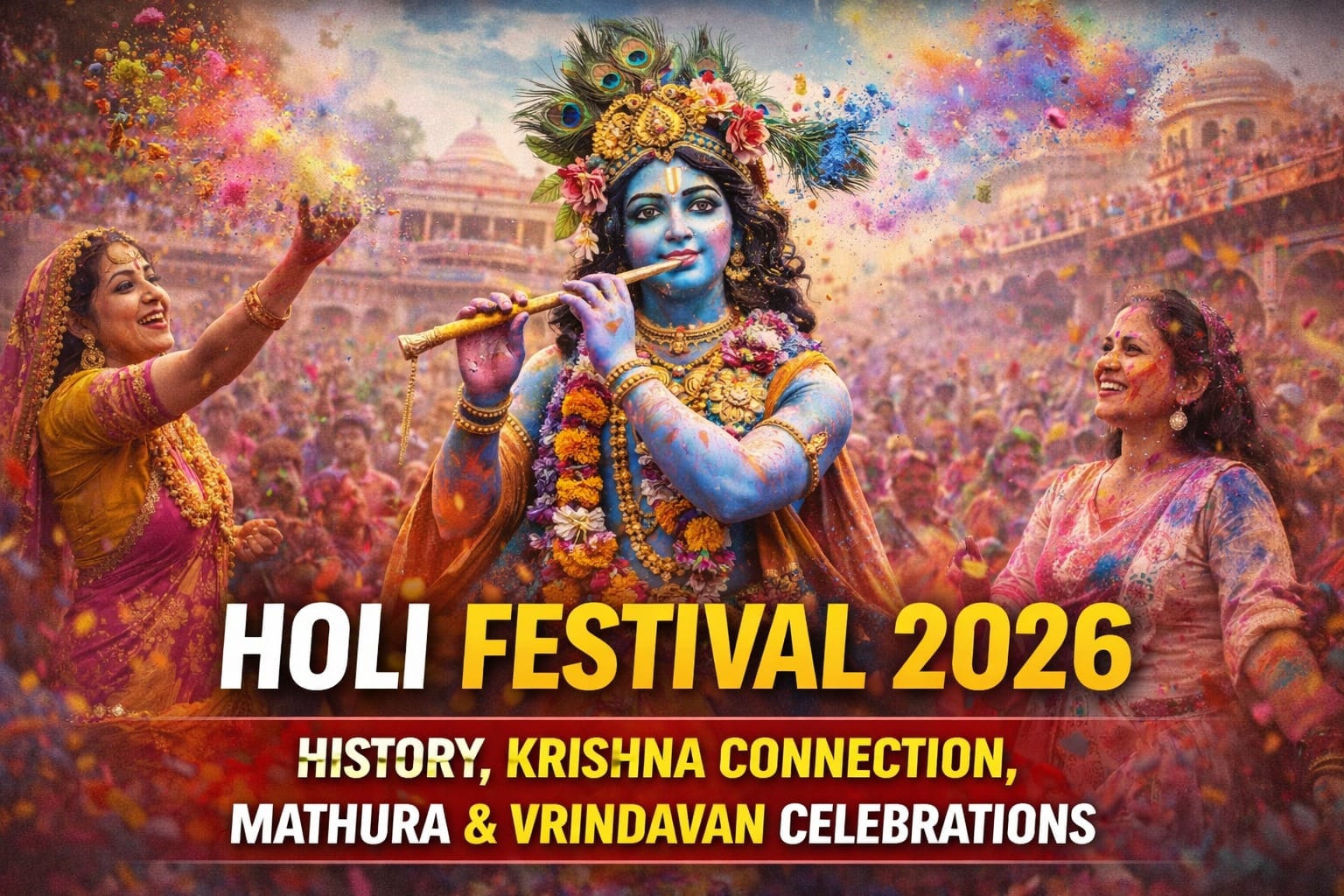
Holi Festival will be celebrated on 4 March
Introduction
Holi, often called the Festival of Colours, is one of the most vibrant, joyful, and culturally rich festivals in India. Celebrated across religions, regions, and communities, Holi symbolizes the arrival of spring, victory of good over evil, renewal of relationships, and celebration of love and unity.
Beyond colours and celebration, Holi carries deep mythological, spiritual, social, and psychological meanings that date back thousands of years.
In 2026, Holi will be celebrated on 4 March, while the ritual of Holika Dahan will take place on the evening of 3 March.
This detailed article explores:
- History and origin of Holi
- Religious and mythological significance
- Connection with Lord Krishna
- Traditions and rituals across India
- Unique Holi celebrations in Mathura and Vrindavan
- Cultural, spiritual, and social meaning
- Holi 2026 dates and schedule
Origin and History of Holi
Ancient roots of the festival
Holi’s origins trace back to ancient Hindu scriptures and agricultural traditions celebrating the end of winter and beginning of spring harvest season. Historically, it marked:
- Fertility and abundance
- Seasonal transition
- Social renewal and forgiveness
- Community bonding
The festival is referenced in texts such as:
- Puranas
- Narada Purana
- Bhavishya Purana
- Medieval Indian literature and poetry
Mythological Story of Holika and Prahlad
The central myth associated with Holi is the story of Prahlad, Holika, and Hiranyakashipu.
Hiranyakashipu, a demon king, demanded worship as a god, but his son Prahlad remained devoted to Lord Vishnu. Enraged, the king plotted to kill him with help of his sister Holika, who possessed immunity to fire.
Holika sat with Prahlad in flames, but divine protection saved Prahlad while Holika perished. This event symbolizes:
- Victory of devotion over arrogance
- Triumph of good over evil
- Protection of faith
The ritual of Holika Dahan, where bonfires are lit, commemorates this myth.
Also read – Was Mahabharta a Nuclear War?
Religious Significance of Holi
Holi represents multiple spiritual meanings:
1. Victory of good over evil
The Prahlad story emphasizes moral triumph.
2. Celebration of divine love
Especially associated with Radha-Krishna traditions.
3. Spiritual renewal
People forgive, forget past conflicts, and rebuild relationships.
4. Symbolism of colors
Colors represent diversity, joy, and emotional expression.
Holi and Lord Krishna: The Divine Connection
Holi’s most profound cultural link is with Lord Krishna, especially in the Braj region (Mathura, Vrindavan, Barsana, Nandgaon).
According to legends:
- Young Krishna complained about Radha’s fair complexion
- Mother Yashoda suggested applying colours to Radha
- Krishna playfully colored Radha and Gopis
This playful interaction became the foundation of Holi celebrations.
The Krishna connection symbolizes:
- Divine love and romance
- Joyful devotion
- Breaking social boundaries
- Playfulness and spiritual intimacy
The Braj region, associated with Krishna’s childhood, celebrates Holi with unmatched devotion and grandeur.
Holi 2026 Date and Ritual Calendar
Key dates
- Holika Dahan: 3 March 2026
- Rangwali Holi (main festival): 4 March 2026
In the Braj region, celebrations begin earlier and extend over several days or weeks with multiple themed Holi events.
How Holi Is Celebrated Across India
Holika Dahan (Chhoti Holi)
On the night before Holi:
- Bonfires are lit
- People gather around flames
- Ritual offerings are made
- Symbolic burning of negativity
Rangwali Holi (Dhulandi)
On the main day:
- People apply gulal and colours
- Water balloons and pichkaris used
- Music, dance, and festivities
- Exchange of sweets like gujiya and thandai
- Community gatherings
Traditional foods
Holi cuisine includes:
- Gujiya
- Malpua
- Dahi bhalla
- Thandai
- Puran poli
- Kanji
- Mathri
Food plays a major role in festive bonding.
Social and Psychological Significance
Holi is considered one of India’s most socially transformative festivals.
Breaking social barriers
Caste, class, and age distinctions dissolve during Holi.
Emotional healing
People reconcile conflicts and strengthen relationships.
Celebration of freedom
Holi allows emotional expression through color and joy.
Community integration
The festival fosters unity and collective happiness.
Holi Traditions and Rituals
Colour play
Applying gulal symbolizes love and positivity.
Water celebrations
Water play represents purification and freshness.
Singing and dancing
Folk songs like Holi Rasiya celebrate Krishna.
Temple rituals
Devotional celebrations occur across temples.
Visiting friends and relatives
Symbolizes strengthening social ties.
Holi in Mathura and Vrindavan: The Spiritual Heart of Holi
Mathura and Vrindavan are considered the birthplace and playground of Holi, deeply connected to Lord Krishna.
Unlike typical one-day celebrations, Braj Holi is a sequence of events across towns representing Krishna’s life story.
Celebrations here can span weeks and attract pilgrims worldwide.
Major Holi Events in Braj Region (2026)
Barsana Laddu Holi
Devotees throw laddus and colors in Radha Rani Temple.
Lathmar Holi
Women playfully strike men with sticks, reenacting Radha-Krishna legends.
Nandgaon Holi
Krishna’s village hosts reciprocal celebrations.
Phoolon Ki Holi
Flower petals replace colours inside temples.
Gokul Holi
Traditional village celebrations and rituals.
Holika Dahan
Bonfire rituals across Mathura.
Dhulandi Holi
Grand color celebrations across Braj.
Unique Holi Traditions in Mathura and Vrindavan
Lathmar Holi (Barsana)
Symbolizes playful teasing between Radha and Krishna.
Phoolon Ki Holi
Celebrated with flowers instead of colours.
Widow Holi
A modern tradition promoting inclusivity and social reform.
Temple Holi
Devotional rituals in Banke Bihari and Krishna Janmabhoomi temples.
Huranga Festival
Energetic celebrations with colors and traditional games.
Cultural Significance of Braj Holi
The Braj Holi represents:
- Divine love narrative
- Cultural heritage
- Devotional expression
- Tourism attraction
- Preservation of ancient traditions
The region becomes a spiritual and cultural hub during the festival.
Vrindavan Holi: A Spiritual and Devotional Experience
Vrindavan, the sacred land where Lord Krishna spent his childhood, is considered one of the most extraordinary places to experience Holi. Unlike the casual celebration in many parts of India, Holi in Vrindavan is deeply devotional and rooted in temple rituals.
Banke Bihari Temple Holi
One of the most iconic Holi celebrations takes place at the Banke Bihari Temple, where devotees gather days before the main festival. Here, priests and devotees throw gulal and flowers while devotional songs echo throughout the temple premises.
This celebration reflects:
- Spiritual surrender
- Collective devotion
- Divine love between Krishna and devotees
- Immersive cultural experience
The temple Holi begins earlier than the actual festival day, often weeks in advance, creating an extended spiritual celebration.
Phoolon Ki Holi (Flower Holi)
Phoolon Ki Holi is among the most unique celebrations in Vrindavan. Instead of colors, temple priests shower flower petals over devotees, symbolizing purity and divine blessing.
Key aspects include:
- Celebration inside temples
- Use of marigold, rose, and jasmine petals
- Musical devotional performances
- Representation of Krishna’s playful nature
This event attracts thousands of pilgrims and tourists seeking a peaceful and devotional Holi experience.
Widow Holi in Vrindavan
A socially transformative celebration, Widow Holi allows widowed women — traditionally excluded from festivities — to participate in Holi.
This event represents:
- Social reform
- Gender equality
- Emotional healing
- Inclusion and empowerment
The celebration has gained global recognition as a powerful symbol of changing social attitudes in India.
Mathura Holi: Celebrating Krishna’s Birthplace
Mathura, Lord Krishna’s birthplace, hosts grand Holi celebrations centered around temples and public festivities.
Krishna Janmabhoomi Holi
The Krishna Janmabhoomi Temple hosts devotional singing, color play, and spiritual rituals reflecting Krishna’s life.
Processions and street celebrations
Mathura streets transform into vibrant spaces with:
- Folk performances
- Cultural processions
- Devotional music
- Color throwing
- Community feasts
The city becomes a living representation of Krishna’s playful spirit.
Barsana and Nandgaon Holi Traditions
Lathmar Holi (Barsana)
Lathmar Holi reenacts the playful teasing between Radha and Krishna. Women of Barsana playfully strike men from Nandgaon with sticks while men defend themselves with shields.
This tradition symbolizes:
- Playful romance
- Folk heritage
- Gender role reversal
- Cultural storytelling
The event attracts massive crowds and international media attention.
Nandgaon Holi
Celebrated after Barsana Holi, Nandgaon’s festivities continue the playful exchange between villages, reflecting Krishna’s childhood narratives.
Gokul and Baldeo Huranga Holi
Huranga Holi in Baldeo Temple is a high-energy celebration featuring playful games, water colors, and folk performances, showcasing rural Braj traditions.
Spiritual Symbolism of Holi Colors
Colors in Holi are deeply symbolic:
- Red – Love and fertility
- Yellow – Turmeric and health
- Green – Spring and renewal
- Blue – Krishna and divinity
- Pink – Happiness and friendship
The act of applying color symbolizes acceptance, equality, and emotional expression.
Holi’s Cultural Significance Beyond Religion
Holi transcends religious boundaries and is celebrated by diverse communities across India.
Social harmony
The festival encourages forgiveness and reconciliation.
Emotional liberation
People express joy freely, breaking routine social norms.
Community bonding
Holi strengthens neighborhood and family relationships.
Holi Celebrations Across India
Different regions celebrate Holi with unique customs:
Punjab – Hola Mohalla
Martial arts displays and Sikh spiritual celebrations.
West Bengal – Dol Jatra
Devotional singing and Radha-Krishna processions.
Maharashtra – Rang Panchami
Delayed color celebrations and street festivals.
Gujarat – Folk dance and community rituals
Garba and festive gatherings.
South India – Kama Dahanam
Celebrating the legend of Kamadeva.
Global Celebrations of Holi
Holi has become a global cultural festival celebrated in:
- USA
- UK
- Canada
- Australia
- South Africa
- Nepal
- Mauritius
International Holi festivals emphasize cultural exchange, music, and community unity.
Economic and Tourism Impact of Holi
Holi significantly contributes to India’s economy.
Tourism boost
Mathura, Vrindavan, and Jaipur attract international visitors.
Retail surge
Sales of colors, sweets, clothing, and gifts increase.
Event industry growth
Music festivals and cultural events generate revenue.
Modern Evolution of Holi
Holi has evolved with changing lifestyles.
Organic colors movement
Promotes eco-friendly celebrations.
Music festivals
Modern Holi parties and concerts attract youth.
Corporate celebrations
Workplaces host Holi gatherings to boost morale.
Environmental Concerns and Sustainable Holi
While Holi promotes joy, concerns include:
- Water wastage
- Chemical colors harming skin and environment
- Waste generation
Sustainable Holi practices
- Use organic colors
- Limit water usage
- Avoid plastic waste
- Respect animals and nature
Holi Safety Tips
To ensure safe celebrations:
- Use skin-friendly colors
- Protect eyes and hair
- Stay hydrated
- Avoid excessive alcohol
- Respect consent during color play
Holi and Psychological Well-Being
Holi offers psychological benefits:
- Stress relief
- Emotional expression
- Social connection
- Mood enhancement
- Sense of belonging
Festivals like Holi are linked to improved mental health through collective joy.
Holi 2026: Complete Celebration Timeline
3 March 2026 – Holika Dahan
4 March 2026 – Rangwali Holi
Braj celebrations begin earlier and continue for multiple days with themed events.
Conclusion
Holi stands as one of the most meaningful festivals in India, blending mythology, spirituality, romance, social harmony, and seasonal celebration. Its connection with Lord Krishna transforms Holi into a divine narrative of love and joy, particularly in Mathura and Vrindavan, where traditions recreate Krishna’s playful leelas.
From temple rituals and flower Holi to global color festivals, Holi continues to evolve while preserving its core message — celebrating life, unity, and the triumph of good over evil.
Holi 2026 on 4 March promises to bring millions together in a spectacular celebration of color, devotion, and cultural heritage.
Subscribe to our YouTube Channel The Logic Stick for more video insights