




3 Crore Voters removed by the Election Commission of India
In a sweeping revision of electoral rolls in Uttar Pradesh (UP) — India’s most populous state — nearly 3 crore voters removed from the draft voter list. The Election Commission of India (ECI), which is constitutionally mandated to maintain accurate and credible electoral data, has stirred public debate, political reactions, and citizen concern after publishing the draft electoral rolls that exclude a significant portion of the electorate.The Times of India+1
This article explores why so many names were removed, how the process works, the legal and democratic implications, what the ECI says, and what affected voters need to do now — all in a clear, SEO-friendly format.
What Happened? Nearly 3 Crore Voters Removed
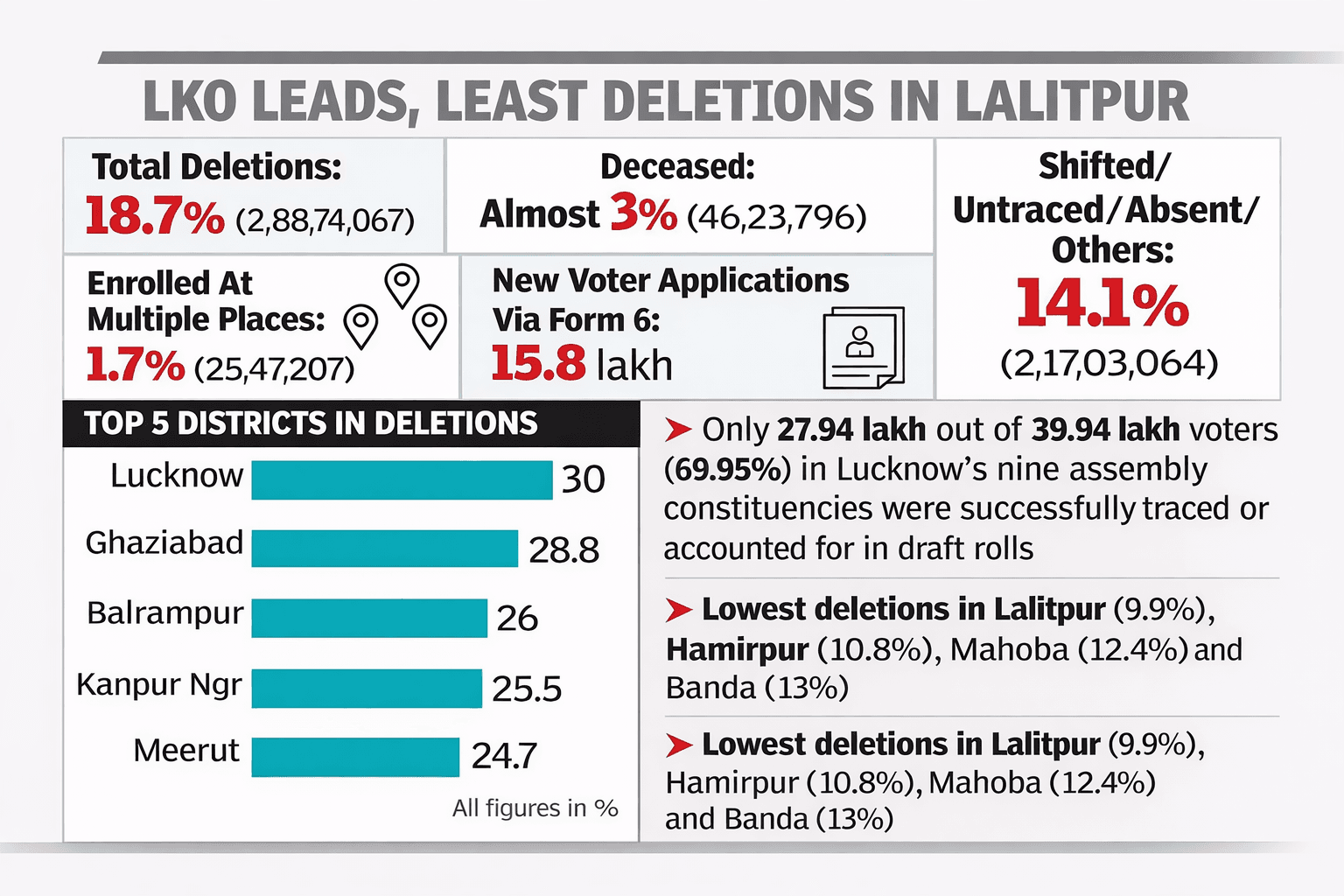
On January 6–7, 2026, the Election Commission of India released the draft voter list for Uttar Pradesh following the completion of the Special Intensive Revision (SIR) process. Out of approximately 15.44 crore registered voters, around 2.89 crore names — nearly 18.7 % of the electorate — were struck off the rolls.The Times of India
These removed names now do not appear in the draft voter list, which will later be finalized ahead of upcoming elections.
Breakdown of the Deleted Names
According to official ECI and media data, the exclusions occurred due to:
- Deceased voters: around 46 lakh names were removed because individuals were confirmed dead.www.ndtv.com
- Migration or absence: nearly 2.17 crore voters were marked as permanently moved, untraceable, or absent during verification.www.ndtv.com
- Duplicate registrations: about 25.5 lakh entries were identified as duplicates across different locations.Rediff
Also read – USA-Venezuela Crisis Explained with Timeline
Understanding the Special Intensive Revision (SIR)
The massive deletions occurred as part of a Special Intensive Revision (SIR) of the electoral roll — an exercise mandated by the ECI to ensure voter lists are accurate, up-to-date, and free from errors such as duplicate records or outdated entries.Wikipedia
What Is SIR?
- The Special Intensive Revision is a systematic update of electoral rolls.
- Booth-Level Officers (BLOs) conduct door-to-door enumeration, collecting signed forms from electors.
- This process verifies whether a registered voter:
- Still resides at the same address;
- Is alive and eligible;
- Has only one valid registration.
- SIR is legally backed by Article 324 of the Constitution of India and provisions in the Representation of the People Act, 1951 empowering ECI to revise electoral records.Wikipedia
Why This SIR Was So Significant
While electoral roll revisions happen periodically, the 2025–26 SIR is unusually consequential because:
- It covers a massive electorate (over 15 crore voters in UP alone).
- It uses door-to-door verification rather than just administrative updates.
- It aims to reduce duplicates and errors ahead of multiple upcoming elections nationwide.Wikipedia
This is one reason why the draft list’s publication and the large number of deletions have drawn intense public and political attention.
Why So Many Names Were Removed
The deletions stem from several factors identified during SIR:
1. Failure to Submit Verification Forms
During the enumeration phase, voters were required to sign and return enumeration forms via BLOs by December 26, 2025. Those who didn’t submit forms — even if still valid voters — saw their names excluded in the draft list.Rediff
2. Migration and Absence
Many voters were marked as “permanently shifted,” “untraceable,” or “absent” because they were not found at their registered addresses during the verification drive.Scroll.in
3. Duplicate Registrations
Where individuals were found registered at more than one location, only one registration will be retained once the draft list is finalized.www.ndtv.com
4. Death of Electors
Confirmations of deaths — via official records or witness interviews — resulted in those names being removed.Facebook
The ECI’s Position on the Roll Revision
The Election Commission of India defends the SIR process as a fundamental quality check to preserve electoral integrity. ECI officials have consistently stated that:
- No eligible voter will be permanently disenfranchised without an opportunity to rectify their status.The Times of India
- The deletions reflect rigorous verification standards — not political biases.Rediff
- A claims and objections window is open to help reinstatement of missing electors.The Times of India
The ECI emphasizes the draft is not final, and inclusion, correction, and objection periods will ensure fairness.
Claims and Objections Period: What Voters Must Know
Perhaps the most crucial aspect for excluded voters is that the ECI has opened a window for claims and objections.
Key Details:
- Deadline: Voters left out of the draft list have until February 6, 2026 to file objections or inclusion requests.The Times of India
- Final Roll Publication: After processing claims and objections — and completing verification — the final electoral roll will be published by March 6, 2026.The Times of India
How to File a Claim
Affected voters or their proxies can:
- Submit Form-6 (inclusion form) along with supporting proof of identity and residence.
- File objections through local Electoral Registration Officers (EROs) or booth offices.
- Follow ECI guidelines available on the official portal voters.eci.gov.in or UP CEO’s website.Rediff
What Happens Next
- EROs will review all claims, objections, and evidence submitted.
- Validation may include physical verification and identity checks.
- Valid claims result in re-entry into the final voter list.
- Duplicate registrations will be consolidated into one location.
Political and Civic Implications
The removal of nearly 3 crore names has not only administrative but significant democratic implications, prompting reactions from political parties, civil groups, and citizens.
Opposition Reactions and Allegations
Some political leaders and parties have called the SIR exercise:
- “Hasty” and incomplete, given the tight timelines in a large state like UP.Rediff
- A possible disenfranchisement risk if genuine voters are left out.
- A point of concern in broader debates on electoral fairness and inclusion.
These political disagreements underline the sensitivity of electoral roll revisions in a vibrant democracy like India.
ECI’s Response to Criticism
The ECI has stressed:
- Transparency and fairness in the SIR process.
- Multiple verification layers to ensure errors are corrected before the final list.
- Engagement with political representatives and local election teams to avoid exclusion of genuine electors.Rediff
Why This Matters: The Importance of Accurate Voter Rolls
Clean and accurate electoral rolls are the foundation of free and fair elections. They ensure:
- Every eligible citizen gets one vote — and only one vote.
- No dead or duplicate voters clog the system.
- Election outcomes truly reflect the will of the electorate.
However, if large numbers of eligible citizens are accidentally or unfairly omitted, it can undermine the legitimacy of electoral outcomes and weaken democratic participation.
This makes the current situation in Uttar Pradesh — with nearly 3 crore names dropped — a matter of intense civic and national interest.
What You Should Do If Your Name Was Removed
Here’s a practical checklist for anyone affected:
- Check your status online
Visit the ECI portal or UP CEO website to see if your name appears in the draft list.The Economic Times - Submit a claim or objection before Feb 6
Use Form-6 with valid ID and address proofs. - Reach out to your BLO or ERO
Local officers are working on claims and can guide you through corrections. - Follow updates on final roll publication
The final list will be issued around March 6, 2026.The Times of India - Seek legal advice if needed
If there are unresolved disputes, citizens can pursue legal remedies, though the ECI process encourages administrative resolution first.
Conclusion: A Critical Moment for Democracy in UP
The Election Commission’s move to strike off nearly 3 crore voters from the Uttar Pradesh draft electoral rolls is a major development with far-reaching consequences. While the primary objective of SIR is to update and correct voter lists, the scale of exclusions has prompted debate, raised concerns, and sparked political responses.
Importantly, the claims and objections window ensures that no eligible citizen is left out without due opportunity to be heard. As the final electoral roll process unfolds, millions of UP citizens are now engaged in ensuring their democratic right remains intact.
For now, the message from the ECI to voters is clear: check your status, file your claim before February 6, and stay informed — your vote matters.