







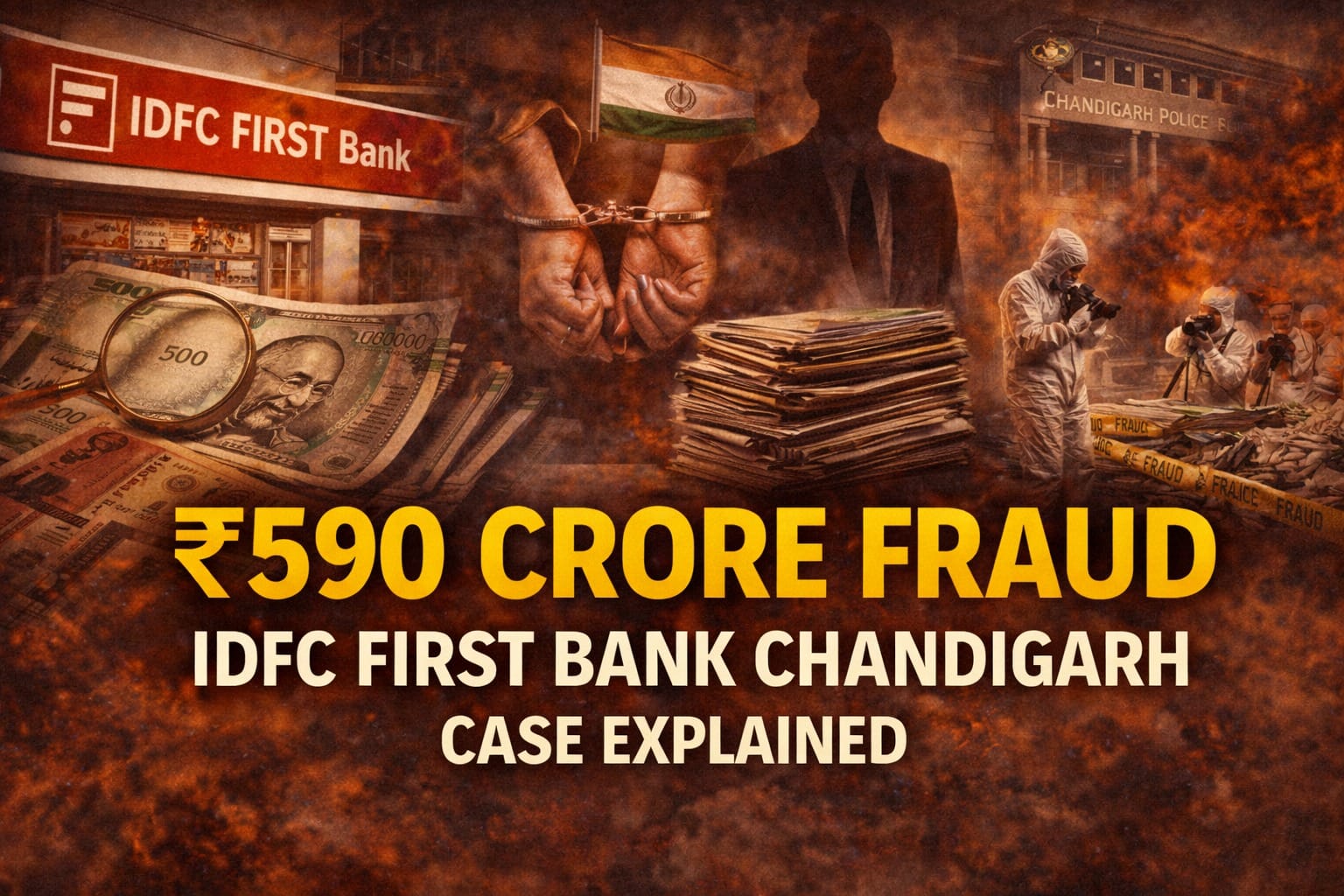
The IDFC First Bank fraud case that emerged in early 2026 has become one of the most talked-about banking scandals in India. What initially appeared to be a routine reconciliation issue at a single branch soon exposed a large-scale financial fraud worth around ₹590 crore, involving bank employees, private entities, and government-linked accounts.
The scandal not only shook the financial markets but also triggered investigations by law-enforcement agencies, arrests of key suspects, and regulatory scrutiny. Eventually, the bank paid ₹645 crore to settle claims related to the fraud, marking a major development in the case.
This article explains how the IDFC scam started, who was involved, how the money was siphoned off, the timeline of events, and the latest updates.
What Is the IDFC First Bank Scam?
The IDFC First Bank scam refers to a fraud uncovered at the bank’s Chandigarh branch involving accounts linked to several Haryana government departments.
According to the bank’s disclosures and investigative reports, unauthorised transactions amounting to roughly ₹590 crore were carried out by certain bank employees in collusion with external individuals.
The fraud remained undetected for months before discrepancies surfaced during routine financial checks.
The discovery sent shockwaves through the banking sector because it involved:
- government department accounts
- large-scale unauthorised fund transfers
- suspected collusion between insiders and outsiders
How the Scam Was Discovered
The fraud came to light when a Haryana government department requested the closure of its bank account and transfer of funds.
During this process, officials noticed that the amount available in the account did not match the expected balance.
Further reconciliation revealed a massive gap between recorded deposits and actual funds available.
What initially appeared to be accounting discrepancies soon revealed a deeper issue — unauthorised debit transactions carried out over several months.
This discovery triggered an internal investigation by IDFC First Bank, followed by a police complaint and regulatory reporting.
Also read – Proven Smart Investor Strategy When Stock Market Crashes
How the Fraud Was Executed
Investigators believe the fraud involved a combination of manual cheque transactions, manipulation of records, and unauthorized fund transfers.
The suspected modus operandi included:
1. Manipulating Government Accounts
The accused allegedly targeted accounts belonging to government departments maintained at the bank.
2. Using Manual Cheque Transactions
Fraudulent debits were made using manual cheque entries, bypassing automated safeguards.
3. Routing Money Through Private Firms
Funds were transferred to accounts linked to private entities controlled by the accused.
4. Layering Transactions
Money was reportedly moved through multiple accounts to make the trail harder to detect.
5. Diverting Funds to Businesses
Investigators found that part of the siphoned money was routed to jewellery shops and other businesses, indicating possible money laundering.
Key Accused in the IDFC Fraud Case
The Haryana Anti-Corruption Bureau arrested four key individuals believed to be central to the scam.
The accused include:
1. Ribhav Rishi
A former branch head of IDFC First Bank, identified as the alleged mastermind.
2. Abhay Kumar
A former relationship manager at the bank, suspected of assisting in the fraudulent transactions.
3. Swati Singla
A private businesswoman associated with a firm used to route funds.
4. Abhishek Singla
Swati Singla’s brother and partner in the company allegedly involved in the money trail.
Authorities believe their firm Swastik Desh Project was used to channel a significant portion of the funds.
Money Trail: Where Did the ₹590 Crore Go?
Investigators uncovered a complex money trail that showed funds moving across multiple accounts and businesses.
Key findings included:
- hundreds of crores routed through private firms
- funds transferred to jewellery businesses
- large sums moved between banks without proper documentation
- suspicious financial transactions between related entities
One example cited by investigators involved ₹46.56 crore transferred between banks without complete paperwork, raising red flags.
Timeline of the IDFC First Bank Scam
Phase 1: Fraud Begins (2024–2025)
Investigators believe the fraudulent transactions began months before detection.
Bank employees allegedly exploited manual processes and weak controls to siphon funds gradually.
Phase 2: Discrepancies Noticed (Early 2026)
A government department requested account closure and transfer of funds.
During reconciliation, officials noticed the balance did not match expected deposits.
Phase 3: Bank Disclosure (February 2026)
On February 22, 2026, IDFC First Bank officially disclosed the suspected fraud of around ₹590 crore at its Chandigarh branch.
The bank also:
- informed regulators
- filed police complaints
- suspended four employees
Phase 4: Market Reaction
The announcement had an immediate impact on the stock market.
IDFC First Bank shares fell nearly 20%, triggering panic among investors.
The case also raised concerns about internal controls in private banks.
Phase 5: Arrests and Investigation
The Haryana Anti-Corruption Bureau launched a major investigation.
Authorities arrested the four accused and began tracking the flow of funds across banks and businesses.
A forensic audit by KPMG was also initiated to examine the transactions.
Phase 6: Government Action
The Haryana government took several steps after the scandal.
These included:
- closing government accounts with private banks
- moving funds to nationalised banks
- introducing stricter approvals for opening accounts
Some departments reportedly moved hundreds of crores out of private banks as a precaution.
Phase 7: Claims Settlement (March 2026)
In the latest development, IDFC First Bank confirmed it has paid ₹645 crore to settle claims linked to the fraud.
The amount exceeded the earlier estimate of ₹590 crore because additional claims were verified during reconciliation.
The bank stated that:
- all claims have been settled
- no further discrepancies were found
- customer deposits remain stable
Impact on IDFC First Bank
Although the fraud was confined to a single branch, the reputational impact was significant.
Key consequences included:
Market Reaction
The bank’s stock price dropped sharply after the disclosure.
Investor Confidence
Investors demanded stronger internal controls and transparency.
Regulatory Scrutiny
Banking regulators began examining compliance systems.
Operational Changes
The bank is introducing stronger verification systems for large transactions.
Regulatory and Legal Action
Multiple agencies are now involved in the investigation.
These include:
- Haryana Anti-Corruption Bureau
- local police
- banking regulators
- forensic auditors
The accused face charges under:
- the Prevention of Corruption Act
- Indian Penal Code provisions for fraud
- banking and financial regulations
Authorities are also investigating whether other bank employees or government officials were involved.
Lessons From the Scam
The IDFC fraud case highlights several critical weaknesses in financial systems.
Insider Risk
Fraud involving employees can bypass many controls.
Weak Manual Processes
Manual cheque transactions created vulnerabilities.
Monitoring Failures
Large discrepancies remained undetected for months.
Government Account Oversight
Public funds held in private banks require stronger monitoring.
Could More Banking Frauds Be Hidden?
Experts say the case underscores the importance of stronger fraud detection systems in Indian banks.
Modern banking relies heavily on automated monitoring systems that flag unusual transactions.
However, fraud involving insider manipulation can still slip through.
This is why regulators are pushing for:
- stricter transaction verification
- stronger audit systems
- real-time fraud monitoring
What Happens Next?
Even though the bank has settled claims, the legal investigation is far from over.
Authorities are still working to:
- trace the full money trail
- recover remaining funds
- determine the involvement of other individuals
The final outcome of the case could set an important precedent for how banking fraud cases are handled in India.
Conclusion
The IDFC First Bank Chandigarh fraud case is a reminder of how financial crimes can unfold even within regulated institutions.
What started as a discrepancy in government accounts eventually exposed a ₹590 crore fraud involving insiders, private firms, and complex financial transactions.
The case has already led to arrests, regulatory action, and a massive ₹645 crore settlement by the bank.
But the broader investigation continues.
As authorities unravel the full scope of the scam, the lessons learned from this case could reshape fraud detection and financial oversight across India’s banking sector.
Subscribe to out YouTube Channel The Logic Stick for more video insights