







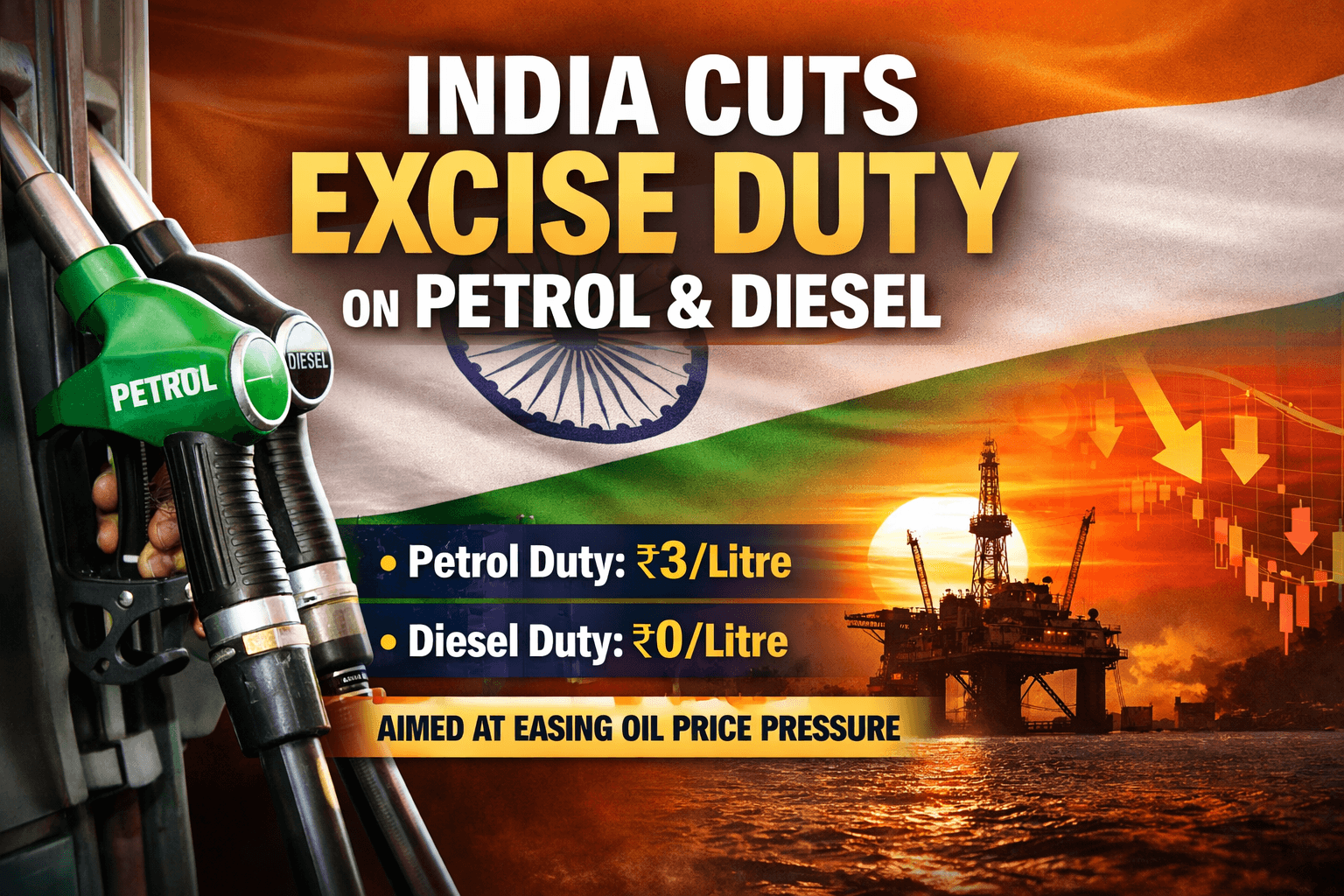
India Cuts Excise Duty on Petrol and Diesel to Stabilize Fuel Market and Ease Pressure on Oil Companies
India has taken a significant step to manage rising fuel costs by cutting excise duty on petrol and diesel, a move aimed at cushioning the impact of soaring global crude oil prices. The decision comes at a time when geopolitical tensions, particularly in West Asia, have disrupted global energy markets and pushed oil prices upward.
The government’s move is being viewed as a strategic economic intervention to balance domestic fuel stability, support oil marketing companies (OMCs), and prevent inflationary shocks in the Indian economy.
What Has the Government Announced?
According to multiple verified reports, including Reuters and leading Indian media outlets:
- The excise duty on petrol has been reduced from ₹13 per litre to ₹3 per litre
- The excise duty on diesel has been reduced from ₹10 per litre to ₹0
- The revised rates have come into immediate effect
This effectively translates into a reduction of up to ₹10 per litre, marking one of the most significant duty cuts in recent times.
It is important to note that while media reports reference specific duty components, official classification of the tax should be interpreted cautiously unless directly cited from government notifications. Therefore, the broader and accurate framing is that India has reduced excise duties on petrol and diesel.
Why Did India Cut Excise Duty Now?
1. Surge in Global Crude Oil Prices
The primary trigger behind this decision is the sharp increase in global crude oil prices, which have risen significantly due to ongoing geopolitical tensions.
Key contributing factors include:
- Escalating conflict in West Asia
- Disruptions in oil supply chains
- Increased uncertainty around major shipping routes
One of the most critical concerns is the Strait of Hormuz, a key global oil transit route. Any disruption in this region can have immediate consequences for oil-importing countries like India.
Read more on Iran Israel here.
2. Protecting the Domestic Economy from Inflation
Fuel prices have a cascading impact across the economy. A rise in petrol and diesel prices affects:
- Transportation and logistics
- Food prices
- Manufacturing costs
- Overall inflation
By cutting excise duties, the government aims to:
- Prevent a sharp spike in inflation
- Stabilize prices of essential commodities
- Maintain economic balance
This move is particularly important given the sensitivity of fuel prices in India’s inflation structure.
3. Supporting Oil Marketing Companies (OMCs)
India’s major oil marketing companies—such as Indian Oil, Bharat Petroleum, and Hindustan Petroleum—have been under financial strain.
With rising crude oil prices, these companies have often:
- Absorbed losses instead of increasing retail prices
- Maintained price stability despite global volatility
The excise duty cut helps:
- Offset part of their financial burden
- Improve cash flow
- Ensure uninterrupted fuel supply
Will Petrol and Diesel Prices Fall Immediately?
Despite the duty cut, consumers may not see an immediate reduction in fuel prices.
This is because:
- Oil companies are currently absorbing higher crude costs
- The tax relief is being used to compensate for these losses
- Global oil prices remain volatile
As a result, the benefit of the duty cut is currently being absorbed within the system, rather than directly passed on to consumers.
However, this still plays a crucial role in preventing further price increases.
Additional Measures: Export Duties Introduced
Alongside the excise duty cut, the government has also introduced export duties on certain petroleum products.
Reports indicate:
- Export duty on diesel has been increased
- Export duty on aviation turbine fuel (ATF) has also been imposed
The purpose of these measures is to:
- Ensure sufficient domestic fuel supply
- Discourage excessive exports during a crisis
- Maintain internal price stability
This dual approach—cutting domestic duties while taxing exports—helps balance both supply and revenue concerns.
Economic Impact of the Decision
1. Impact on Government Revenue
Reducing excise duties leads to a decline in government revenue.
Economists estimate that:
- The fiscal impact could be significant
- It may affect budget calculations and deficit targets
However, this cost is being viewed as necessary to protect the broader economy from inflationary shocks.
2. Inflation Control
The move is expected to:
- Reduce inflationary pressure
- Stabilize prices across sectors
- Prevent a ripple effect on essential goods
Fuel costs are a major driver of inflation in India, and this decision helps control that risk.
3. Market Reaction
Following the announcement:
- Financial markets showed cautious reaction
- Bond yields moved slightly upward
- Investors expressed concern over fiscal implications
This reflects the classic trade-off between economic relief and fiscal discipline.
Geopolitical Context: Why This Move Matters Now
India’s decision must be understood in the context of global developments.
West Asia Tensions
The ongoing instability in West Asia has:
- Disrupted oil supply chains
- Increased uncertainty in global markets
- Pushed crude prices higher
Global Supply Chain Disruptions
Additional challenges include:
- Higher shipping costs
- Delays in oil transportation
- Reduced availability of crude
These factors have collectively contributed to volatility in global oil markets.
India’s Energy Dependency: A Structural Challenge
India is one of the world’s largest oil consumers and relies heavily on imports.
This makes the country vulnerable to:
- Global price fluctuations
- Geopolitical tensions
- Supply disruptions
The current situation highlights the need for:
- Diversification of energy sources
- Increased investment in renewable energy
- Strengthening strategic oil reserves
Political Context: A Possible Factor
While the decision is primarily economic, analysts suggest that:
- Fuel prices are politically sensitive
- Governments often act to maintain price stability
- Timing may align with broader public sentiment
However, it is important to note that there is no official confirmation linking this move directly to political motives.
What Does This Mean for Common Citizens?
Short-Term Impact
- No immediate drop in fuel prices
- Reduced risk of sudden price hikes
- Continued availability of fuel
Medium-Term Impact
- Stabilized fuel pricing
- Controlled inflation
- Improved economic predictability
Long-Term Impact
- Possible adjustments in taxation policies
- Continued government intervention if needed
Expert Analysis: A Balanced but Costly Move
Economists describe the decision as a necessary but costly intervention.
Advantages
- Protects consumers
- Supports oil companies
- Controls inflation
Challenges
- Reduces government revenue
- May not offer immediate relief to consumers
- Highlights dependence on global oil markets
Overall, the move is seen as a pragmatic response to a global crisis.
What Happens Next?
The future impact of this decision will depend on:
1. Global Oil Price Trends
- Stabilization could lead to consumer price relief
- Further increase may require additional intervention
2. Geopolitical Developments
- Resolution of tensions could ease supply concerns
- Continued instability may prolong high prices
3. Domestic Policy Decisions
- Further tax adjustments
- Possible subsidies
- Continued monitoring of inflation
Conclusion: A Strategic Move in Uncertain Times
India’s decision to cut excise duty on petrol and diesel reflects a calculated effort to navigate a complex global energy landscape.
While the move may not immediately lower fuel prices, it plays a critical role in:
- Preventing economic shock
- Supporting key industries
- Maintaining supply stability
At the same time, it underscores a larger challenge—India’s dependence on imported oil and vulnerability to global disruptions.
In the current scenario, this policy decision is not just about fuel prices—it is about economic resilience and strategic stability.