






India-EU Free Trade Agreement Explained
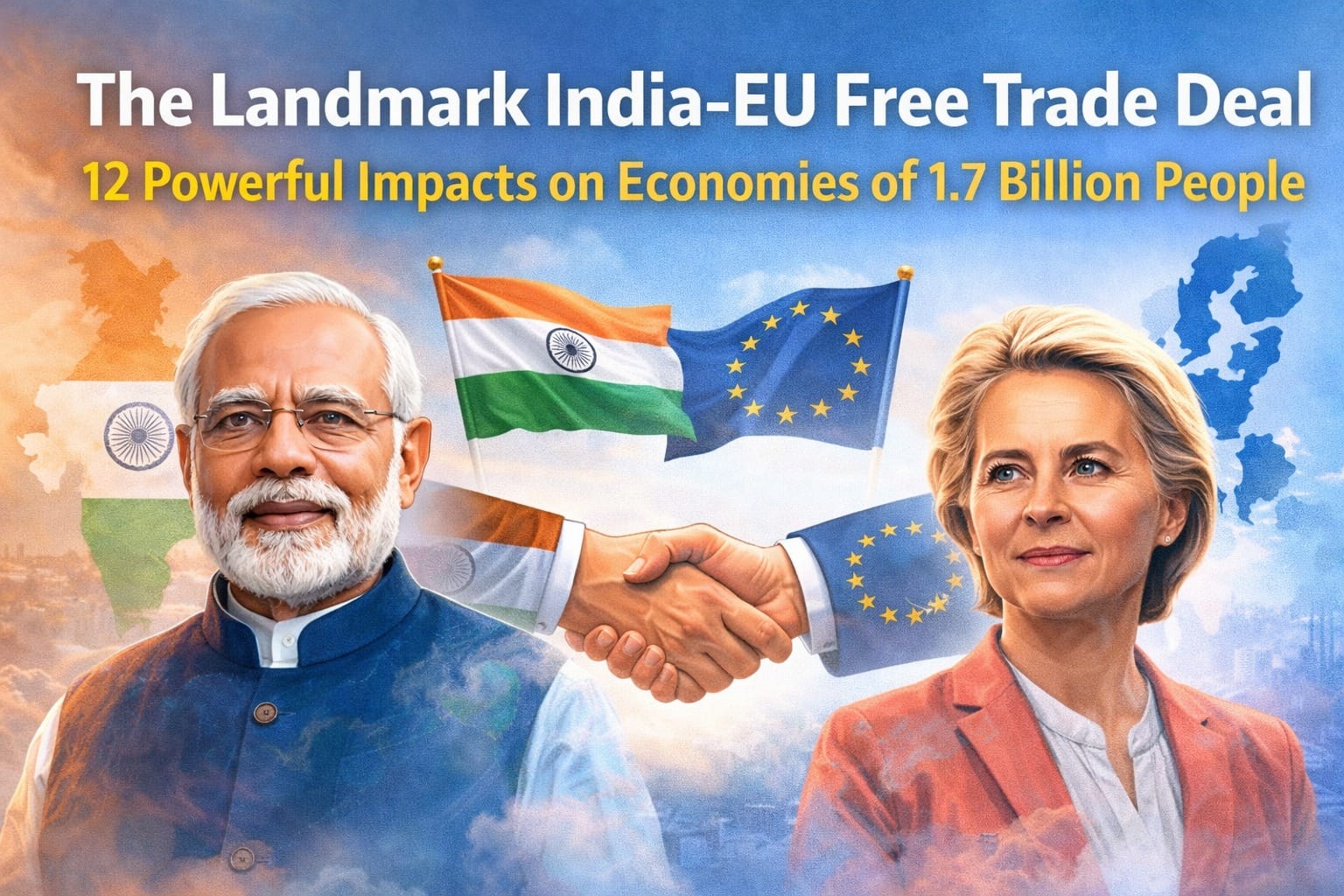
On 27 January 2026, India and the European Union (EU) finalized a historic Free Trade Agreement (FTA) after nearly 20 years of negotiations — a pact many officials and analysts have already hailed as the “mother of all trade deals.”
This extensive commercial pact is expected to reshape global trade dynamics, deepen bilateral economic ties, expand market access, reduce tariffs on a vast range of products, and generate growth momentum for both sides. It also comes amid a shifting geopolitical environment — including rising U.S. tariffs under the Trump administration — prompting global powers to diversify their trade partnerships.
In this article, we break down the full story of the India–EU FTA — its significance, key provisions, expected impacts on India’s economy and stock markets, implications for the U.S. and global trade, and longer-term outcomes that matter for businesses and consumers.
1. What Is the India–EU Free Trade Agreement?
A Free Trade Agreement (FTA) is a negotiated pact between countries or regions designed to reduce barriers to trade such as tariffs, quotas, and restrictions, thus promoting cross-border economic activity.
The India–EU FTA — concluded in January 2026 — aims to significantly liberalize trade between India and the 27 member states of the European Union. The pact encompasses goods, services, investment, and trade facilitation measures, and is expected to:
✔ Eliminate or reduce tariffs on the vast majority of traded goods
Under the agreement:
- Over 96% of goods by value will either become tariff-free or see drastically cut duties over time.
- European tariffs on Indian exports to EU markets will be reduced.
- Indian tariffs on EU products such as automobiles, machinery, pharmaceuticals, spirits and other consumer goods will decline.
✔ Enhance market access for services and professionals
Though the core focus remains on goods, the FTA also seeks to deepen cooperation in services trade, including financial, maritime and other professional services — central to India’s export strengths.
✔ Foster long-term economic cooperation and regulatory alignment
The deal includes provisions to streamline trade rules, reduce non-tariff barriers, and build a more predictable investment environment.
Because this negotiation spanned almost two decades, its conclusion is seen as a major geopolitical and economic achievement.
2. Why This Deal Is Historic (and Why It Matters)
i. Scale of Trade and Strategic Importance
The India–EU free trade pact is among the largest trade agreements globally when measured by combined GDP, population, and trade volume.
- The combined economic output of India and the EU accounts for nearly one-quarter of global GDP.
- Together they create a free trade zone of about 2 billion consumers — one of the world’s largest consumer markets.
- The EU is already India’s largest trading partner, with trade in goods worth over €120 billion in 2024 and growing rapidly.
ii. Long-Pending Negotiations Realized
Negotiations on this FTA began over 20 years ago, making its finalization in 2026 particularly significant for bilateral economic diplomacy and confidence building.
iii. Response to Global Trade Shifts
In recent years:
- U.S. tariff policies under the Trump administration have raised barriers on Indian exports.
- China’s dominance in global supply chains has prompted economic powers to diversify partnerships.
This FTA signals a pragmatic effort by both India and the EU to reduce reliance on single markets like the U.S. and China — strengthening their bargaining power and economic resilience.
3. Key Provisions of the Agreement
While details are still being finalized and will be fully revealed upon formal ratification, major elements of the agreement include:
a. Tariff Reductions
Tariffs on goods traded between India and the EU will be progressively reduced or eliminated, covering around 96% of trade by value. Both sides have agreed to protect some sensitive products, but most duties will decline over time.
b. Automotive Sector
One of the most closely watched elements is the reduction of tariffs on EU-made cars entering India:
- Currently, duties on imported European autos can be as high as 110%.
- Under the pact, they will be lowered to around 10% for up to 250,000 vehicles annually, making imports cheaper and more competitive in India.
c. Machinery, Chemicals and Pharmaceuticals
Tariffs on critical industrial products such as machinery, chemicals and pharmaceuticals — previously as high as 44%, 22% and 11% respectively — are expected to be significantly cut.
d. Consumer Goods
European wines, spirits, chocolates, olive oil and other processed foods are expected to become more affordable in India due to lower tariffs, expanding consumer choices.
e. Services and Regulatory Cooperation
While goods are the main focus, the deal also includes measures to facilitate trade in services — a key Indian strength — and improve mutual regulatory cooperation.
f. Sustainability and Climate Support
The agreement includes climate funding support to assist India’s transition to low-carbon growth, further aligning economic cooperation with global climate goals.
Also read – Everything You Need To Know About the BRICS Currency “UNIT” and its impact on Dollar
4. How the FTA Helps the Indian Economy
A. Boost to Exports and Trade Balance
The FTA is expected to:
- Increase Indian exports by reducing EU tariffs on Indian goods.
- Expand access for Indian products in engineering, pharmaceuticals, textiles, chemicals and marine products — sectors where India has competitive advantage.
Experts estimate that exports of Indian goods to the EU could grow by tens of billions of dollars over the next decade, offsetting trade losses from other regions.
B. Market Diversification
By strengthening ties with the EU, India diversifies its export markets beyond traditional partners like the U.S. and Middle East, making its economy more resilient to regional shocks.
C. Consumer Benefits
Indian consumers can expect a broader range of European products at lower prices — from automobiles to food products — due to reduced tariffs.
D. Investment and Technology Transfer
Improved market access and regulatory alignment may attract more EU investment into India, particularly in technology, manufacturing, and services — fostering innovation and skills development.
E. Strengthening Services Exports
India’s services, especially IT, financial and professional services, may find deeper access to European markets under the new pact.
5. Impact on the Indian Stock Market
While major structural impacts will unfold over years, analysts believe long-term sentiment could improve as investors anticipate higher export growth and deeper EU engagement.
Market Reaction
Initial responses have been cautiously optimistic rather than euphoric, with markets focusing on the “devil in the details” — such as timelines for tariff cuts, rules of origin and the treatment of sensitive sectors.
Sector Winners
Potential beneficiaries include:
- Textiles and apparel
- Pharmaceuticals
- Engineering goods
- Chemicals
- IT and business services
Experts believe over time, these sectors could outperform if export access and regulatory clarity improve under the FTA.
Also read – Why the United Nations Is Losing Power in 2026
6. India’s Other Free Trade Agreements
The India–EU FTA is part of a broader strategy by New Delhi to expand trade ties globally. India is simultaneously pursuing or implementing a range of other trade pacts:
i. India–United Kingdom Free Trade Agreement
Signed in July 2025, this deal lowered tariffs and boosted bilateral trade and investment between India and the UK, especially in goods and services.
ii. India–EFTA Trade and Economic Partnership Agreement
India has an FTA with the European Free Trade Association (EFTA), covering Norway, Switzerland, Iceland and Liechtenstein. This deal eliminates or sharply reduces tariffs for most goods, enhancing industrial and specialty product trade.
iii. Other Negotiations and Future FTAs
India is actively negotiating or seeking FTAs with multiple regions and countries, covering 51 nations in 12 trade talks — reflecting an aggressive shift toward global trade integration.
7. Global Implications: Impact on the USA and World Trade
The India–EU FTA comes at a time of heightened tariff tensions, especially between India, the U.S. and Europe due to recent protectionist trade measures.
A. A Strategic Counterweight to U.S. Tariffs
Under the Trump administration, the U.S. imposed or threatened higher tariffs on key Indian exports. The EU–India FTA may help India mitigate these pressures by strengthening ties with a major trading bloc, potentially reducing the relative impact of U.S. trade restrictions.
B. Shifting Global Alliances
By deepening economic integration with the EU, India reinforces its role as a leading global trading partner outside the heavy influence of U.S.–China dynamics. This shift may encourage other countries to pursue diversified trade portfolios and reduce reliance on single markets.
8. Challenges and Areas to Watch
Despite its potential benefits, the FTA has challenges and areas that will require careful implementation:
Sensitive Sectors and Protection
Both sides have excluded certain highly sensitive sectors — such as dairy and small cars — from full liberalization to safeguard domestic industries.
Rules of Origin and Compliance
Strict rules determining where goods are produced and how they qualify for tariff concessions will be vital for businesses to benefit fully from the agreement.
Transition Periods
Tariff reductions will not be immediate but phased over several years, meaning competitive dynamics will shift slowly and require strategic planning by businesses.
Implementation and Dispute Resolution
Effective implementation mechanisms will be critical to ensure that trade flows are smooth and disputes are managed efficiently.
9. What This Means for Businesses and Consumers
Consumers
- Cheaper European products like wine, food, chocolates and cars.
- More consumer choice and competitive pricing due to tariff cuts.
Exporters
- Expanded access to Europe’s 450+ million wealthy consumers.
- Stronger presence for Indian textiles, pharmaceuticals, chemicals and machinery.
Investors
- Potential for increased foreign investment and technology transfers.
- Long-term market confidence and global integration.
Also Watch
10. Conclusion: A New Era in Global Trade
The India–EU Free Trade Agreement marks a transformative milestone in India’s economic journey — integrating its 1.4 billion consumers with Europe’s vast economic space. Described as the “mother of all deals,” this agreement reflects decades of negotiation, strategic foresight, and a shared vision of deeper economic partnership.
For India, it promises stronger export growth, increased competitiveness, enhanced services access and an expanded role on the global stage. For Europe, it offers a gateway to a large, dynamic market hungry for high-value products and services. Internationally, this deal signals a shift toward multipolar trade integration, where countries build diversified partnerships in response to evolving global economic realities.
As ratification and implementation unfold, businesses, consumers, policymakers, and investors will watch closely — because the effects of this FTA will reverberate across industries, markets and nations for years to come.
Subscribe to our YouTube Channel The Logic Stick for more video insights