





Introduction
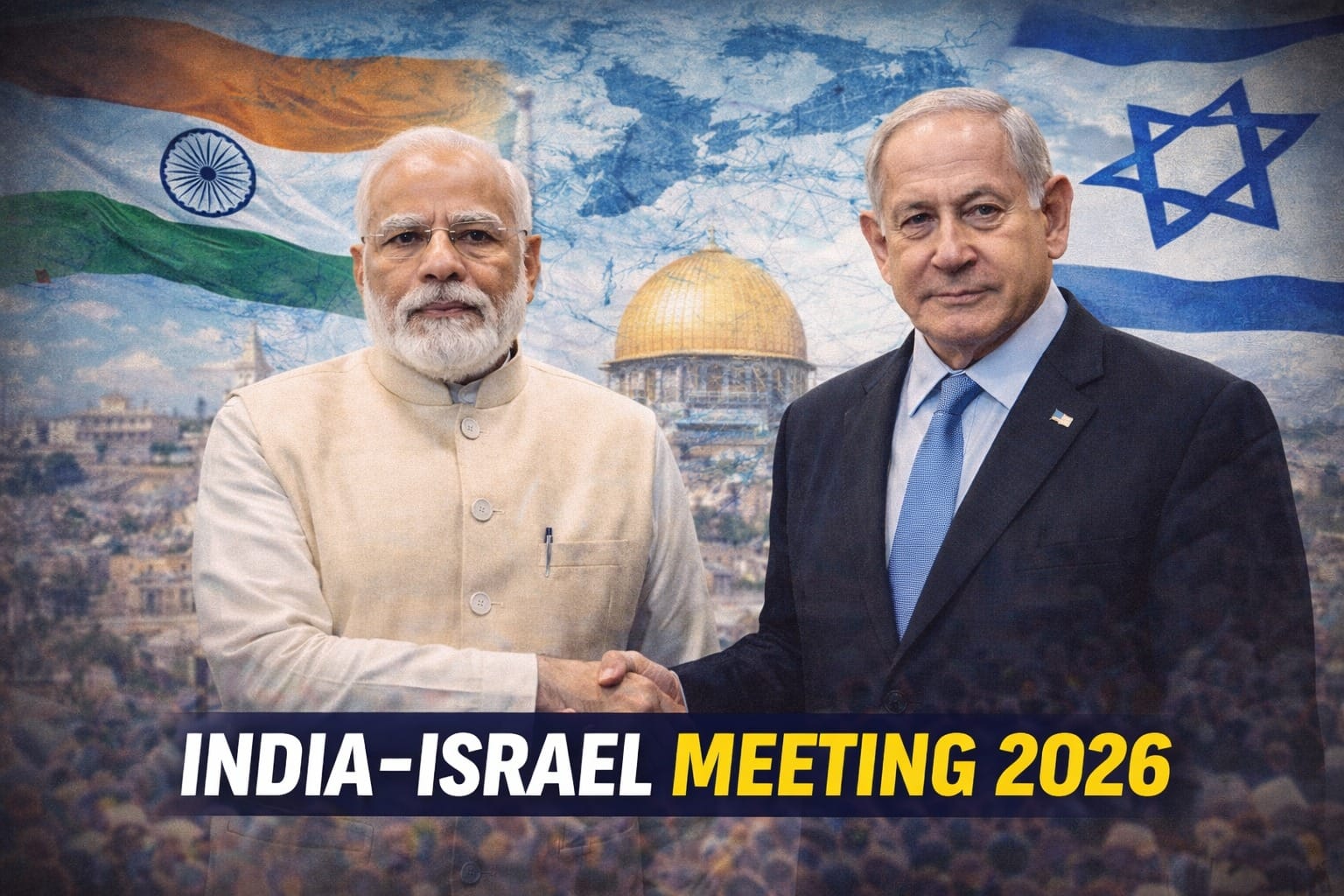
The India Israel meeting 2026 between Prime Minister Narendra Modi and Israeli Prime Minister Benjamin Netanyahu has emerged as one of the most strategically significant diplomatic engagements in recent months. Modi’s two-day state visit to Israel (February 25–26, 2026) reflects deepening ties in defense, technology, innovation, and regional security amid evolving geopolitical tensions in West Asia.
The visit builds upon the historic 2017 trip that elevated relations to a strategic partnership and highlights India’s growing role in Middle East diplomacy while balancing regional sensitivities.
This detailed article covers:
- Full agenda of the Modi–Netanyahu meeting
- Key agreements and defense deals
- Technology and economic cooperation
- Strategic and geopolitical discussions
- Role of the Hexagon alliance concept
- Security and terrorism dialogue
- Regional implications
Background: Evolution of India–Israel Relations
India established diplomatic relations with Israel in 1992, but ties expanded significantly after 2014 under Modi’s government, transforming cooperation from transactional to strategic.
Today, the partnership spans:
- Defense and security
- Agriculture and water technology
- Innovation and startups
- Cybersecurity and AI
- Trade and investment
Bilateral trade reached approximately $3.6 billion in 2025, highlighting economic momentum.
Overview of Modi’s 2026 Israel Visit
Modi’s visit included several high-profile engagements:
- Delegation-level talks with Netanyahu
- Meeting with Israeli President Isaac Herzog
- Address to the Knesset (Israeli Parliament)
- Interaction with Indian diaspora
- Strategic discussions on defense and technology cooperation
The trip aimed at strengthening security, economic, and technological cooperation between the two nations.
Agenda of the Modi–Netanyahu Meeting
1. Defense and security cooperation
Defense collaboration was the central pillar of discussions.
Talks included:
- Advanced missile defense systems
- Intelligence sharing
- Counter-terrorism cooperation
- Joint development of air defense technologies
India and Israel are reportedly exploring a technology transfer MoU involving Iron Dome, Iron Beam, and advanced missile systems, marking deeper defense collaboration focused on co-development rather than simple procurement.
2. Technology and innovation partnership
Another major agenda area was technological cooperation.
Key sectors discussed:
- Artificial intelligence
- Quantum technology
- Cybersecurity
- Space cooperation
- Start-up ecosystem collaboration
Both countries aim to combine Israel’s innovation capabilities with India’s scale and digital ecosystem.
3. Economic and trade cooperation
Economic engagement formed a crucial discussion point.
Topics included:
- Expanding bilateral trade
- Investment protection mechanisms
- Infrastructure collaboration
- Startup and innovation funding
- Supply chain partnerships
Israel views India as a major economic partner in Asia, and both countries seek to unlock new trade corridors.
4. Counter-terrorism dialogue
Terrorism remained a core strategic issue.
Modi reaffirmed India’s zero-tolerance stance on terrorism, emphasizing global cooperation against extremist threats.
Netanyahu echoed similar concerns, highlighting shared security challenges posed by radical networks.
5. Regional geopolitics and Middle East stability
The leaders discussed:
- Gaza conflict and ceasefire efforts
- Iran-related regional tensions
- Maritime security
- Strategic balance in West Asia
Modi supported diplomatic solutions and peace initiatives while emphasizing regional stability.
6. Hexagon of alliances discussion
Netanyahu also raised the concept of a Hexagon of Alliances, a multi-regional strategic framework linking Israel, India, Mediterranean partners, and potential Arab and African states.
The concept reflects Israel’s effort to build broader geopolitical partnerships around the Middle East.
Key Deals and Agreements
Defense technology transfer
The most significant expected deal involves technology transfer related to:
- Iron Dome air defense system
- Iron Beam laser defense technology
- Advanced missile systems
This represents a shift toward joint innovation rather than procurement-only defense ties.
Air defense collaboration
Discussions included potential collaboration between India’s Sudarshan Chakra air defense initiative and Israeli missile technologies.
Investment and trade agreements
Talks also focused on:
- Investment protection agreements
- Expansion of trade partnerships
- Startup and innovation cooperation
Technology MoUs
MoUs in emerging tech sectors such as AI and cybersecurity are expected to deepen innovation collaboration.
Strategic Outcomes of the Meeting
Strengthening India–Israel strategic partnership
The meeting reaffirmed commitment to expanding cooperation across defense, innovation, and economic sectors.
Boost to defense manufacturing
Technology transfer discussions could enhance India’s domestic defense manufacturing under the Make-in-India initiative.
Expansion of innovation ecosystem collaboration
India and Israel aim to jointly develop next-generation technologies.
Modi’s Address to the Knesset
Modi’s speech at the Israeli Parliament was a major highlight.
He emphasized:
- Friendship, respect, and partnership between the two nations
- India’s solidarity against terrorism
- Support for regional peace and stability
- Recognition of historical ties between Jewish and Indian communities
His address symbolized deepening diplomatic and cultural ties.
Netanyahu’s Perspective on India
Netanyahu described India as a major global power and strategic partner, highlighting the importance of India in Israel’s regional alliance framework.
He also stressed personal rapport between leaders as a driver of bilateral cooperation.
Role of Personal Diplomacy
The personal relationship between Modi and Netanyahu has been widely credited with accelerating bilateral ties, facilitating:
- Faster negotiations
- Strategic trust
- Political alignment
- Expanded cooperation
Geopolitical Implications of the Meeting
1. India’s growing Middle East role
India’s engagement reflects its emergence as a key diplomatic player in West Asia.
2. Shift toward multi-alignment diplomacy
India continues balancing ties with Israel, Arab states, and Iran.
3. Israel’s strategic diversification
Israel seeks partnerships beyond traditional Western allies.
4. Security architecture evolution
The meeting contributes to evolving regional security frameworks.
Pakistan’s Reaction and Regional Concerns
Reports indicate Pakistan views expanding India–Israel defense ties as potentially shifting regional security dynamics.
Concerns include:
- Strengthened India military capabilities
- Advanced missile defense collaboration
- Strategic alignment in West Asia
Analysts suggest these developments may influence South Asian security calculations.
Challenges and Limitations
Despite strong cooperation, challenges remain:
- Regional political sensitivities
- India’s balancing act with Arab nations
- Israel’s regional conflicts
- Geopolitical polarization risks
Future Areas of Cooperation
Looking ahead, both countries may expand cooperation in:
- Renewable energy
- Semiconductor manufacturing
- Space research
- Agriculture technology
- Water management
- Defense co-production
Conclusion
The 2026 Modi–Netanyahu meeting represents a major milestone in India–Israel relations, reflecting the transformation of bilateral ties into a comprehensive strategic partnership.
The discussions covered defense technology transfer, innovation collaboration, economic agreements, and regional geopolitics, positioning both nations as key partners in shaping emerging security and technological architectures.
While the visit reinforces shared commitments against terrorism and strengthens economic cooperation, it also highlights India’s growing diplomatic influence in West Asia and Israel’s strategy to diversify partnerships through frameworks such as the Hexagon of Alliances.
As global geopolitics move toward multi-regional alliances and strategic autonomy, the India–Israel partnership is likely to remain a cornerstone of technological, defense, and diplomatic collaboration in the coming decade.
SUBSCRIBE TO OUR YOUTUBE CHANNEL THE LOGIC STICK FOR MORE VIDEO INSIGHTS