




India officially conveyed condolences to Iran
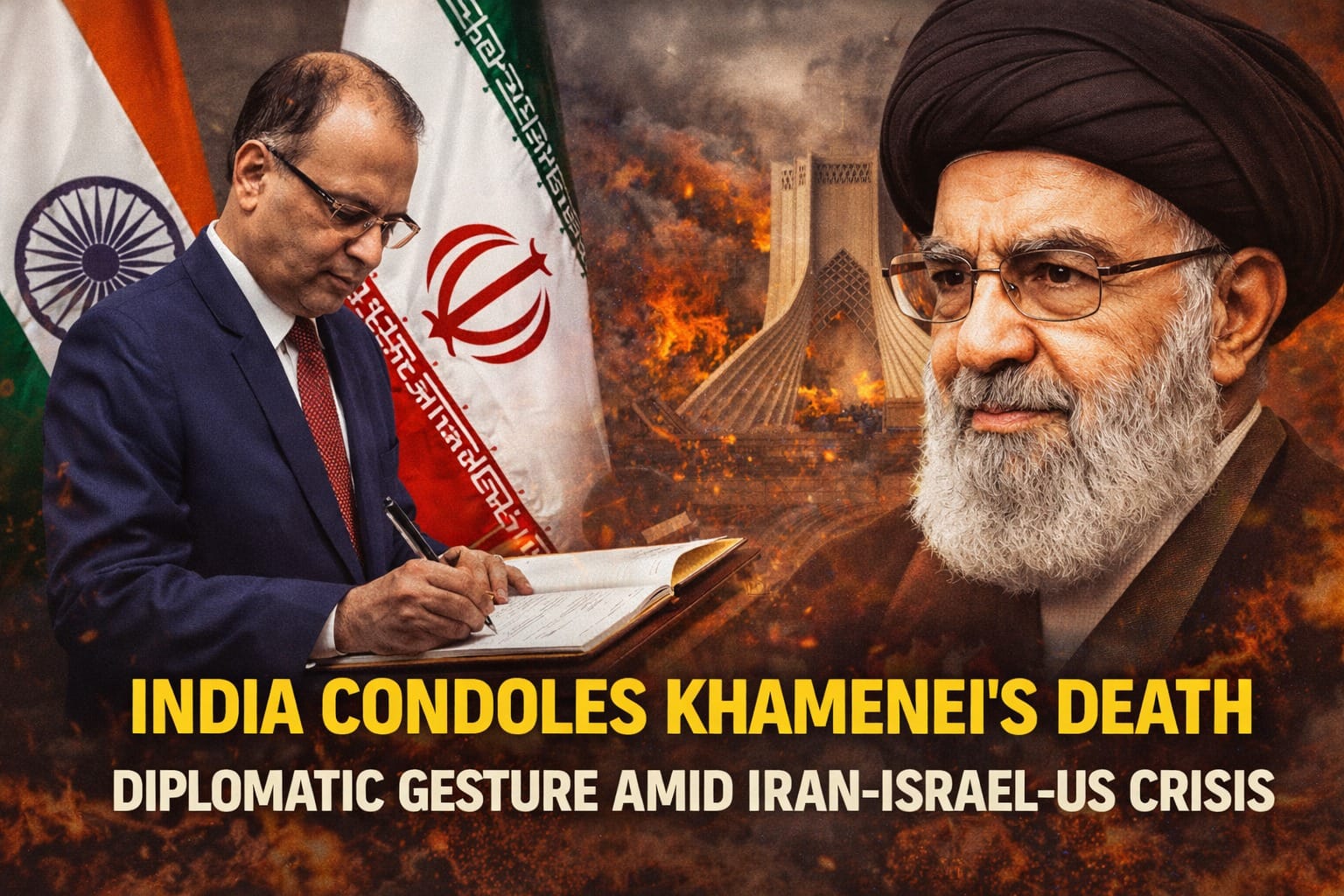
The death of Iran’s Supreme Leader Ayatollah Ali Khamenei during the escalating Israel–US–Iran conflict has triggered global political reactions, protests, and diplomatic gestures. Among the many countries responding to the development, India officially conveyed condolences to Iran, signalling a carefully calibrated diplomatic response amid a volatile geopolitical environment.
India’s reaction reflects a delicate balancing act. On one hand, New Delhi maintains long-standing strategic ties with Iran, particularly in areas such as energy cooperation, connectivity projects, and regional stability. On the other hand, India also has strong relations with the United States, Israel, and Gulf nations — all key players in the unfolding Middle East crisis.
This article explores how India officially condoled Khamenei’s death, the diplomatic significance of the move, reactions within India, and what this means for India–Iran relations in the future.
India Condoles Khamenei’s Death: Official Diplomatic Gesture
India formally expressed condolences following the death of Ayatollah Ali Khamenei, who ruled Iran for more than three decades and was one of the most influential figures in Middle Eastern geopolitics.
As part of the official gesture, India’s Foreign Secretary Vikram Misri visited the Iranian Embassy in New Delhi and signed the condolence book, extending sympathy on behalf of the Indian government.
The move came shortly after Khamenei’s death in a major US-Israel military strike in Tehran, which significantly escalated tensions across the Middle East.
India’s condolence message was seen as an important diplomatic signal. While several Western nations avoided offering condolences or openly criticised Khamenei’s legacy, New Delhi chose a more traditional diplomatic approach by acknowledging the passing of a head of state.
This gesture reaffirmed India’s policy of maintaining diplomatic engagement even during geopolitical crises.
External Affairs Ministry’s Response
India’s Ministry of External Affairs (MEA) has consistently urged restraint and dialogue following the Middle East escalation.
Prime Minister Narendra Modi and senior officials have emphasised the importance of peace and stability in West Asia, calling for de-escalation and diplomatic engagement among the parties involved in the conflict.
External Affairs Minister S. Jaishankar also held discussions with Iran’s foreign minister after the strike that killed Khamenei, reflecting India’s efforts to stay engaged with the region amid the growing crisis.
Such diplomatic communication highlights India’s broader foreign policy strategy of maintaining channels of dialogue with all major stakeholders in the region.
The Context: Khamenei’s Death and the Regional War
Ayatollah Ali Khamenei had served as Iran’s Supreme Leader since 1989, wielding enormous political and religious authority in the Islamic Republic. Over his decades in power, he shaped Iran’s foreign policy, its nuclear ambitions, and its confrontation with Western powers.
His death during the Israel-US airstrike marked a dramatic turning point in Middle Eastern geopolitics.
The attack not only escalated the ongoing Israel-Iran conflict but also triggered widespread protests, political reactions, and diplomatic tensions across several countries.
Reactions Inside India: Protests and Political Debate
Khamenei’s death has sparked mixed reactions within India.
In several states, including Jammu and Kashmir, Bihar, Karnataka, and Uttar Pradesh, protests and candle marches were reportedly organised by groups expressing solidarity with Iran.
Authorities in parts of Kashmir imposed security restrictions to prevent unrest as demonstrations emerged following the news of Khamenei’s killing.
The event also triggered political debate in India. Some opposition leaders criticised the government’s initial silence following the attack, arguing that New Delhi should have taken a clearer stance.
However, others defended the government’s approach, noting that India often adopts a cautious and balanced diplomatic tone in sensitive international conflicts.
India’s Delicate Diplomatic Balance
India’s response to Khamenei’s death must be understood within the broader framework of its foreign policy.
New Delhi maintains relationships with multiple countries that are currently involved in or affected by the conflict:
Key partners include:
• Israel – a major defence and technology partner
• United States – India’s strategic ally
• Iran – a key energy and connectivity partner
• Gulf countries – home to millions of Indian expatriates
Balancing these relationships requires diplomatic nuance.
Condoling Khamenei’s death does not necessarily imply endorsement of Iran’s policies; rather, it reflects diplomatic protocol and respect for sovereign states.
India–Iran Relations: A Strategic Partnership
India and Iran share a long history of political, economic, and cultural engagement.
Energy Cooperation
Iran has historically been an important supplier of crude oil to India, though sanctions and geopolitical tensions have affected trade volumes in recent years.
Chabahar Port Project
One of the most significant pillars of India-Iran cooperation is the Chabahar Port project, which aims to create a trade corridor connecting India to Afghanistan and Central Asia.
India signed a 10-year agreement to develop and operate Chabahar Port, strengthening economic ties between the two countries.
The port also plays a strategic role by providing India with access to Central Asian markets while bypassing Pakistan.
Historical Tensions Between India and Khamenei
Despite strong bilateral relations, Khamenei occasionally made remarks that created friction between Iran and India.
For example, he publicly commented on the treatment of Muslims in India, prompting the Indian government to criticise those remarks as “misinformed and unacceptable.”
Such moments highlighted the complex nature of India-Iran relations — cooperative yet occasionally strained.
Why India’s Condolence Matters Diplomatically
India’s decision to formally condole Khamenei’s death carries several diplomatic implications.
1. Respect for Diplomatic Protocol
Countries often offer condolences following the death of national leaders, even when political differences exist.
2. Maintaining Strategic Communication
By acknowledging the death, India signals that diplomatic engagement with Iran will continue.
3. Protecting Indian Interests in the Region
Millions of Indians live and work across the Middle East. Maintaining stable relations with regional powers helps protect their safety and economic interests.
4. Avoiding Escalation
India’s cautious messaging reflects its preference for dialogue rather than confrontation.
Impact on Indian Citizens in the Gulf
The Middle East conflict has direct implications for India.
Millions of Indian expatriates work in Gulf countries such as the UAE, Saudi Arabia, Kuwait, and Qatar.
The escalation following Khamenei’s death has raised concerns about:
• safety of Indian workers
• disruptions in shipping routes
• rising oil prices
• regional instability
At the same time, reports indicate that thousands of Indian sailors and workers have been affected by disruptions in maritime routes due to the ongoing conflict.
This makes India’s diplomatic approach even more critical.
Global Reactions to Khamenei’s Death
While India chose to offer condolences, reactions from other countries varied significantly.
Some Western nations refrained from expressing sympathy, while others described Khamenei as a controversial leader responsible for regional instability.
Meanwhile, several countries and communities around the world organised protests condemning the strike that killed him.
This divergence in global reactions underscores how polarising Khamenei’s legacy remains.
What Happens Next in Iran?
Following Khamenei’s death, Iran is expected to undergo a significant political transition.
The Supreme Leader position is central to Iran’s political structure, controlling key institutions including:
• the armed forces
• the judiciary
• the Revolutionary Guard
• major economic networks
The process of selecting a new Supreme Leader is expected to involve Iran’s Assembly of Experts, though political factions within the country may compete for influence.
The Bigger Picture: India’s Role in a Changing Middle East
India’s response to Khamenei’s death reflects its broader geopolitical philosophy.
New Delhi seeks to maintain:
• strategic autonomy
• diplomatic engagement with multiple powers
• stability in energy supply routes
• protection of Indian diaspora interests
As tensions continue between Iran, Israel, and the United States, India’s diplomatic balancing act will become increasingly important.
Conclusion
India’s decision to condole the death of Iran’s Supreme Leader Ayatollah Ali Khamenei reflects a carefully calibrated diplomatic response during a volatile global crisis.
By sending its Foreign Secretary to the Iranian Embassy and expressing condolences, New Delhi reaffirmed its commitment to diplomatic engagement and regional stability.
At the same time, India continues to maintain strong relations with other regional powers involved in the conflict — demonstrating the complex balancing act that defines its foreign policy.
As the Middle East conflict evolves and Iran enters a new political phase, India’s strategic interests in energy security, regional connectivity, and diaspora safety will remain closely tied to developments in Tehran.
The coming months will reveal how India navigates this delicate geopolitical landscape.
SUBSCRIBE TO OUR YOUTUBE CHANNEL THE LOGIC STICK FOR MORE VIDEO INSIGHTS