







India Waives Customs Duty on Key Petrochemicals Amid West Asia Conflict as Global Supply Chains Tighten
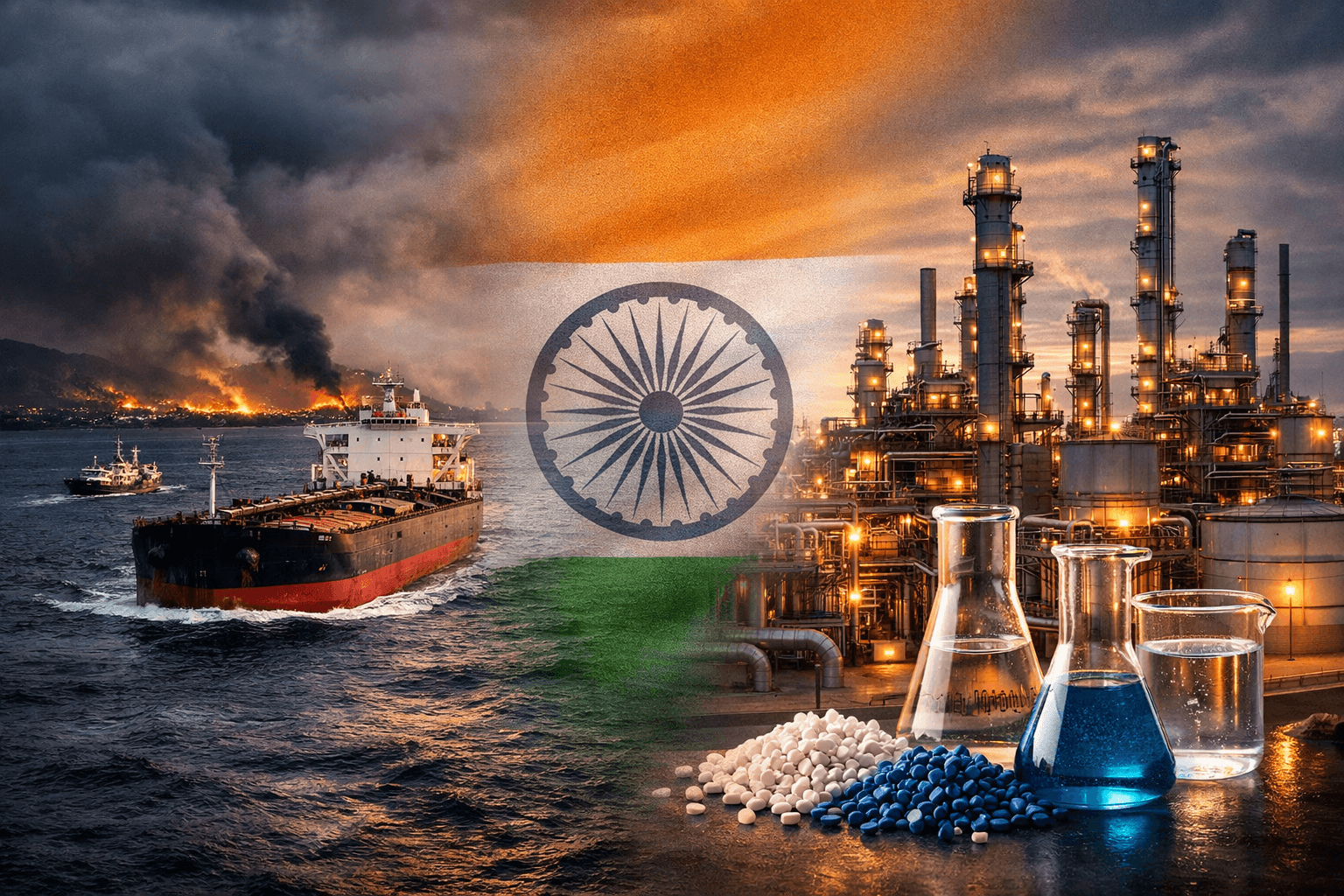
India has announced a full customs duty exemption on 40 critical petrochemical products until June 30, 2026, in what appears to be a targeted attempt to cushion domestic industry from the fallout of the ongoing conflict in West Asia. The move comes as the war-linked disruption to shipping routes, feedstock flows and energy markets has raised costs for chemical and manufacturing sectors across Asia.
The official basis for the decision is clear. The Ministry of Finance said the exemption is intended to ensure the continued availability of critical petrochemical inputs, reduce cost pressure on downstream sectors and safeguard supply stability in the country. The relief is temporary, and the government has framed it as a targeted response to exceptional global conditions rather than a permanent tariff shift.
This matters because petrochemicals sit at the base of a vast industrial chain. They are used in plastics, packaging, textiles, automotive parts, pharmaceuticals, paints, consumer goods and multiple manufacturing processes. When feedstock prices rise or cargo flows become uncertain, the impact does not remain confined to the chemical industry. It spreads quickly through industrial output, business margins and, in some cases, retail prices.
Why India took this step now
The decision is tied to the ongoing conflict in West Asia and the resulting supply chain disruption. According to Reuters, the war has choked petrochemical flows through the Strait of Hormuz and pushed prices of key plastics and polymers to roughly four-year highs. Reuters also reported that the Middle East accounted for more than 40% of global polyethylene exports in 2025, underlining why Asian importers are especially vulnerable when the region faces conflict.
The same Reuters report noted that Asia’s naphtha refining margins surged sharply after the conflict began, with countries such as Japan, South Korea and India among the most exposed because of their dependence on imported crude and petrochemical inputs. That broader market backdrop helps explain why India chose a customs-duty route to provide immediate relief to industry rather than wait for international prices to cool on their own.
Hindustan Times reported that the waiver was announced to shield domestic industry from the effects of the war and that the exemptions would remain in place till June 30, 2026. The newspaper also linked the decision to tightening shipping routes and rising input costs in energy-linked industries.
Read more about India Census 2026 here.
What exactly has been exempted
One of the biggest corrections to make is this: the exemption is not a vague relief on “some petrochemicals.” The official annexure lists 40 product categories. These include both chemicals and polymers that are widely used across manufacturing.
Among the major chemicals covered are:
- Anhydrous ammonia
- Toluene
- Styrene
- Dichloromethane
- Vinyl chloride monomer
- Methanol
- Isopropyl alcohol
- Monoethylene glycol
- Phenol
- Acetic acid
- Vinyl acetate monomer
- Purified terephthalic acid
- Ethylenediamine
- Di ethanolamine and mono ethanolamine
- Toluene di-isocyanate
- Ammonium nitrate
- Linear alkylbenzenes
The list also covers a large range of polymers and intermediates, including:
- Polymers of ethylene
- Polypropylene
- Polystyrene
- Styrene-acrylonitrile
- Acrylonitrile-butadiene-styrene
- Polyvinyl chloride
- Polytetrafluoroethylene
- Polyvinyl acetate
- Polyvinyl alcohol
- Poly methyl methacrylate
- Polyoxymethylene
- Polyols
- Polyether ether ketone
- Epoxy resins
- Polycarbonates
- Alkyd resins
- PET chips
- Unsaturated polyester resins
- Poly butylene terephthalate
- Formaldehyde-based resins
- Polyurethanes
- Polyphenylene sulphide
- Poly butadiene and styrene butadiene
That list shows the scope of the government’s move. It is not limited to one narrow industrial segment. It spans upstream chemicals and downstream polymers that feed into everyday manufacturing.
Which sectors are likely to benefit
The Finance Ministry itself said the exemption is expected to help sectors dependent on petrochemical feedstock and intermediates, including plastics, packaging, textiles, pharmaceuticals, chemicals, automotive components and other manufacturing segments. It also said the move should provide relief to consumers of final products.
The plastics and packaging industry is among the clearest beneficiaries. Polyethylene, polypropylene, PVC, PET and related polymers are basic materials for packaging used in food, consumer products, logistics and retail. With international resin markets under stress, lower customs duty can soften the landed cost for Indian users.
Textiles also stand to gain, especially where synthetic fibres and intermediates are involved. Materials such as purified terephthalic acid and monoethylene glycol are essential building blocks for polyester chains and related applications. Lower import costs could help ease pressure on manufacturers already facing volatile global freight and input conditions.
The automotive and engineering sectors are also exposed because plastics, specialty polymers and engineered resins are widely used in interiors, housings, wiring systems, insulation, coatings and components. Pharmaceuticals and chemicals, meanwhile, rely on several of the exempted inputs directly or indirectly in manufacturing processes.
Will this reduce inflation?
The safer and more accurate answer is: it may help limit cost escalation, but it does not guarantee lower retail prices.
That is an important correction. The official release says the measure is meant to reduce cost pressures on downstream sectors and provide relief to consumers of final products. It does not promise broad-based consumer price cuts.
Still, the inflation logic is straightforward. When feedstock prices spike because of war, shipping disruption and constrained supply, manufacturers either absorb the hit or pass it on. Reuters has already reported that global chemical companies have begun pushing through price increases to customers as petrochemical costs rise.
India has also recently taken other steps to limit inflationary pressure from the same geopolitical shock. Reuters reported on March 27 that India cut excise duties on petrol and diesel to protect consumers as global oil prices surged during the Iran war. That does not directly relate to petrochemicals, but it shows the government is using tax instruments more broadly to contain the domestic impact of higher imported energy and logistics costs.
So the most accurate conclusion is that the petrochemical duty waiver is designed to act as a buffer against input-cost inflation in manufacturing-heavy sectors.
A wider policy pattern is emerging
This customs-duty waiver does not stand alone. Reuters reported on April 1 that India also allowed factories in export-focused Special Economic Zones to sell a capped share of goods domestically at reduced customs duties, with analysts linking the urgency of that decision to the conflict in the Middle East and the resulting jump in freight and oil costs.
Taken together, these measures suggest India is trying to protect domestic industry through temporary, tactical interventions rather than broad, permanent trade-policy changes. The aim appears to be resilience: keep inputs flowing, reduce panic cost spikes, and make better use of existing production capacity during an externally driven shock.
What this does not mean
A fact-checked article also needs to be clear about what cannot yet be claimed.
First, there is no official claim that this exemption alone will transform India’s petrochemical competitiveness in the long term. It is a temporary relief measure valid till June 30, 2026.
Second, it would be too strong to say the move will immediately make consumer goods cheaper across the board. The official language is more cautious and refers to reducing cost pressure and providing relief, not guaranteeing price reductions.
Third, while the HT headline refers to the US-Iran conflict, the official PIB release uses the broader phrase “ongoing conflict in West Asia.” That wording is important and more precise for a corrected report.
Conclusion
India’s decision to waive customs duty on 40 key petrochemical products is a targeted response to a fast-moving geopolitical and industrial problem. The conflict in West Asia has disrupted petrochemical supply chains, tightened shipping routes and pushed up prices for critical feedstocks and polymers used across manufacturing. In that context, the exemption is meant to protect domestic industry from a sudden cost shock and help maintain supply stability through June 30, 2026.
The policy is significant because it reaches deep into the industrial value chain, covering basic chemicals, feedstocks and polymers used in packaging, textiles, pharmaceuticals, chemicals and automotive components. It is also part of a wider pattern of tax and trade adjustments India has used in recent days to soften the domestic economic effects of the West Asia conflict.
For industry, the message is immediate relief. For the government, it is an attempt to buy stability in an unstable market. And for the broader economy, it is another sign that distant wars can rapidly reshape domestic policy when supply chains, energy prices and manufacturing costs are all tied to the same global choke points.