







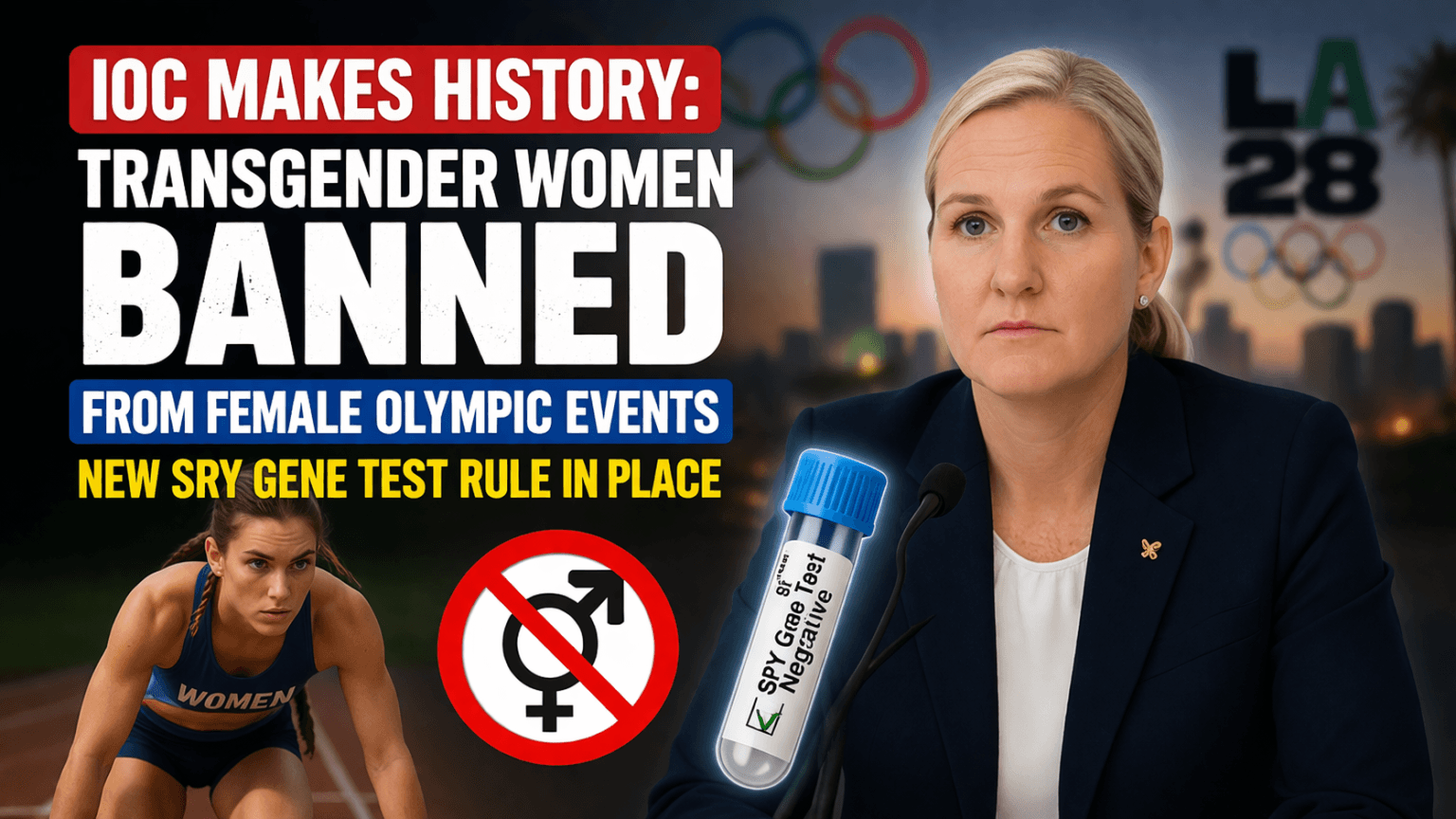
IOC Transgender Women Athletes Ban Introduces SRY Testing and New Eligibility Rules, Triggering Global Debate on Fairness and Inclusion
In a historic and highly controversial move, the International Olympic Committee (IOC) has announced a ban on transgender women and certain athletes with Differences of Sex Development (DSD) from competing in the female category at the Olympic Games, starting with the 2028 Los Angeles Olympics and continuing for future editions.
This landmark decision marks one of the most significant shifts in modern sporting history, fundamentally redefining eligibility in women’s Olympic events. It also introduces a new biological screening requirement, signaling a move toward stricter, science-led criteria for participation at the highest level of global sport.
What Is the IOC Transgender Women Athletes Ban?
The IOC transgender women athletes ban refers to the newly announced Olympic-level rule that excludes transgender women and certain DSD athletes from competing in female categories at elite Olympic competitions.
According to reports, the IOC has made it clear that:
- The rule applies to elite Olympic-level competitions
- It will be enforced starting from the 2028 Olympics in Los Angeles
- It is expected to influence future Olympic Games and global sports federations
This is not a partial or indirect restriction—it is a direct eligibility rule change at the Olympic level.
Introduction of SRY Gene Testing: A Major Policy Shift
One of the most significant aspects of this decision is the introduction of a one-time SRY gene test for athletes entering the female category.
What is the SRY Test?
The SRY (Sex-determining Region Y) gene is typically found on the Y chromosome and is associated with male biological development.
Under the new IOC framework:
- Athletes competing in the female category must undergo a one-off SRY screening
- The test is designed to determine biological sex markers
This represents a clear shift from hormone-based eligibility criteria to genetic and biological verification, making the new rules more rigid and less open to interpretation.
Read more on the Transgender Amendment Bill here.
Why Did the IOC Implement This Ban?
The IOC has justified the transgender women athletes ban primarily on the grounds of fairness and safety in women’s sports.
1. Fair Competition
IOC leadership has stated that allowing athletes who have undergone male puberty to compete in women’s events could create performance advantages and unequal competition conditions.
2. Scientific Backing
The IOC has said the policy is based on scientific research and developed with input from medical experts. The argument presented is that biological differences resulting from male puberty can persist and impact elite-level performance.
3. Protecting Women’s Category
The decision emphasizes the need to preserve the integrity of women’s sports and ensure equal opportunities for athletes assigned female at birth.
Statements from IOC Leadership
IOC President Kirsty Coventry addressed the decision, stating that it would not be fair for “biological males” to compete in the female category and that the move is intended to protect fairness in elite competition.
This reflects a clear and firm stance, indicating that fairness has now become the IOC’s primary priority in defining eligibility.
Who Does the Ban Apply To?
The IOC has clarified that the rule applies specifically to:
1. Transgender Women Athletes
Athletes who have transitioned from male to female will not be eligible for the female category at Olympic-level competitions.
2. Certain DSD Athletes
Athletes with Differences of Sex Development (DSD) may also be affected under the new criteria, depending on biological markers.
Reports have referenced high-profile athletes such as Caster Semenya and Imane Khelif in the broader discussion around eligibility rules, though these references are part of ongoing debates and should be understood in that context.
Scope of the Rule: Elite Sport Only
The IOC has emphasized that the transgender women athletes ban applies only to elite-level competition, including:
- Olympic Games
- High-performance international events
It does not apply to:
- Grassroots sports
- Recreational participation
- Community-level athletics
This distinction suggests that while the IOC is enforcing strict rules at the elite level, it is not restricting participation at broader levels of sport.
Impact on Global Sports Federations
The IOC’s decision is expected to influence international sports federations across the world.
Possible outcomes include:
- Adoption of similar biological eligibility rules
- Greater alignment with Olympic standards
- Increased scrutiny around athlete eligibility
This could lead to a more standardized global framework for gender categories in sports.
Global Reaction: A Divided Sporting World
The announcement has triggered intense reactions worldwide, with opinions sharply divided.
Supporters argue:
- It ensures fairness in women’s sports
- Protects opportunities for biological female athletes
- Aligns with scientific perspectives on performance differences
Critics argue:
- It excludes transgender athletes from elite competition
- Raises concerns about discrimination and human rights
- Could reinforce social stigma
This divide highlights the broader tension between fairness and inclusion in modern sports.
A Turning Point in Olympic History
The IOC transgender women athletes ban represents a major turning point in Olympic history.
For decades, the Olympics have stood for inclusion, equality, and global unity. This decision introduces a new dimension—biological verification as a key factor in determining eligibility.
What This Means for the Future of Sports
The long-term implications of this decision could be significant.
1. Policy Changes Across Sports
More sports organizations may adopt biological testing frameworks.
2. Increased Regulation
Athlete eligibility could involve more rigorous checks and standardized criteria.
3. Continued Debate
The issue will likely remain a subject of global debate across legal, ethical, and scientific domains.
Conclusion: A Defining Moment for Fairness vs Inclusion
The IOC transgender women athletes ban is one of the most impactful decisions in modern sports governance.
With the introduction of SRY gene testing and stricter biological criteria, the IOC has clearly prioritized fairness in competition at the elite level.
At the same time, the decision raises important questions about inclusion, identity, and the evolving nature of global sports.
As the 2028 Los Angeles Olympics approach, this policy will remain at the center of one of the most important and sensitive debates in the world of sports.
Follow our You Tube Channel For more such updates.