




Iran Charges $2 Million Toll for Ships
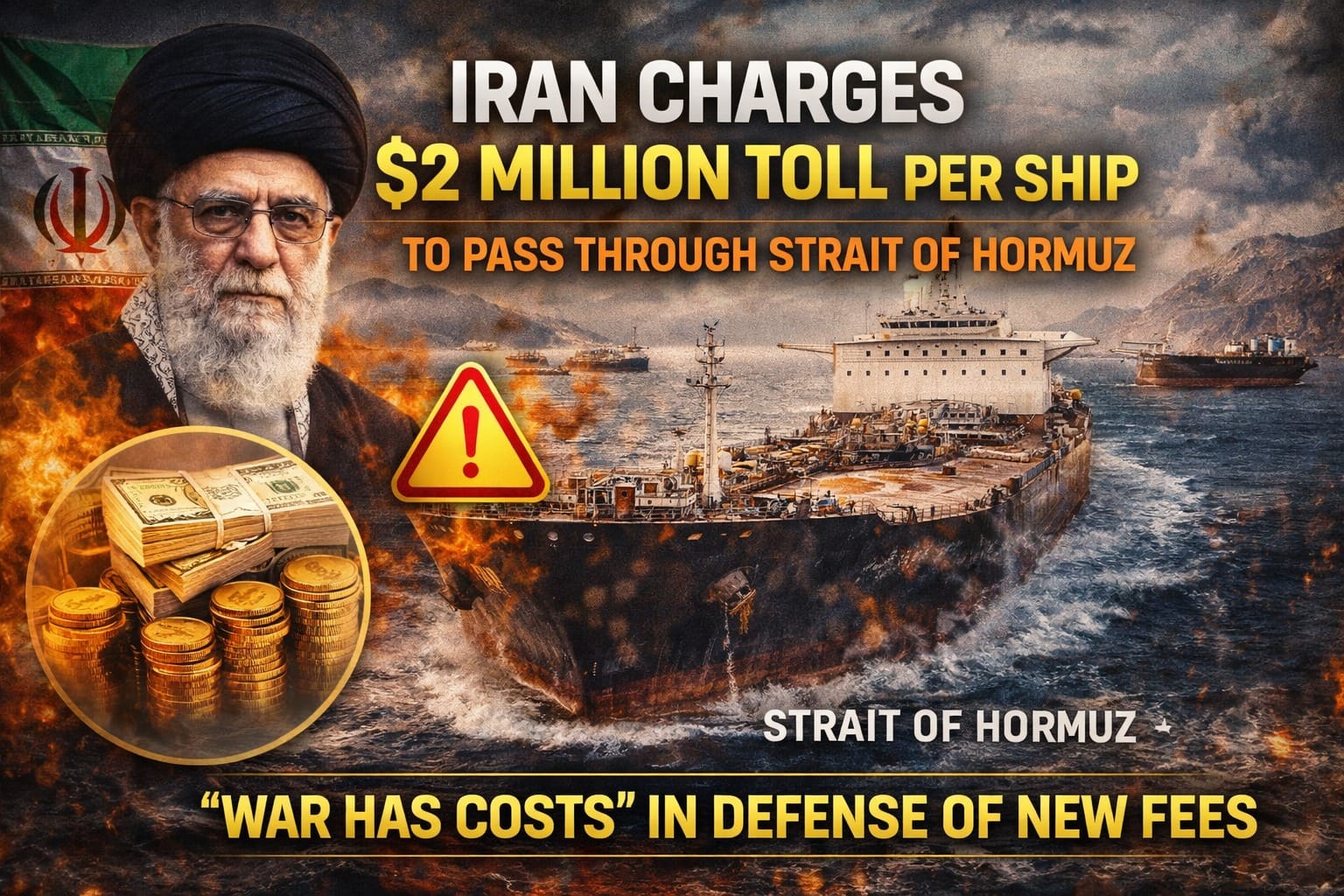
The ongoing Iran war in 2026 has taken a dramatic economic turn, with Tehran now reportedly charging $2 million Toll per ship to allow passage through the strategically vital Strait of Hormuz.
This move, described by Iranian officials as a reflection of “war has costs”, marks a significant escalation—not just militarily, but economically and strategically.
The Strait of Hormuz, through which nearly 20% of global oil supply flows, has now become a bargaining tool, a battlefield, and a revenue stream—all at once.
This article breaks down:
- Why Iran is charging $2 million toll
- The strategy behind this move
- How it impacts global oil, trade, and geopolitics
- What this means for the future of warfare
What Exactly Is Happening? The $2 Million Toll Explained
Iran has reportedly started charging certain ships $2 million (approx ₹18.8 crore) to pass through the Strait of Hormuz.
According to Iranian lawmaker Alaeddin Boroujerdi:
- The move reflects a new “sovereign regime” in the Strait
- It demonstrates Iran’s control and authority over the waterway
- And most importantly, it is justified because “war has costs”
This is not just a fee—it is a strategic signal.
Iran is essentially saying:
If the world wants access to its most important oil route, it will have to pay—literally and politically.
Why the Strait of Hormuz Is So Important
To understand the significance of this move, you need to understand the Strait itself.
- Nearly one-fifth of the world’s oil passes through Hormuz
- It connects the Persian Gulf to global markets
- It is the lifeline for oil exports from countries like:
- Saudi Arabia
- UAE
- Kuwait
- Iraq
Even a slight disruption can:
- Spike oil prices
- Trigger global inflation
- Disrupt supply chains worldwide
Now imagine adding a $2 million toll per ship.
Why Iran Is Charging This Toll: The Real Strategy
This move is not random—it is a calculated geopolitical strategy.
1. Turning Geography Into Power
Iran has always controlled one side of the Strait.
But now, it is converting that control into:
- Economic leverage
- Political influence
- Strategic dominance
By charging a toll, Iran is effectively:
Monetizing its geographic advantage
2. Funding the War Effort
Wars are expensive.
By charging ships:
- Iran generates direct revenue
- Offsets economic pressure from sanctions
- Funds military operations
This aligns with the statement:
“War has costs… we must take transit fees.”
In simple terms:
The war is now being partially funded by global trade
3. Economic Pressure on the West
The toll acts as an indirect economic weapon.
How:
- Increases cost of oil transportation
- Raises global fuel prices
- Impacts Western economies
Even if the toll applies to limited ships:
- It creates uncertainty
- Drives up insurance premiums
- Increases shipping risk costs
4. Selective Control Over Shipping
Iran is not allowing all ships to pass freely.
Reports indicate:
- Only “approved” ships can pass
- “Enemy-linked” vessels face restrictions or denial
This creates:
- A controlled access system
- Favoritism toward neutral or friendly countries
- Pressure on Western allies
5. Creating a New ‘Maritime Tax’ System
Iran is signaling a bigger long-term vision:
- Establish a new regulatory regime in the Strait
- Introduce tolls, restrictions, and approvals
- Redefine control over global trade routes
This is similar to how countries:
- Charge tolls in canals (like Suez or Panama)
- But with a major difference—this is happening during war
The Bigger Picture: A Shift to Economic Warfare
The $2 million toll represents a shift from:
Traditional warfare → Economic warfare
Instead of just missiles and drones, Iran is using:
- Trade routes
- Oil supply
- Shipping access
as weapons.
Impact on Global Oil Prices
The immediate effect of this move is already visible:
1. Rising Oil Prices
- Prices have surged above $100 per barrel
- Further increases expected if tensions continue
2. Increased Transportation Costs
- Shipping companies now face:
- Toll costs
- Higher insurance
- Security risks
3. Supply Chain Disruptions
- Delays in oil delivery
- Reduced tanker movement
- Global uncertainty
Shipping Crisis: Ships Stuck and Routes Disrupted
The situation in the Strait is already chaotic.
- Hundreds of ships remain stranded
- Traffic has dropped drastically
- Only a few vessels are allowed through
In some cases:
- Countries are negotiating directly with Iran
- Others are seeking naval escorts
This has turned global shipping into:
A negotiation-based system instead of free passage
Legal and International Implications
Charging tolls in an international waterway raises serious questions.
Under International Law:
- The Strait of Hormuz is considered a global transit route
- Freedom of navigation is expected
Iran’s Position:
- Claims sovereign control
- Justifies tolls as wartime necessity
This creates a legal grey area:
Is this regulation or coercion?
How Countries Are Reacting
1. United States
- Strongly opposes restrictions
- Threatened military action if Strait is blocked
2. Europe
- Concerned about oil supply
- Avoiding direct military involvement
3. Asian Countries (India, China, Japan)
- Highly dependent on Hormuz oil
- Seeking diplomatic routes for safe passage
Who Gains and Who Loses?
Winners
- Iran (economic leverage + revenue)
- Oil-exporting countries (higher prices)
Losers
- Oil-importing nations
- Global consumers
- Shipping companies
Risks of This Strategy
While the toll gives Iran leverage, it also carries risks:
1. Military Escalation
- Could provoke direct confrontation
- Increase naval conflict
2. Global Isolation
- Further sanctions
- Diplomatic backlash
3. Alternative Routes Development
- Countries may seek bypass options
- Reduce long-term dependence on Hormuz
What Happens Next? Possible Scenarios
Scenario 1: Toll Becomes Permanent
- Hormuz turns into a controlled economic zone
- Iran gains long-term revenue
Scenario 2: Military Intervention
- U.S. and allies attempt to reopen Strait
- Naval conflict escalates
Scenario 3: Diplomatic Settlement
- Negotiations reduce tensions
- Toll system removed or regulated
The Real Insight: A New Type of War
Iran’s $2 million toll is not just about money.
It represents a new reality:
- Wars are no longer just fought on land
- Trade routes are weapons
- Economics is strategy
Conclusion: When Geography Becomes Power
The Strait of Hormuz has always been important.
But in 2026, it has become:
- A battlefield
- A bargaining chip
- A revenue generator
By charging $2 million per ship, Iran is sending a clear message:
Control the route, control the world’s economy.
And in modern geopolitics, that might be more powerful than any missile.
Also read – How a long Iran War could benefit Russia: Zelensky Warns
Subscribe to our YouTube Channel The Logic Stick for more video insights