







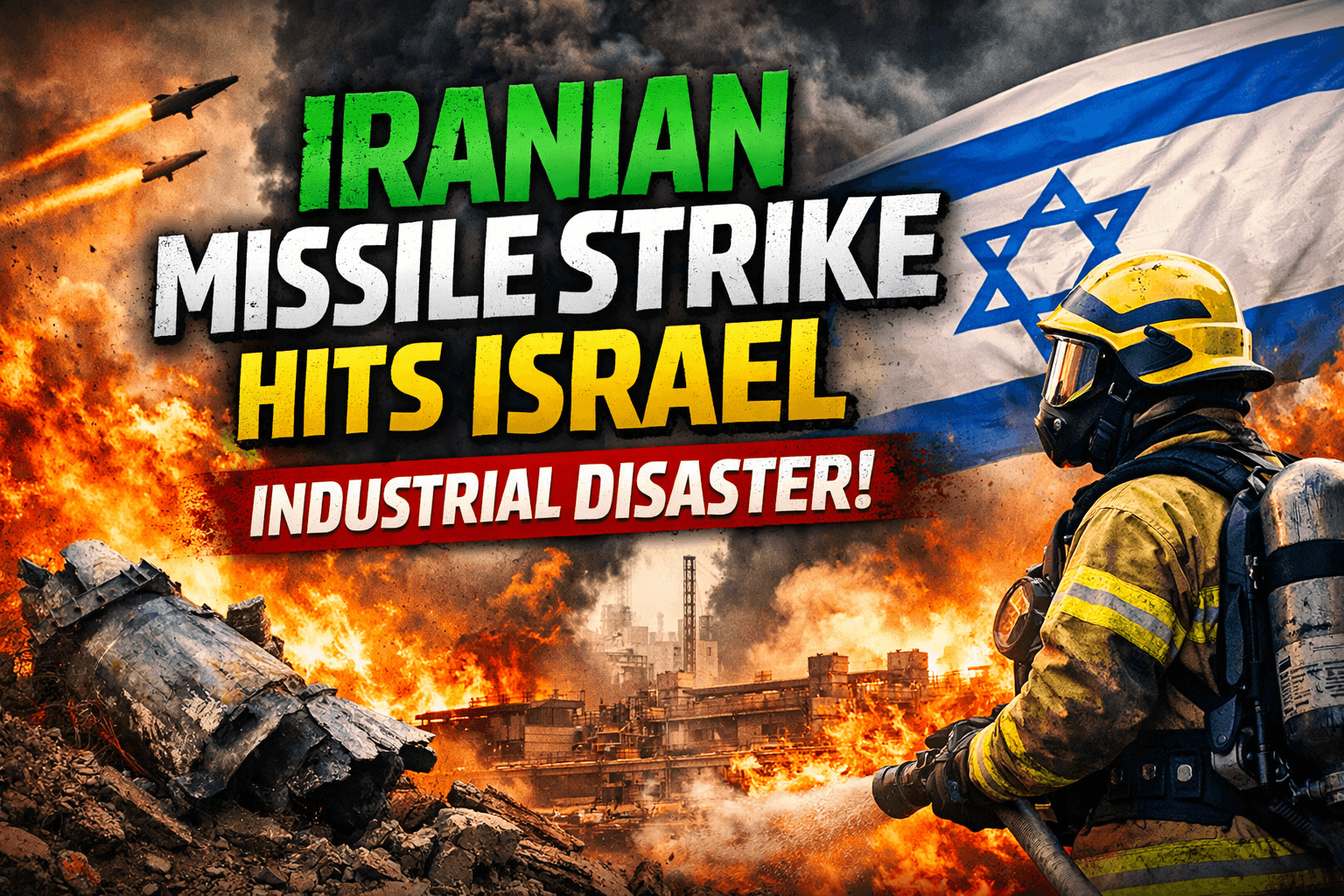
Iran Israel war industrial facility strike triggers massive blaze in Neot Hovav after missile or interceptor debris impact during fresh Iranian barrage.
The Explosive Iran Israel War industrial facility strike triggers fire in southern Israel after a missile or interceptor debris hit a key industrial site in the Neot Hovav zone during an Iranian barrage. The impact caused a major blaze at a chemical facility, prompting emergency response teams and safety warnings over potential hazardous material risks, even as no immediate casualties were reported.
What Happened: Industrial Facility Hit Amid Missile Barrage
During a wave of missile launches from Iran, an industrial site in the Ne’ot Hovav industrial zone near Beersheba was struck. The facility, operated by chemical company ADAMA, suffered significant damage after being hit by either a missile or debris from an intercepted projectile.
The impact led to:
- A large fire breaking out at the facility
- One building being completely destroyed
- Deployment of around 30+ firefighting teams to control the blaze
- Emergency response teams rushing to contain the situation
Authorities later confirmed that no injuries were reported, but the scale of the fire and the nature of the facility made the situation extremely sensitive.
Hazard Concerns: Why Authorities Issued Safety Warnings
The Ne’ot Hovav zone is one of Israel’s key industrial hubs, housing chemical plants and hazardous-material facilities. Because of this, even a non-direct missile hit can create serious risks.
Following the incident:
- Residents in nearby areas were instructed to stay indoors
- People were advised to shut windows and turn off ventilation systems
- Emergency services monitored for any toxic or hazardous leaks
These precautions were taken not because of confirmed contamination, but due to the potential risk associated with chemical infrastructure.
Missile or Debris? The Critical Detail
One of the most important aspects of this incident is that it is not definitively confirmed whether the facility was hit by a direct missile or by debris from an intercepted one.
This distinction matters because:
- Israel’s air defense systems intercept many incoming missiles mid-air
- Destroyed missiles can break into large, high-speed fragments
- These fragments can still cause serious damage on the ground
In this case, the safest confirmed understanding is:
The damage occurred during an Iranian missile attack, and the facility was struck either by the missile itself or by interceptor debris.
A Pattern Emerging in the Iran–Israel Conflict
This incident is part of a broader escalation in the Iran–Israel war, where missile exchanges have become more frequent and intense.
Recent developments suggest:
- Iran has launched multiple waves of missiles toward Israeli territory
- Israeli defense systems have intercepted many of these threats
- Despite interceptions, ground damage continues due to falling debris and partial impacts
This reflects a key reality of modern warfare—interception does not eliminate risk entirely.
The Strategic Importance of Ne’ot Hovav
The location of the strike adds another layer of concern.
The Ne’ot Hovav industrial zone is:
- One of Israel’s major chemical and industrial clusters
- Home to facilities dealing with hazardous materials and waste processing
- Strategically important for industrial and environmental management
A fire in such a zone is not just an infrastructure issue—it carries potential environmental and public safety implications, even if no immediate harm is reported.
Read more on Google Agent Smith Ai here.
Emergency Response: Rapid Containment Efforts
Israeli emergency services responded quickly to prevent the situation from escalating further.
Key actions included:
- Deployment of dozens of firefighting units
- Efforts to contain the fire before it spread to nearby facilities
- Continuous monitoring of air quality and chemical risks
Fire crews reportedly worked for hours to bring the blaze under control, focusing on preventing secondary incidents.
No Casualties, But High Alert Remains
While authorities confirmed no injuries or fatalities, the situation remains significant for several reasons:
- Industrial fires can escalate unpredictably
- Chemical exposure risks can emerge even after the fire is contained
- The psychological impact of missile strikes continues to affect civilian populations
The absence of casualties does not reduce the seriousness of the event—it instead highlights the narrow margin between control and catastrophe.
How This Changes the Nature of the Conflict
This incident illustrates a key shift in how wars are now experienced on the ground.
1. Indirect Damage Is Increasing
Even when missiles are intercepted, debris can:
- Damage infrastructure
- Start fires
- Endanger civilians
2. Civilian and Industrial Zones Are Vulnerable
Facilities not directly targeted can still be affected due to:
- Falling debris
- Miscalculations in interception trajectories
3. Defensive Systems Have Limits
Air defense systems are effective, but:
- They cannot prevent all forms of damage
- Secondary risks remain a major concern
Regional Tensions Continue to Rise
The Iran–Israel conflict is unfolding in a broader regional context, with rising tensions across the Middle East.
Key concerns include:
- Continued missile exchanges between Iran and Israel
- Risk of further escalation involving allied groups
- Potential impact on regional stability and global markets
While this particular incident did not result in casualties, it contributes to an environment where every strike increases the stakes.
Global Attention on the Conflict
The international community is closely monitoring the situation for several reasons:
- The Middle East remains a critical region for global energy supply
- Escalation could impact trade routes and oil prices
- The conflict involves advanced missile and defense technologies
Incidents like this one reinforce concerns about how quickly localized strikes can have wider global implications.
Conclusion: A Stark Reminder of Modern War Risks
The fire at the Israeli industrial facility is more than just an isolated event—it is a reflection of the complex risks in modern warfare.
Key takeaways:
- The facility was struck during an Iranian missile attack
- The damage may have been caused by missile debris or interceptor fragments
- A major fire broke out, but no injuries were reported
- Authorities acted quickly to contain risks and protect civilians
As the Iran–Israel war 2026 continues, such incidents highlight how even successful defense measures cannot fully eliminate danger.
In today’s conflicts, the threat is no longer just the missile—it is everything that comes with it.