







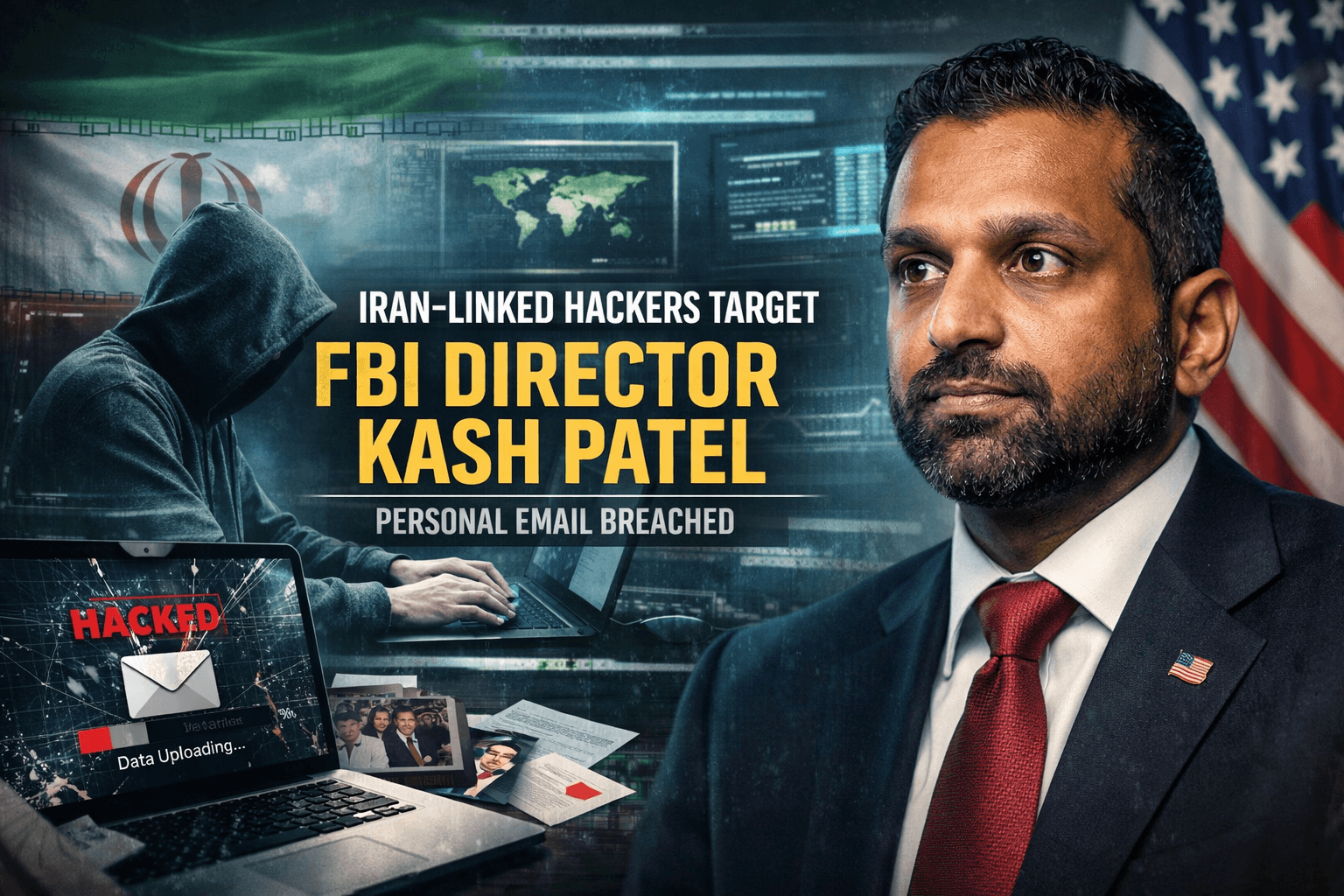
Iran-linked hackers target FBI Director Kash Patel as personal email breach highlights growing global cyber warfare threats.
A pro-Iranian hacking group’s claimed breach of FBI Director Kash Patel’s personal email account has become one of the most closely watched cybersecurity incidents involving a top US official this year. The group, known as the Handala Hack Team, published personal photographs, documents, and what it said were emails tied to Patel’s private account. The FBI has acknowledged that “malicious actors” targeted Patel’s personal email information, while stressing that the exposed material was historical and not related to official government business.
The incident matters not because it appears to have exposed classified FBI systems, but because it shows how personal digital accounts belonging to senior officials can become high-value targets in a wider geopolitical confrontation. In today’s environment, cyberattacks do not need to penetrate classified networks to have impact. A leak of old emails, photos, resumes, travel records, or personal documents can still be used for humiliation, intimidation, narrative warfare, and follow-on cyber operations. That is why the Patel breach is being seen as part of a much bigger cyber and political story involving Iran-linked actors, US retaliation, and the increasing use of hack-and-leak tactics in international conflict.
What Actually Happened
According to Reuters and AP, the Handala Hack Team publicly claimed responsibility for hacking Patel’s personal account and posted material online that appeared to include years-old photographs, a résumé, and other private documents. Reuters reported that more than 300 emails and several personal photos were published by the group, while AP described the material as dating back more than a decade. The FBI confirmed the targeting of Patel’s personal email information and said steps had been taken to mitigate potential risks.
One of the most important corrections to make is this: there is no verified public evidence that FBI systems themselves were hacked in this episode. Coverage pointed to Patel’s personal Gmail account or personal email information, not a confirmed breach of official FBI infrastructure. Wired specifically noted that while the hackers tried to project a larger victory, there was no evidence they had penetrated the FBI’s own networks in this incident.
Another key correction is that the leaked content was described by the FBI and reporters as historical. Reuters said the material dated from roughly 2010 to 2019, and the FBI said it did not involve government-related information. That does not mean the breach was harmless, but it does mean early assumptions that sensitive federal files were compromised would overstate what has been publicly confirmed so far.
Who Is the Handala Hack Team?
The group at the center of the case calls itself the Handala Hack Team and is widely described in current reporting as pro-Iranian or Iran-linked. Reuters reported that the US government recently moved against infrastructure connected to Handala, including domain seizures tied to Iranian cyber activity. AP also reported that the Trump administration was offering up to $10 million for information on Handala members, describing the group as one that has repeatedly targeted US officials.
That said, a careful fact-check requires precision here. Public reporting strongly links Handala to Iranian interests or Iranian cyberintelligence units, but attribution in cyber cases is often complex. It is safer and more accurate to describe Handala as Iran-linked or pro-Iranian, which is how major coverage framed it, rather than present every aspect of the group’s exact state relationship as conclusively proven in public.
Click here to read more on Jewar International Airport Inauguration.
Why the FBI Director Became a Target
Kash Patel is not just any US official. As FBI director, he is one of the most visible law-enforcement and national-security figures in Washington. A successful breach of his personal account offers propaganda value even if it does not expose official files. By publishing personal photos and documents, a group like Handala can show reach, embarrass a prominent figure, and feed a broader message that powerful American officials remain vulnerable outside hardened government systems.
AP added an important detail: Patel had reportedly been warned in 2024 by the FBI that he could be a potential target of Iranian cyber activity before he became FBI director. That background gives the latest breach added significance, because it suggests he may already have been on the radar of Iran-linked actors well before this public leak.
The attack also came shortly after US authorities announced action against cyber infrastructure associated with Handala. Reuters reported that the Justice Department had announced the seizure of four domains used in connection with Iran’s Ministry of Intelligence and Security. In that context, the targeting of Patel can also be read as retaliation, messaging, or both.
What Was Leaked
Fact-checking requires caution here because not every document posted online has been independently verified. Reuters said the group published more than 300 emails and personal photographs, while AP referred to years-old photos, a work résumé, and other personal documents. Reuters also noted that it could not independently verify the authenticity of all the leaked emails, though the compromised email address matched records from prior breach datasets.
That means the safest wording is not “all the leaked emails were confirmed genuine,” because that has not been publicly established in full. The more accurate statement is that the materials appear to include personal emails and records connected to Patel, and that at least parts of the trove were treated by reporters and officials as credible enough to confirm a real breach of his personal account.
Why This Breach Still Matters Even Without Classified Files
Some readers may wonder whether a hack involving old personal emails is really that serious. The answer is yes. Even historical and non-government material can be valuable to foreign-linked actors. Personal photos, contacts, patterns of travel, former passwords, business records, and social networks can all be used to build profiles for intimidation, phishing, doxxing, or future intrusions. A senior official does not need to lose classified files for a breach to become strategically useful to an adversary.
Wired’s assessment reinforces this point. Its reporting suggested that the hack was significant not because it toppled an agency network, but because it fit a pattern of noisy, public-facing cyber operations meant to maximize psychological and political effect. The public dump of personal materials can shape media coverage, trigger embarrassment, and help hostile actors claim symbolic victories.
A Broader Pattern in Iran-Linked Cyber Operations
Current reporting places the Patel breach within a wider rise in cyber tensions connected to Iran. Reuters linked the episode to a US intelligence assessment warning of potential low-level Iranian cyberattacks amid rising geopolitical tensions. Reuters also reported that Handala had recently claimed responsibility for disruptive attacks involving US sectors such as healthcare and defense-linked targets, including Stryker and Lockheed Martin-related activity.
This is important because it suggests the Patel episode was not an isolated stunt. Instead, it appears to fit a broader strategy in which cyberattacks are used to pressure opponents, test defenses, generate headlines, and blur the line between espionage, retaliation, intimidation, and propaganda. In that sense, the breach is part of a larger modern pattern: states and state-linked groups increasingly use cyberspace not only to steal secrets, but to shape perception and project power.
What the FBI Has Said
The FBI’s public line has been notably careful. According to Reuters and AP, the bureau confirmed that malicious actors targeted Patel’s personal email information and said it had taken steps to minimize risks. It also emphasized that the material was historical and not connected to government matters. Those statements are important because they narrow what has been officially confirmed and rule out some of the more dramatic interpretations circulating online.
At the same time, the bureau’s response does not make the case trivial. Acknowledging the breach, even while minimizing national-security fallout, shows that investigators considered the incident serious enough to address publicly. The combination of confirmation and containment is often how agencies respond when they want to reassure the public without understating the significance of a cyber intrusion.
The Cybersecurity Lesson for Governments and Individuals
A major lesson from the Patel breach is that personal accounts remain a major weak point, even in an age of advanced official cybersecurity systems. Governments may heavily secure internal networks, but senior officials still live part of their lives on consumer platforms, personal devices, and long-standing email accounts. That creates openings for foreign-linked actors who understand that the easiest route to influence is sometimes not through a secure agency gateway, but through an older, softer personal target.
For organizations beyond government, the lesson is just as clear. The distinction between personal and professional digital security is often artificial. A breach of an executive’s private account can expose relationship maps, travel details, internal culture, side communications, and old attachments that later become valuable in spear-phishing campaigns or reputational attacks. Cybersecurity is no longer only about protecting servers. It is about protecting the people attached to them.
Corrected Bottom Line
The most accurate summary, based on current reporting, is this: an Iran-linked hacking group called Handala claimed and appears to have carried out a breach of FBI Director personal email information, publishing old photos, documents, and purported emails online. The FBI confirmed malicious targeting of Patel’s personal email information, said the data was historical, and stated that no government-related information was involved. There is no public confirmation in the reporting reviewed that official FBI systems were breached in this specific incident.
Conclusion
The Patel breach is a reminder that modern cyber conflict often aims for visibility as much as access. Even when official government files are not compromised, the public exposure of a senior official’s personal data can serve strategic goals: embarrassment, intimidation, political messaging, and perceived deterrence. That is why this episode matters. It shows how digital warfare has expanded beyond classified networks into the personal online lives of the people who lead major institutions.
For the United States, the incident sharpens an uncomfortable truth: protecting national security now means protecting not just agencies and databases, but the broader digital footprint of the officials who run them. For the rest of the world, it is another sign that cyber conflict is no longer a side theater. It is now central to geopolitics, influence, and modern statecraft.