







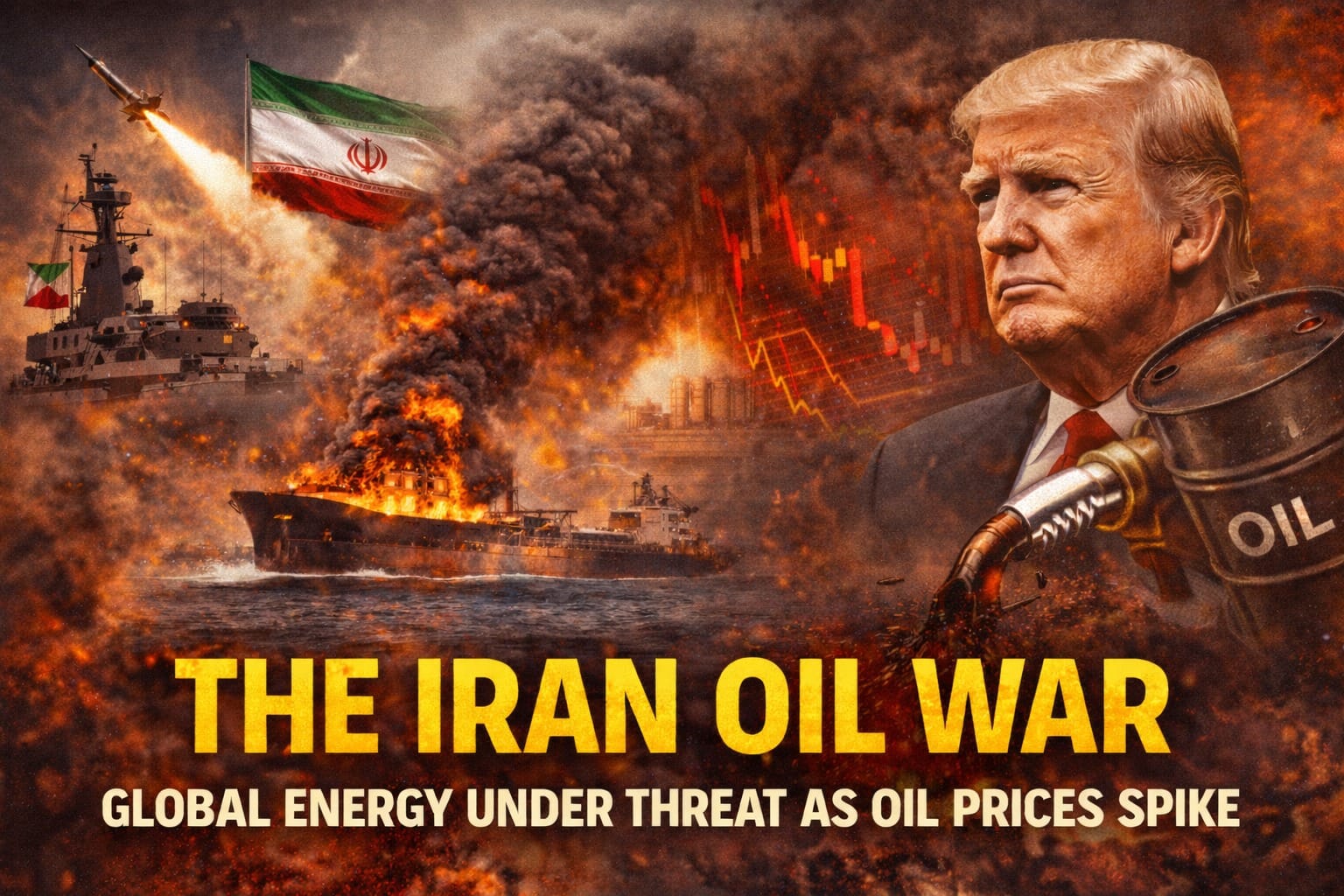
The ongoing Iran–US–Israel conflict has rapidly evolved into what analysts are now calling an “Iran Oil War.” What began as a military confrontation has quickly spread into the global energy system, disrupting oil shipments, threatening critical infrastructure, and sending shockwaves through international markets.
Over the past few days, the Middle East has witnessed attacks on oil facilities, disruption of tanker traffic, rising fuel prices, and fears of a prolonged energy crisis. The conflict has also exposed the vulnerability of global energy supply chains — especially the Strait of Hormuz, one of the world’s most important oil transit routes.
This article explains what happened in the past five days, how the Iran oil war is unfolding, and where the global oil market could be headed next.
What Triggered the Iran Oil War
The energy crisis began after US and Israeli strikes on Iranian military and nuclear infrastructure, which triggered retaliatory actions from Iran and its allied forces across the region.
Almost immediately after the strikes, global energy markets reacted sharply.
Oil traders began pricing in the possibility that Iran could target energy infrastructure or disrupt shipping routes, particularly the Strait of Hormuz — a narrow waterway through which a significant portion of the world’s oil passes.
The war quickly transformed into a battle not just of missiles and drones but of economic pressure through oil supply disruption.
Why the Strait of Hormuz Is the Center of the Oil War
The Strait of Hormuz sits between Iran and Oman and connects the Persian Gulf with the global ocean.
Its importance cannot be overstated.
Approximately 15–20 million barrels of crude oil — nearly 20% of global supply — pass through the strait every day.
This includes oil exports from:
- Saudi Arabia
- Iraq
- Kuwait
- Qatar
- UAE
- Iran
- Bahrain
Any disruption in this corridor immediately affects global energy markets.
As tensions escalated, tanker traffic through the Strait of Hormuz collapsed dramatically, with shipping activity reportedly falling by nearly 80% after drone strikes and security threats in the region.
Insurance companies also began cancelling coverage for tankers entering the region, making it nearly impossible for commercial shipping to continue normally.
What Happened in the Last 4–5 Days
1. Tanker Traffic Through Hormuz Collapses
Over the past few days, commercial oil shipments through the Strait of Hormuz slowed dramatically.
Several oil tankers were targeted or threatened by drone attacks, causing ship operators to avoid the route entirely.
Satellite data and maritime tracking services showed dozens of vessels stranded or rerouting, while shipping companies halted operations until security conditions improve.
Because Hormuz is such a critical chokepoint, the disruption immediately tightened global oil supply.
2. Drone Attacks on Oil Infrastructure
Energy facilities across the region have also been affected.
One of the most significant incidents was a drone attack on Saudi Arabia’s Ras Tanura oil refinery, the largest refinery operated by Saudi Aramco.
Although the attack caused limited damage, the refinery temporarily halted operations out of caution.
Saudi authorities also began rerouting oil exports through alternate routes, which are less efficient and more expensive.
Meanwhile, drone strikes targeted shipping and infrastructure near Oman’s ports, damaging facilities and even killing an oil tanker crew member.
These attacks signaled that the conflict could expand beyond Iran itself into the broader Gulf energy system.
3. Oil Prices Cross the $100 Mark
As supply disruptions intensified, global oil prices surged dramatically.
Brent crude oil crossed $100 per barrel for the first time in nearly four years, driven by fears of prolonged disruption in Middle Eastern supply.
In some trading sessions, prices surged even higher as traders anticipated that the crisis could escalate further.
Energy analysts warned that if the Strait of Hormuz remained blocked for weeks, prices could reach $120–$150 per barrel.
Some forecasts suggest that the conflict has already taken millions of barrels per day off the global market.
Also read – Israel US Iran War: The Complete Breakdown with Reasons
4. Energy Infrastructure Across the Gulf Under Threat
The Iran oil war has not only affected shipping but also major energy infrastructure.
Several facilities across the Gulf region have reported disruptions, including:
- Qatar’s Ras Laffan LNG export terminal
- Saudi Arabia’s Ras Tanura refinery
- UAE’s Fujairah oil terminal
- Iraq’s Basra oil export facilities
- Bahrain’s oil refinery
In some cases, operations were halted due to security threats or damage from attacks.
Experts warn that if these facilities remain offline, global oil inventories could shrink rapidly.
5. Global Markets Begin to Panic
Financial markets have also reacted strongly to the energy shock.
Oil price volatility has increased dramatically, while inflation concerns are rising again in major economies.
In the United States and Europe, gasoline prices have begun climbing as energy companies pass higher crude prices to consumers.
Even countries thousands of kilometers away from the conflict are feeling the impact through rising fuel costs.
Why This Is Being Called an “Oil War”
The current conflict is increasingly described as an oil war because energy infrastructure has become a central battlefield.
Instead of directly confronting each other militarily on a large scale, countries and militias are targeting economic pressure points such as:
- oil tankers
- export terminals
- refineries
- shipping lanes
- gas production facilities
By attacking energy supply routes, combatants can inflict global economic damage without necessarily escalating into full conventional war.
This strategy also amplifies geopolitical pressure because energy prices affect virtually every country.
Impact on Global Trade and Shipping
The disruption in Gulf shipping has also begun affecting global trade.
The Strait of Hormuz is not only critical for oil but also for liquefied natural gas (LNG) shipments.
Countries like Qatar export massive volumes of LNG through this route, supplying energy to Asia and Europe.
When shipping slows down:
- energy prices rise
- insurance costs increase
- shipping routes become longer and more expensive
Some shipping companies have already begun rerouting tankers through longer routes, increasing freight costs and delaying deliveries.
Impact on Asia and India
Asian economies are particularly vulnerable to the Iran oil war.
Countries such as India, China, Japan, and South Korea rely heavily on Middle Eastern oil imports.
About three-quarters of oil exports from the Gulf are destined for Asian markets, making the region highly exposed to disruptions.
In India’s case, the impact could be significant.
India imports more than 85–90% of its crude oil, much of which comes from the Middle East.
If oil prices remain elevated, the country could face:
- rising petrol and diesel prices
- higher LPG cylinder costs
- increased inflation
- pressure on government subsidies
Higher oil prices also increase transportation and manufacturing costs across the economy.
Why Oil Markets Are Extremely Nervous
Energy markets react quickly to geopolitical risk.
Even the threat of disruption in the Strait of Hormuz can trigger price spikes because traders know that replacing such a large volume of oil supply is extremely difficult.
Strategic oil reserves can cushion supply shocks temporarily, but they cannot replace a prolonged disruption.
If the war continues and infrastructure damage spreads, the global energy system could face a significant shortage.
Can Iran Sustain an Oil Blockade?
Many analysts believe Iran could disrupt shipping in the Strait of Hormuz for weeks or months using:
- naval mines
- missile strikes
- drones
- attacks on tankers
However, a complete blockade would also hurt Iran’s own economy.
Iran relies heavily on oil exports, and closing the strait could damage its relationships with key buyers like China.
Therefore, experts believe Iran may use intermittent disruptions rather than a permanent blockade as a strategic tool.
Possible Scenarios for the Oil War
Scenario 1: Short Conflict
If diplomatic pressure leads to de-escalation within a few weeks:
- oil prices may stabilize
- tanker traffic could resume
- markets could calm down
However, even short disruptions can leave lasting economic damage.
Scenario 2: Prolonged Energy Crisis
If the war continues and attacks on oil infrastructure intensify:
- oil prices could exceed $150 per barrel
- global inflation could spike
- supply shortages could appear in some countries
This would resemble past energy shocks such as the 1973 oil crisis.
Scenario 3: Global Energy Realignment
A longer conflict could accelerate major shifts in global energy strategy, including:
- increased US and Brazilian oil production
- faster adoption of renewable energy
- diversification of supply routes
- expansion of strategic reserves
Countries may also attempt to reduce dependence on the Middle East.
The Geopolitical Stakes
The Iran oil war is not just about energy markets — it is about geopolitical power.
Control over oil supply routes can influence global economics and diplomacy.
The conflict therefore involves multiple actors:
- Iran
- Israel
- United States
- Gulf countries
- global energy markets
Each of them has strategic interests tied to the outcome of the conflict.
Conclusion: A War That Could Shape the Global Economy
The Iran oil war has rapidly become one of the most consequential geopolitical crises in recent years.
In just a few days, the conflict has disrupted shipping routes, damaged energy infrastructure, and driven oil prices above $100 per barrel.
With nearly 20% of the world’s oil supply passing through the Strait of Hormuz, the stakes could not be higher.
If the crisis escalates further, the world may face an energy shock that affects everything from petrol prices to global inflation.
For now, markets and governments around the world are watching closely — because what happens next in the Persian Gulf could determine the direction of the global economy.
SUBSCRIBE TO OUR YOUTUBE CHANNEL THE LOGIC STICK FOR MORE VIDEO INSIGHTS