






Iran Strikes Qatar LNG Plant
The Iranian strike on Qatar’s Ras Laffan industrial complex represents a turning point not only in the ongoing Middle East conflict, but in the nature of modern warfare itself. What was once a confrontation defined by military targets and territorial control is now rapidly evolving into a struggle over economic lifelines. With a single strike, Iran has demonstrated that the global energy system—long considered resilient—is in fact deeply vulnerable.
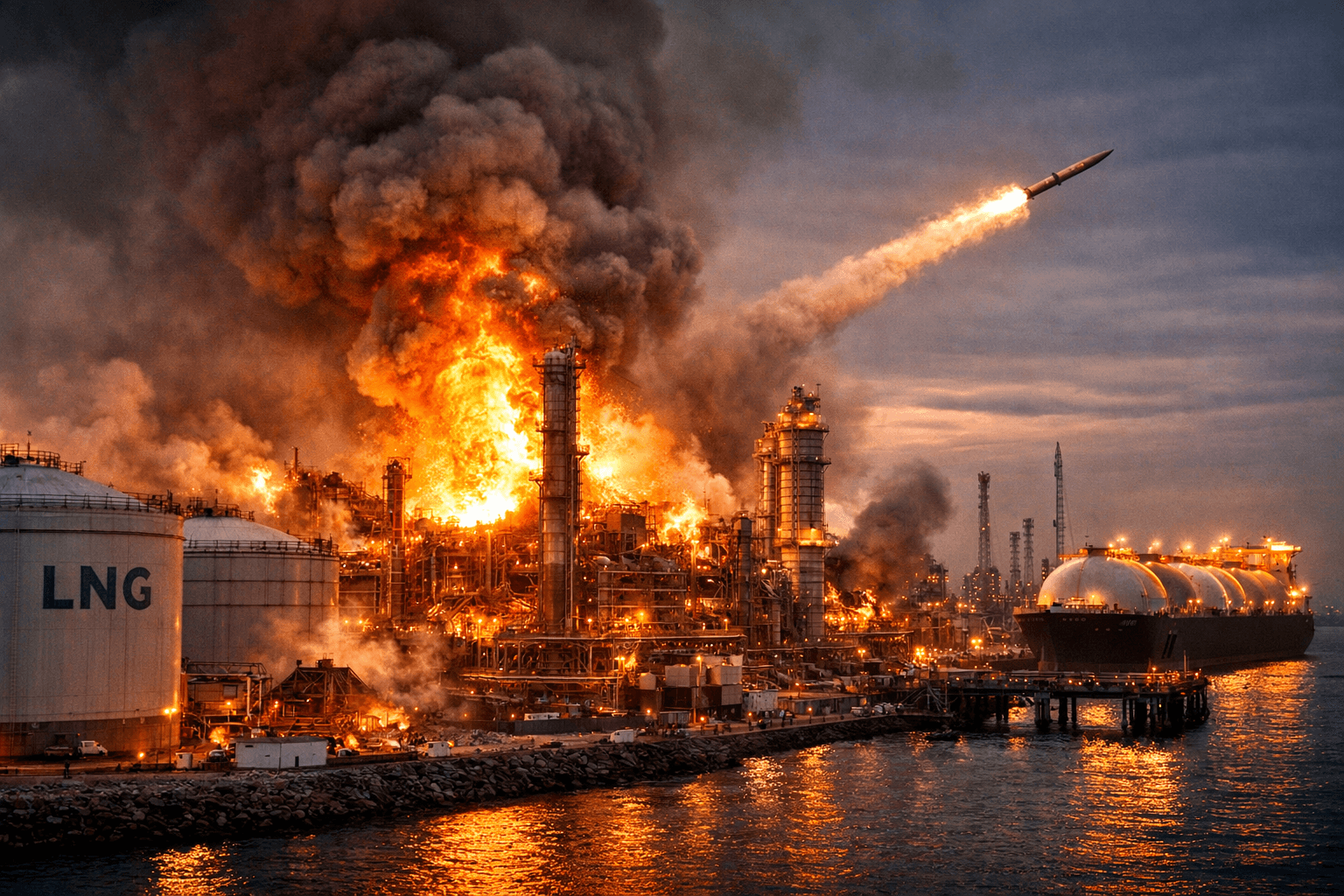
Ras Laffan is no ordinary facility. It is the world’s largest liquefied natural gas (LNG) export hub, a cornerstone of Qatar’s economy, and a critical supplier to energy-hungry markets across Asia and Europe. When reports emerged that Iranian missiles had struck parts of the complex, damaging key production units and forcing operational shutdowns, the implications were immediate and far-reaching. This was not just an attack on infrastructure; it was an assault on one of the most important arteries of global energy supply.
The Strike and Its Immediate Impact
The attack is believed to have targeted multiple LNG processing units—commonly referred to as “trains”—along with associated gas-to-liquids facilities. While the full extent of the damage is still being assessed, early estimates suggest that roughly 17% of Qatar’s LNG production capacity has been disrupted. In real terms, this translates to millions of tonnes of liquefied natural gas being removed from the global market almost overnight.
The consequences were swift. Qatar invoked force majeure on several export contracts, signaling that it would be unable to meet agreed delivery obligations. Shipping schedules were disrupted, and buyers across Asia and Europe were left scrambling to secure alternative supplies. Within hours, global LNG prices surged, reflecting not just the immediate loss of supply but also the uncertainty surrounding future disruptions.
What makes this development particularly alarming is the scale of dependency on Qatari LNG. Countries such as Japan, South Korea, India, and several European nations rely heavily on these exports to meet their energy needs. For many of them, especially those already grappling with post-pandemic recovery and energy transitions, the sudden shock introduces a layer of vulnerability that is difficult to mitigate in the short term.
A $20 Billion Shock to the System
Beyond the immediate supply disruption lies a deeper economic impact. Analysts estimate that the damage to Ras Laffan could result in annual losses of up to $20 billion for Qatar. This figure encompasses not only lost LNG exports but also reduced output of related products such as liquefied petroleum gas (LPG), condensates, and helium—all of which are critical components of global industrial supply chains.
The broader economic ripple effects are harder to quantify but equally significant. Energy markets are interconnected, and disruptions in one segment tend to cascade into others. Rising LNG prices can increase electricity costs, push up manufacturing expenses, and ultimately feed into inflation across multiple economies. For countries already dealing with economic uncertainty, this adds yet another layer of strain.
Why Ras Laffan Was Targeted
To understand the significance of the strike, it is important to examine why Iran chose to target LNG infrastructure in Qatar. The answer lies in a combination of retaliation, strategy, and signaling.
In recent weeks, Iranian energy infrastructure—particularly the South Pars gas field—had come under attack from US and Israeli forces. South Pars is not just Iran’s largest gas field; it is part of a shared reservoir with Qatar’s North Dome field. By targeting Ras Laffan, Iran appears to have been sending a calibrated message: if its own energy assets are vulnerable, so too are those of its neighbors and adversaries.
However, this was not merely an act of retaliation. It was also a demonstration of strategic leverage. Energy infrastructure occupies a unique position in global geopolitics. Unlike military targets, which primarily affect the countries involved in a conflict, energy facilities have global implications. By striking Ras Laffan, Iran effectively extended the battlefield beyond the Middle East, pulling the global economy into the equation.
The Fragility of Global Energy Systems
For decades, the Gulf region has been viewed as both indispensable and relatively stable when it comes to energy supply. Even during periods of conflict, there has been an implicit understanding that large-scale disruptions to energy infrastructure would be avoided due to their global consequences. The strike on Ras Laffan challenges that assumption.
What it reveals is a system that is highly concentrated and therefore inherently fragile. A significant portion of the world’s LNG supply originates from a handful of facilities, and when even one of them is compromised, the effects are immediate and widespread. This concentration creates efficiency under normal conditions but becomes a liability in times of conflict.
The situation is further complicated by logistical constraints. LNG cannot be rerouted or replaced as easily as other commodities. It requires specialized infrastructure for liquefaction, transportation, and regasification. This means that even if alternative suppliers exist, scaling up their output to compensate for Qatar’s losses is neither quick nor straightforward.
Also read – Pakistani Airstrikes on Kabul Hospital Leave 400 Dead
Recovery: A Long and Uncertain Road
Perhaps the most concerning aspect of the situation is the expected recovery timeline. Experts suggest that it could take three to five years to fully restore the damaged infrastructure. This is not simply a matter of repairing physical structures. LNG facilities are highly complex, involving advanced engineering systems that operate under extreme conditions. Rebuilding them requires specialized equipment, skilled labor, and, crucially, a stable security environment.
In the current context, none of these factors can be taken for granted. Ongoing hostilities in the region raise the risk of further attacks, complicating both repair efforts and investment decisions. Insurance costs are likely to rise, supply chains for critical components may face delays, and international contractors could be hesitant to operate in a conflict zone.
This prolonged recovery period suggests that the impact of the strike will not be a short-term disruption but a structural shift in global energy dynamics.
India and Asia: The Most Exposed
Among the regions affected, Asia stands out as particularly vulnerable. India, for instance, relies significantly on Qatari LNG to meet its domestic energy needs. A disruption of this magnitude is likely to push up gas prices, which in turn could translate into higher electricity tariffs and increased costs for industries such as fertilizers and petrochemicals.
The impact is not limited to India. Japan and South Korea, both major importers of LNG, face similar challenges. Europe, which has increasingly turned to LNG as an alternative to pipeline gas, is also exposed, though its diversified sourcing may provide some buffer.
In all cases, the immediate response is likely to involve securing alternative supplies, often at higher prices. Over time, however, the focus may shift toward reducing dependency on concentrated sources of energy.
A Shift Toward Energy Diversification
The strike on Ras Laffan may accelerate a trend that was already underway: the diversification of energy sources. Countries are likely to reassess their reliance on specific regions and suppliers, seeking to build more resilient and flexible energy systems.
This could involve:
- Increasing imports from alternative LNG exporters such as the United States and Australia
- Expanding strategic reserves
- Investing in renewable energy sources
While such measures may reduce vulnerability in the long term, they cannot fully offset the immediate impact of the current disruption.
The Broader Geopolitical Message
Beyond its economic and energy implications, the strike carries a broader geopolitical message. It underscores a shift in how power is exercised in modern conflicts. Rather than relying solely on military strength, states are increasingly targeting the economic foundations of their adversaries.
In this context, energy infrastructure becomes both a target and a tool. By disrupting supply, Iran has demonstrated its ability to impose costs not just on its immediate opponents but on the global system as a whole. This raises the stakes of the conflict and complicates efforts to contain it.
Conclusion: A New Phase in Economic Warfare
The Iranian strike on Qatar’s LNG plant is likely to be remembered as a defining moment in the 2026 Middle East conflict. It marks a transition from conventional warfare to a more complex form of economic confrontation, where the targets are not just military installations but the systems that sustain global economies.
With 17% of Qatar’s LNG capacity disrupted, an estimated $20 billion in losses, and a recovery timeline stretching up to five years, the consequences are both immediate and long-lasting. More importantly, the strike has exposed the vulnerabilities of a global energy system that is deeply interconnected yet unevenly distributed.
As the conflict continues to evolve, one question looms large:
Can the world adapt quickly enough to protect its energy lifelines, or will such disruptions become the new normal?
Subscribe to our YouTube Channel The Logic Stick for more video insights