







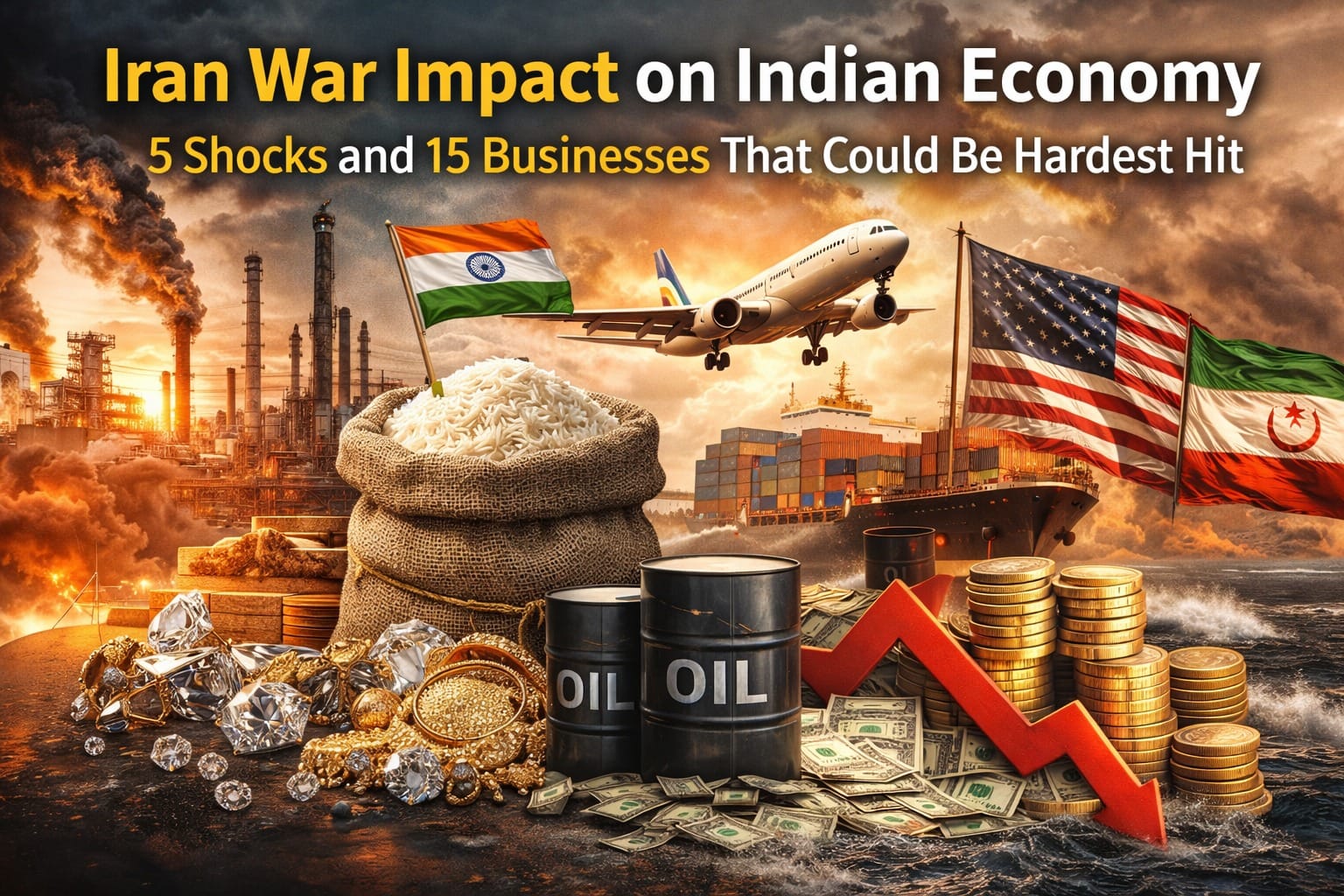
Iran War Impact on Indian Economy
Introduction
The escalating Iran war is not just a geopolitical crisis—it is already beginning to affect global markets and economies, including India.
India is one of the world’s largest importers of crude oil and a major exporter of goods to the Middle East. Any disruption in the region—especially around the Strait of Hormuz, through which nearly 20% of global oil trade flows—can have a direct impact on India’s economy.
From rising crude oil prices and a weakening rupee to disrupted exports and higher logistics costs, the Iran conflict could trigger multiple economic shocks across sectors.
Experts say that while some industries are seeing immediate impact, several other businesses may experience second-order effects in the coming weeks.
Here are five major ways the Iran war could impact the Indian economy and at least fifteen business sectors that may feel the ripple effects.
1. Higher Crude Oil Prices Could Push Inflation Up
The most immediate impact of the Iran war is the rise in global crude oil prices.
India imports nearly 85% of its crude oil requirements, which makes the economy extremely sensitive to oil price fluctuations.
If tensions in the Middle East disrupt oil supply routes or production, global oil prices could surge.
Why this matters for India
Higher crude oil prices affect almost every sector because oil is a core input in:
- Transportation
- Manufacturing
- Logistics
- Aviation
- Agriculture
As fuel costs rise, companies often pass these expenses to consumers, which leads to inflation across the economy.
Higher fuel prices also increase the cost of:
- Petrol and diesel
- Air travel
- Freight transportation
- Electricity generation
All of this eventually translates into higher cost of living for consumers.
Also read – Smart Investor Strategy when Stock Market Crashes
2. Freight and Insurance Costs Are Rising for Global Trade
Another major impact of the Iran conflict is the sharp increase in freight and marine insurance costs.
Shipping companies now consider parts of the Middle East and nearby sea routes as high-risk zones.
This means:
- Higher shipping insurance premiums
- Longer shipping routes
- Delays in cargo movement
For Indian exporters and importers, this results in compressed profit margins.
Industries that rely heavily on international shipping—such as textiles, electronics, and agriculture—may see their costs increase significantly.
3. The Indian Rupee Could Fall Further Against the U.S. Dollar
Another economic consequence of the Iran war could be a weaker Indian rupee.
When oil prices rise, India has to spend more dollars to import energy.
This increases demand for the U.S. dollar in the forex market and puts pressure on the rupee.
A weaker rupee leads to:
- More expensive imports
- Higher inflation
- Increased cost of raw materials
This effect is especially problematic for industries that rely on imported inputs.
4. Aviation Disruptions and Flight Cancellations
The conflict has also created significant disruptions in international air routes.
Many airlines are now avoiding Middle Eastern airspace due to security concerns.
As a result:
- Flights are being cancelled or rerouted
- Travel time is increasing
- Operational costs for airlines are rising
This directly affects the aviation sector and also reduces business travel.
When business travel declines, several sectors suffer, including:
- Hospitality
- Tourism
- International trade
- Corporate services
5. Spike in NRI Remittances but Lower Domestic Consumption
Interestingly, one unusual impact of the conflict could be a temporary rise in remittances from Indians living abroad, especially those working in Gulf countries.
When geopolitical tensions increase, overseas Indians often send more money home as a safety measure.
However, economists say this may not immediately boost the economy.
Instead, households may choose to save the money instead of spending it, which could reduce consumption growth in the short term.
Second-Order Economic Impact: Businesses That Could Be Hit Next
While some sectors are already seeing immediate damage, several industries could soon experience secondary economic shocks.
These impacts could affect at least 15 types of businesses across India.
Basmati Rice Exports Face Major Disruption
Iran is the largest buyer of Indian Basmati rice, followed by Iraq.
Together with Gulf countries, the region accounts for more than 50% of India’s Basmati rice exports.
Currently, more than 200,000 tonnes of Basmati rice shipments are stuck on ships due to disruptions in regional trade routes.
What this means
If exports remain blocked:
- Rice may flood the domestic market
- Domestic rice prices could fall
- Exporters may suffer heavy losses
Farmers and rice traders could be significantly affected if shipments remain stalled.
Gems, Jewellery and Diamonds Sector Under Pressure
India’s gems and jewellery industry—particularly in Surat—could also face serious disruption.
More than half of India’s gold and rough diamond imports come through Dubai, which acts as a major global trading hub.
If trade routes remain disrupted:
- Gold imports could slow down
- Diamond processing may decline
- Jewellery exports could fall
This directly impacts businesses in:
- Surat
- Mumbai
- Jaipur
These cities are major centers of India’s jewellery trade.
Textile and Garment Industry Facing Rising Costs
Surat’s textile industry could be hit again because polyester yarn and synthetic fabric prices are rising.
Higher shipping costs and disrupted supply chains mean that manufacturers may have to pay more for raw materials.
At the same time, exporting finished garments becomes more expensive.
This double pressure—higher costs and weaker exports—could squeeze profit margins for garment manufacturers and exporters.
Paint, Tyre and Chemical Industries
Several manufacturing industries depend heavily on petrochemical raw materials, which are directly linked to crude oil prices.
Industries that could face higher costs include:
- Paint manufacturers
- Tyre manufacturers
- Chemical companies
- Plastic manufacturers
If oil prices remain elevated, these industries may increase product prices to protect margins.
Fertilizer Supply Disruptions Could Hit Agriculture
India imports a large portion of its sulphur-based fertilizers from Gulf countries.
Experts estimate that nearly 70% of India’s sulphur fertilizer imports come from the Gulf region.
If trade disruptions continue:
- Fertilizer supply may decline
- Prices may rise
- Farmers could face higher input costs
This could impact India’s upcoming sowing season in June, potentially pushing food prices higher.
International Travel Industry Could Slow Down
Travel agents and tourism businesses are also preparing for a slowdown.
With airlines cancelling or rerouting flights, international travel may become:
- More expensive
- Less convenient
- Less frequent
As a result, travel companies may shift their focus toward domestic tourism destinations within India.
Businesses That Could Be Affected
Based on current trends, at least 15 types of businesses could face direct or indirect impact from the Iran war:
- Oil marketing companies
- Airlines
- Shipping companies
- Logistics firms
- Rice exporters
- Rice traders
- Gems and jewellery exporters
- Diamond processing units
- Textile manufacturers
- Garment exporters
- Paint companies
- Tyre manufacturers
- Chemical manufacturers
- Fertilizer importers
- International travel agencies
Conclusion
The Iran war is a reminder that geopolitical conflicts can quickly ripple across global economies.
For India, the immediate risks include:
- Rising oil prices
- Currency depreciation
- Export disruptions
- Higher manufacturing costs
- Supply chain instability
While the full economic impact will depend on how long the conflict lasts, businesses across sectors are already preparing for a period of volatility and uncertainty.
From agriculture and manufacturing to aviation and trade, the effects of the Iran war may soon be felt far beyond the battlefield—reaching markets, industries, and households across India.
Subscribe to Our YouTube Channel The Logic Stick for more video insights