





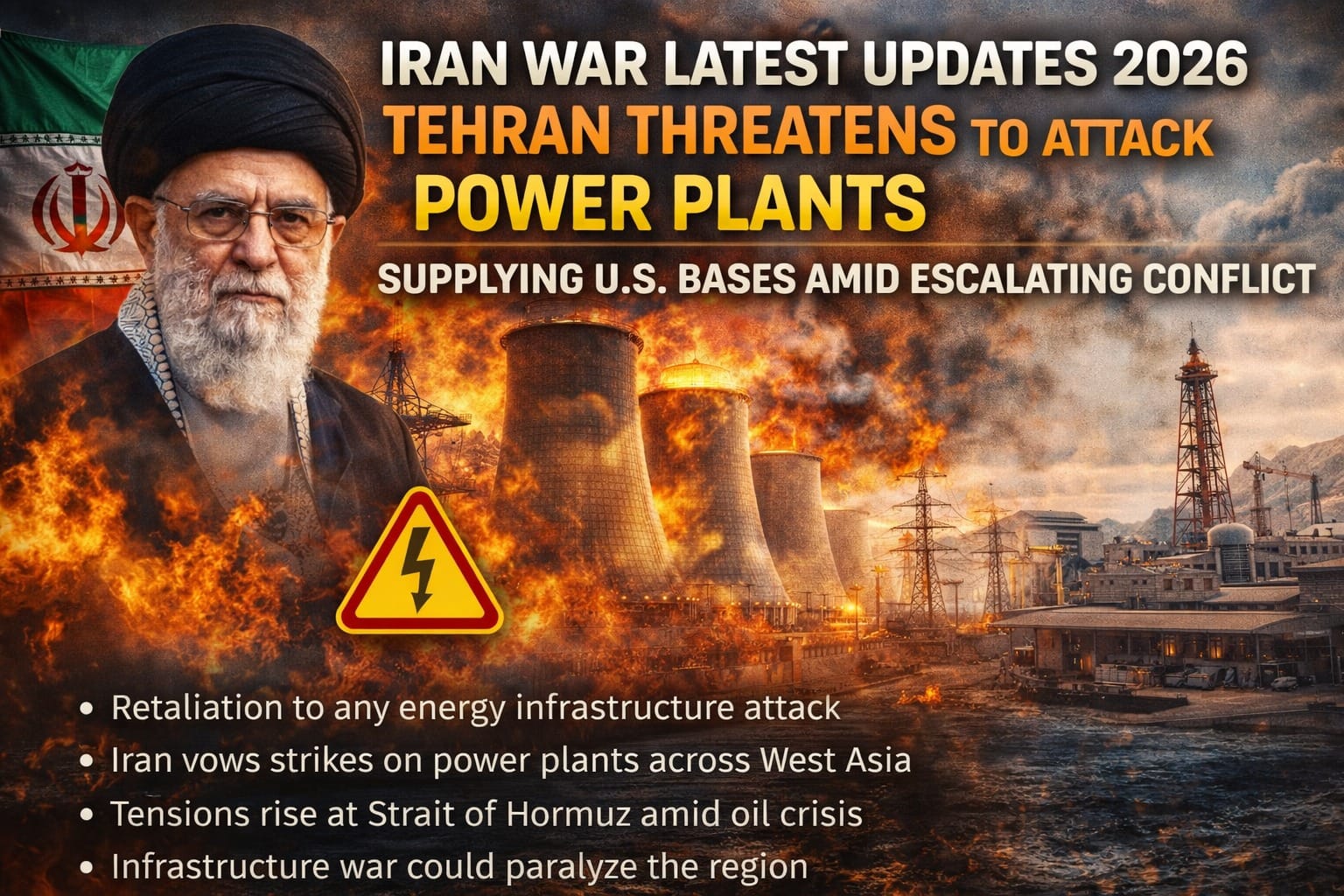
Iran War Latest Updates 2026: Tehran Threatens to Attack Power Plants
The ongoing Iran war in 2026 has entered one of its most dangerous phases yet, with Tehran issuing a direct and alarming warning:
it may attack electrical plants and energy infrastructure powering U.S. military bases across West Asia.
This escalation follows weeks of intense fighting between Iran, Israel, and U.S.-backed forces, turning the conflict into a multi-front regional crisis with global consequences.
From missile strikes and naval confrontations to threats against energy grids and water systems, the war is rapidly transforming into what analysts describe as “infrastructure warfare”—where electricity, oil, and water are becoming primary targets.
Iran’s Latest Threat: Targeting Power Plants Across West Asia
According to the latest updates, Iran has made it clear that:
- If its own energy infrastructure is attacked, it will respond by targeting power plants across the region
- These include facilities that supply electricity to U.S. military bases and allied operations
This reflects a tit-for-tat retaliation strategy, where:
- Any strike on Iran’s power grid
- Will lead to proportional attacks on regional infrastructure
Iran’s Revolutionary Guard has reinforced this position, warning that energy infrastructure linked to the U.S. or Israel will be considered legitimate targets.
What Triggered This Escalation?
The latest threats come after increasing pressure on Iran’s critical infrastructure.
Key Trigger Points:
- Threats to Iranian Power Plants
Iran has faced warnings that its own power plants could be targeted, especially if it continues disrupting maritime routes and military operations. - Closure of the Strait of Hormuz
Iran’s actions in restricting or threatening to shut down the Strait—through which around 20% of global oil passes—have intensified tensions. - Attacks on Energy Facilities
Israel’s strikes on Iran’s South Pars gas field, which affected about 12% of its gas production, have further escalated the situation. - Early War Incidents
Allegations of attacks on water desalination plants early in the war set a precedent for targeting civilian-linked infrastructure.
Missile and Drone War: The Ground Reality
The conflict has already seen heavy military exchanges.
Latest War Developments:
- Iran has launched hundreds of missiles toward Israel, with a high interception rate
- Drone strikes have targeted military bases near Baghdad airport
- Missile attacks have reached sensitive nuclear-linked locations
- Israel continues to strike deep inside Iranian territory
The war is no longer confined to two countries—it now involves:
- Lebanon (via Hezbollah)
- Gulf nations
- U.S. bases across West Asia
Also read – Iran charges $2 Million for every ship that passes through the Strait of Hormuz
The Rise of Infrastructure Warfare
One of the most alarming developments is the shift toward targeting civilian and strategic infrastructure.
What Is Being Targeted?
- Power plants
- Oil and gas facilities
- Desalination plants (critical for water supply)
- Energy grids
Why This Matters:
Attacking infrastructure can:
- Collapse economies
- Disrupt daily life
- Trigger humanitarian crises
The World Health Organization has already warned that the conflict is at a “perilous stage,” especially with strikes near critical sites.
Why Power Plants Are Strategic Targets
Power plants are not just energy sources—they are the backbone of modern economies.
Impact of Power Grid Disruption:
- Military bases lose operational capability
- Oil and gas production halts
- Water desalination plants stop functioning
- Cities face blackouts
For example:
- Iran’s power infrastructure is heavily dependent on natural gas (up to 80%), making it both critical and vulnerable.
This is why:
Targeting power plants is equivalent to attacking an entire nation’s functioning
The Strait of Hormuz: The Global Flashpoint
At the center of this conflict is the Strait of Hormuz, the world’s most important oil chokepoint.
Why It Matters:
- Carries nearly 20% of global oil supply
- Connects Gulf oil producers to international markets
Current Situation:
- Iran has restricted or threatened to close the Strait completely
- Shipping traffic has dropped sharply
- The U.S. has deployed naval forces to reopen it
This has turned the Strait into:
A battlefield that controls the global economy
Global Economic Impact: Oil, Inflation, and Markets
The war is already having massive economic consequences.
Oil Prices:
- Surged above $100 per barrel
- Expected to rise further if disruptions continue
Supply Chain Impact:
- Oil shipments delayed
- Shipping routes disrupted
- Insurance costs skyrocketing
Broader Economic Effects:
- Inflation rising globally
- Stock markets facing volatility
- Risk of recession increasing
The International Energy Agency has described the situation as:
One of the worst energy disruptions since the 1970s
Regional Impact: West Asia on Edge
The threat to power plants has especially alarmed Gulf nations.
Why?
Many Gulf countries depend heavily on:
- Electricity grids
- Desalination plants for drinking water
For example:
- Countries like Qatar, UAE, and Bahrain rely almost entirely on desalinated water
An attack on these facilities could:
- Trigger water shortages
- Create humanitarian crises
- Destabilize entire governments
U.S. and Allies: Preparing for Escalation
The United States and its allies are preparing for potential escalation.
Current Actions:
- Deployment of naval forces in the Gulf
- Military readiness to protect energy routes
- Consideration of strikes on Iranian infrastructure
However, there is also concern that:
- Any direct strike on Iranian power plants
- Could trigger massive retaliation across the region
Iran’s Strategy: Deterrence Through Retaliation
Iran’s current strategy can be summed up in one line:
“If you hit us, we hit everything.”
Key Elements:
- Proportional Retaliation
Any attack will be matched or escalated - Regional Expansion
Conflict will spread beyond Iran - Economic Pressure
Targeting global oil supply - Psychological Warfare
Creating uncertainty and fear
How the War Is Expanding Beyond Borders
This is no longer a bilateral conflict.
Involved or Affected Regions:
- Iran
- Israel
- Lebanon
- Iraq
- Gulf nations
- International shipping lanes
Even countries not directly involved are feeling the impact through:
- Oil prices
- Trade disruptions
- Market instability
Why This Situation Is Extremely Dangerous
Several factors make this phase of the war particularly risky:
1. Civilian Infrastructure at Risk
Attacks on:
- Power
- Water
- Energy
can cause long-term damage beyond military targets.
2. Multi-Front Conflict
Simultaneous fighting in:
- Iran
- Israel
- Lebanon
- Gulf region
3. No Clear Exit Strategy
Neither side appears willing to:
- De-escalate
- Enter negotiations
Possible Scenarios: What Happens Next?
Scenario 1: Full Infrastructure War
- Power plants and water systems targeted
- Massive regional collapse
Scenario 2: Naval Conflict Escalates
- Strait of Hormuz becomes fully blocked
- Global oil crisis deepens
Scenario 3: Diplomatic Intervention
- International pressure forces de-escalation
Scenario 4: Regional War Expansion
- More countries drawn into the conflict
Conclusion: A War Redefining Modern Conflict
The latest Iran war updates reveal a conflict that is no longer just about military strikes.
It is about:
- Energy control
- Economic disruption
- Infrastructure dominance
Iran’s threat to attack power plants supplying U.S. bases marks a critical shift:
From battlefield warfare → to system-level warfare
And in this new kind of war:
- Electricity is a weapon
- Oil is leverage
- Water is power
As the situation continues to evolve, one thing is clear:
This conflict has the potential to reshape not just the Middle East—but the global order itself.
Subscribe to our YouTube Channel The Logic Stick for more video insights