







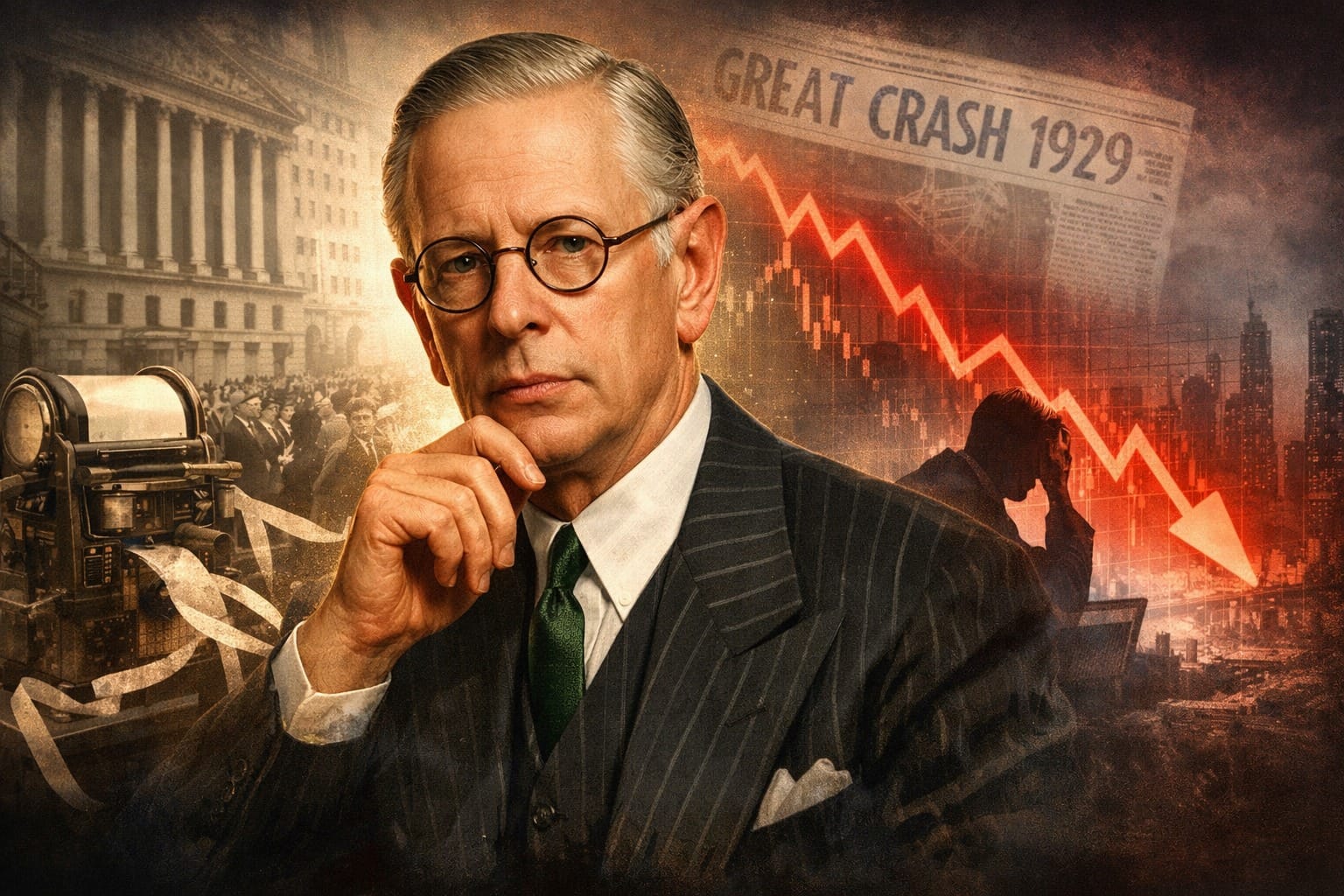
When people talk about the greatest traders in history, one name consistently rises above the rest — Jesse Livermore.
Often referred to as “The Boy Plunger” and “The Great Bear of Wall Street”, Jesse Livermore was not just a trader; he was a phenomenon who shaped modern stock market trading psychology.
Despite living in the early 20th century — long before computers, indicators, or algorithmic trading — Livermore developed principles that traders still follow today. Ironically, his life was a mix of extreme wealth, devastating losses, brilliance, and tragedy.
WATCH VIDEO IN HINDI
This article explores everything Jesse Livermore did, his money-making skills, failures, his legendary book How to Trade in Stocks, and why his techniques continue to benefit traders even in today’s markets.
Who Was Jesse Livermore?
Jesse Lauriston Livermore was born in 1877 in Shrewsbury, Massachusetts. He ran away from home at the age of 14 and began working as a quotation board boy in a brokerage firm, manually writing stock prices on chalkboards.
What separated Livermore from everyone else was his ability to recognize patterns. He noticed that stocks behaved in recurring ways — rising, consolidating, breaking out, and collapsing — driven by human psychology, not random chance.
By his early twenties, Livermore had already made and lost several fortunes, an early indication of the volatile life that lay ahead.
Also read – Was Mahabharata a Nuclear War?
How Jesse Livermore Made His Money
1. Master of Price Action and Tape Reading
Livermore did not rely on balance sheets or company news. Instead, he focused on:
- Price movement
- Volume behavior
- Market momentum
This approach later came to be known as price action trading and tape reading.
He famously said:
“Markets are never wrong — opinions often are.”
Livermore believed that price reflects all known information, a concept that aligns closely with modern market efficiency theories.
2. Trend Following Before It Had a Name
One of Livermore’s greatest contributions was trend following.
He avoided buying stocks simply because they looked “cheap.” Instead, he:
- Bought stocks making new highs
- Sold stocks making new lows
- Held winning positions for extended periods
This mindset was revolutionary at the time, when most traders tried to pick bottoms and tops.
Today, this philosophy is used by:
- Institutional traders
- Hedge funds
- Quant strategies
3. The Famous 1907 and 1929 Market Crashes
Livermore’s legend was cemented during two historic events:
The Panic of 1907
Livermore shorted the market aggressively and reportedly made over $3 million, equivalent to tens of millions today.
The Great Crash of 1929
He correctly anticipated the collapse of the U.S. stock market and made an estimated $100 million — a staggering sum for that era.
These trades made him one of the most feared and respected traders on Wall Street.
Jesse Livermore’s Biggest Failures
Despite his brilliance, Livermore declared bankruptcy multiple times. His failures were not due to lack of knowledge but lack of discipline.
1. Ignoring His Own Rules
Livermore often violated his own principles:
- Overtrading
- Taking oversized positions
- Giving in to ego and overconfidence
He admitted that emotions, not lack of skill, caused his biggest losses.
2. Personal Life and Psychological Struggles
Livermore’s personal life was chaotic:
- Multiple marriages
- Strained family relationships
- Depression and loneliness
In 1940, Jesse Livermore tragically ended his life, leaving behind a suicide note expressing exhaustion with life and inner conflict.
His story serves as a sobering reminder that financial success does not guarantee emotional well-being.
Jesse Livermore’s Book: How to Trade in Stocks
Livermore documented his trading philosophy in the book How to Trade in Stocks, originally published in 1940.
Why This Book Is Special
Unlike typical finance books, this is not about formulas or indicators. Instead, it focuses on:
- Market psychology
- Human behavior
- Discipline and patience
- Risk control
The book is concise, direct, and brutally honest — written by someone who lived through both extreme success and failure.
Key Lessons from How to Trade in Stocks
- Follow the Market, Not Your Opinion
Livermore repeatedly emphasized that ego is a trader’s biggest enemy. - Cut Losses Quickly
He believed small losses were the “cost of doing business.” - Let Profits Run
Big money is made by staying in winning trades, not by frequent profit booking. - Never Average Down
Adding to losing positions was, according to Livermore, a recipe for disaster. - Trade Like a Business
Every trade should have a plan, risk limit, and exit strategy.
These principles form the backbone of modern professional trading.
How Jesse Livermore’s Techniques Help Traders Today
Even in today’s fast-paced, algorithm-driven markets, Livermore’s ideas remain remarkably effective.
1. Relevance in Modern Markets
- Trend following works across stocks, crypto, commodities, and forex
- Risk management rules are timeless
- Psychological discipline is more important than ever
Most modern trading systems are structured versions of Livermore’s core ideas.
2. Traders Who Follow Livermore’s Philosophy
Many successful traders and investors have acknowledged Livermore’s influence, including:
- William O’Neil (CAN SLIM method)
- Paul Tudor Jones (macro trend trading)
- Modern hedge fund managers using momentum strategies
3. Why Beginners Benefit the Most
Livermore’s methods protect beginners from:
- Overtrading
- Emotional decision-making
- Chasing tips and rumors
His rules encourage patience, structure, and self-awareness — traits most new traders lack.
What Makes Jesse Livermore Timeless
Jesse Livermore did not invent indicators or algorithms. What he understood deeply was human nature.
Markets rise and fall because:
- People get greedy
- People get fearful
- People repeat mistakes
As long as humans trade markets, Jesse Livermore’s principles will remain relevant.
Final Thoughts
Jesse Livermore’s life was a paradox — unmatched brilliance paired with personal tragedy. He showed the world how fortunes could be built by understanding trends, discipline, and psychology, yet also demonstrated how ignoring emotional health can destroy even the greatest minds.
For anyone serious about trading, studying Jesse Livermore is not optional — it is essential.
His story teaches us that mastering the market is important, but mastering yourself is critical.
SUBSCRIBE TO OUR YOUTUBE CHANNEL THE LOGIC STICK TO WATCH & LEARN HIS TRADING TECHNIQUES