







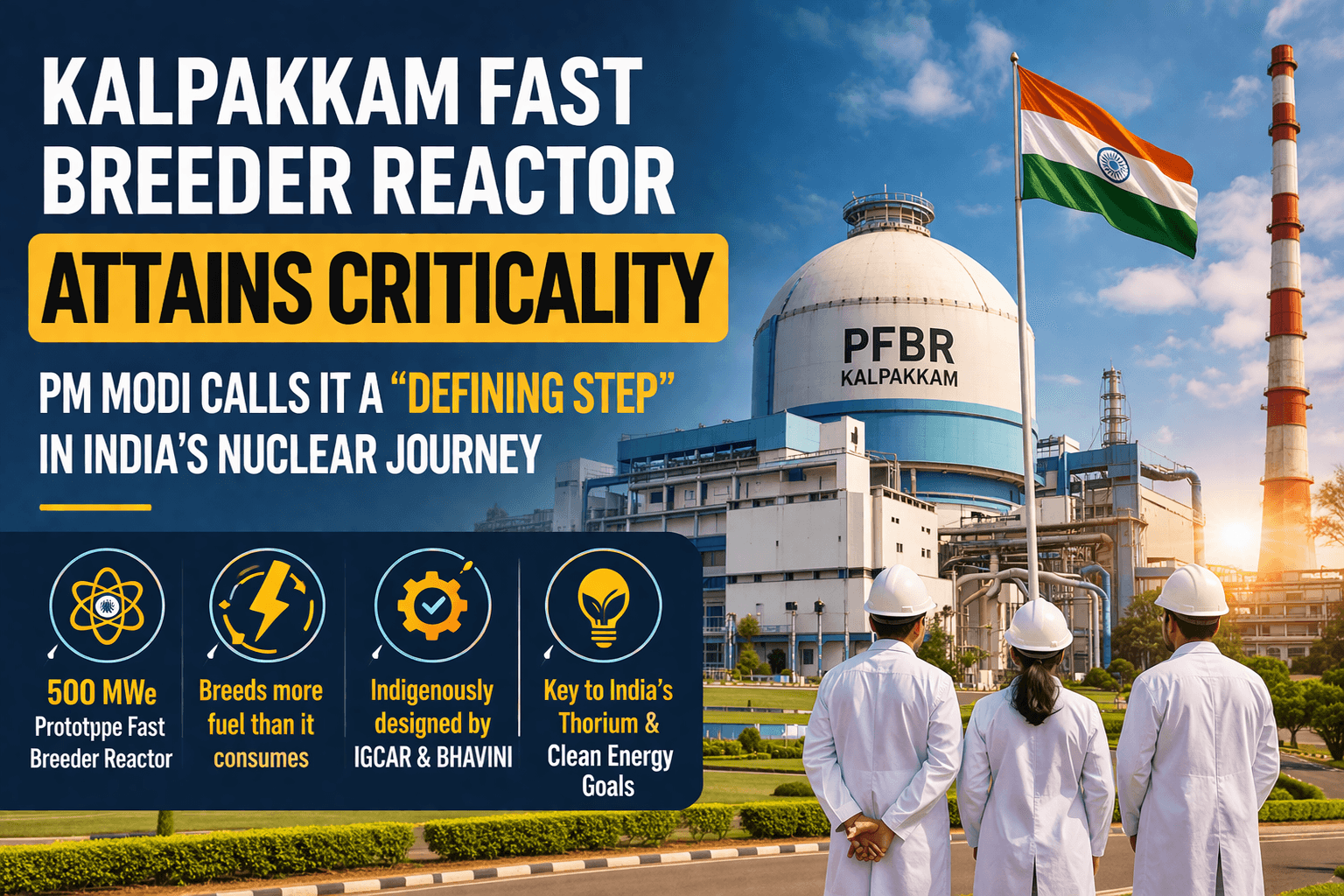
Kalpakkam Fast Breeder Reactor Attains Criticality: Why India’s Nuclear Milestone Matters
India has crossed a major milestone in its long-term nuclear energy journey with the Prototype Fast Breeder Reactor (PFBR) at Kalpakkam, Tamil Nadu, attaining first criticality on April 6, 2026. Prime Minister Narendra Modi called it a “defining step” in India’s civil nuclear journey, saying the achievement advances the second stage of the country’s nuclear programme and reflects the depth of India’s scientific and engineering capabilities. The Department of Atomic Energy said the 500 MWe reactor achieved first criticality at 8:25 PM after meeting Atomic Energy Regulatory Board safety stipulations.
This development is important not only because it marks the start of a controlled fission chain reaction in India’s first indigenously designed and built prototype fast breeder reactor, but also because it strengthens the country’s long-term plan to use its limited uranium more efficiently and eventually tap its vast thorium reserves. In practical terms, the Kalpakkam milestone is about energy security, low-carbon electricity, technological self-reliance, and the future of India’s three-stage nuclear power strategy.
The reactor in question is the 500 MWe Prototype Fast Breeder Reactor, built by Bharatiya Nabhikiya Vidyut Nigam Limited (BHAVINI) at the Kalpakkam Nuclear Complex, with technology development and design carried out by the Indira Gandhi Centre for Atomic Research (IGCAR) under the Department of Atomic Energy. Official statements describe the PFBR as indigenously developed, designed and commissioned, making it one of India’s most significant home-grown strategic energy projects.
To understand why this is such a big step, it is important to understand what criticality means. In nuclear engineering, first criticality is the point at which a reactor starts a self-sustaining controlled chain reaction. It does not mean the reactor has already begun full commercial electricity generation. Instead, it means the reactor has entered a crucial operational phase from which it will move through further testing, power ascension and commissioning steps before regular commercial operation. That distinction matters, because some reporting can blur the line between attaining criticality and becoming fully operational.
The PFBR is central to India’s famous three-stage nuclear power programme, a strategy originally envisioned by Dr. Homi Jehangir Bhabha. The first stage relies on Pressurised Heavy Water Reactors (PHWRs) using natural uranium. The spent fuel from that stage yields plutonium, which becomes the fuel base for the second stage—the fast breeder reactor stage. In the third stage, India aims to use thorium-based reactors, drawing on one of the world’s largest thorium reserves. Official government backgrounders say the Kalpakkam PFBR marks India’s entry into this second stage in a meaningful way.
What makes a fast breeder reactor different from a conventional thermal reactor is its ability to produce more fissile material than it consumes. According to the Department of Atomic Energy, the PFBR uses uranium-plutonium mixed oxide (MOX) fuel, while the reactor core is surrounded by a uranium-238 blanket. Fast neutrons convert this fertile uranium-238 into fissile plutonium-239, allowing the reactor to breed more usable fuel. The reactor is also designed to eventually use thorium-232 in the blanket, which through transmutation can be converted into uranium-233, the fuel expected to support India’s third-stage nuclear ambitions.
This is why the Kalpakkam Fast Breeder Reactor is often discussed in terms of nuclear fuel self-reliance. India does not have abundant high-grade uranium reserves compared to some other nuclear-powered countries, but it does have substantial thorium resources. A fast breeder programme can help India extract far more energy value from its available nuclear materials, close the fuel cycle more efficiently, and reduce long-term dependence on imported fuel resources. The Department of Atomic Energy has explicitly linked the PFBR’s first criticality to long-term energy security and better utilisation of domestic resources.
Prime Minister Modi’s reaction also made the strategic importance of the event clear. In his official statement released by the Prime Minister’s Office, he said India had taken a defining step in its civil nuclear journey and that the advanced reactor, capable of producing more fuel than it consumes, reflects the strength of India’s engineering enterprise. He also said the milestone is a decisive step toward harnessing India’s thorium reserves in the third stage of the programme.
Another important fact worth highlighting is that the reactor attained criticality only after the Atomic Energy Regulatory Board (AERB) issued clearance following a rigorous safety review of plant systems. That detail matters in any fact-checked article because it underscores that the milestone was not simply symbolic or political; it followed a formal regulatory process tied to nuclear safety requirements. The official DAE statement specifically mentions that criticality was achieved in the presence of top DAE, IGCAR and BHAVINI officials after all stipulations were met.
From an energy policy standpoint, the PFBR arrives at a time when India is trying to balance three goals at once: rising electricity demand, lower carbon emissions, and energy independence. Nuclear power is seen as a source of reliable low-carbon baseload electricity, meaning it can complement intermittent renewable sources such as solar and wind. Government material on the PFBR frames this milestone as part of India’s broader clean-energy push and links it to the country’s long-term net zero by 2070 direction.
The Kalpakkam achievement also speaks to the Atmanirbhar Bharat narrative, though the real significance goes beyond a slogan. Advanced nuclear reactors involve demanding work in metallurgy, fuel design, sodium coolant systems, reactor physics, materials engineering, safety systems, and large-scale industrial fabrication. The DAE says the PFBR incorporates advanced safety systems, high-temperature liquid sodium coolant technology, and a closed fuel cycle approach that allows recycling of nuclear materials and reduction of waste. In other words, this is not just about one reactor; it is about the industrial and scientific ecosystem built around it.
One claim that needs careful phrasing in a fact-checked article concerns India’s global position. The latest PIB background note says that once fully operational, India will become only the second country after Russia to operate a commercial fast breeder reactor. That wording is important. India has now achieved first criticality at the PFBR, but it has not yet fully crossed into commercial fast breeder operation. So the accurate way to describe the situation is that India has moved significantly closer to joining that exclusive group, not that it has already fully done so.
The success at Kalpakkam has also taken years of scientific effort and institutional persistence. The reactor has long been regarded as one of the most complex projects in India’s nuclear establishment. While this article focuses on the present milestone, the broader takeaway is that India has kept investing in a programme that many countries have found technologically difficult and financially demanding. First criticality does not erase those challenges, but it does show that the project has crossed one of its most important technical thresholds.
For readers outside the nuclear sector, the easiest way to understand the significance is this: the Kalpakkam PFBR is not just another power plant story. It is a story about whether India can build a long-term domestic energy architecture based on its own resource profile. If the fast breeder and thorium pathway matures over time, it could reshape the way India thinks about strategic fuel security and clean electricity generation for decades.
Read more on Tamil Nadu Custodial Death Case.
The reactor’s first criticality therefore carries scientific, strategic and symbolic weight all at once. Scientifically, it validates years of indigenous research and design. Strategically, it strengthens India’s second-stage nuclear programme and its future thorium roadmap. Symbolically, it projects confidence in India’s ability to execute a difficult advanced-energy project with domestic capability.
In the coming months, attention will shift to the next phases of testing, commissioning and eventual power generation. But even at this stage, the significance is clear. The Kalpakkam Fast Breeder Reactor’s attainment of first criticality is one of the most consequential developments in India’s civil nuclear programme in years. It is a milestone that connects India’s past nuclear vision to its future energy strategy.
For India, this is not merely a technical success. It is a statement that the country intends to stay in the race for advanced nuclear technology, deepen its clean-energy base, and convert long-discussed strategic plans into operational reality. That is why the Kalpakkam reactor’s criticality milestone matters far beyond Tamil Nadu or the nuclear establishment. It matters to the story India is trying to tell about self-reliance, science, and long-term energy security.