







Khalistani Protests Outside Hindu Temples in Canada After Bill C-9 Passage Raise New Concerns
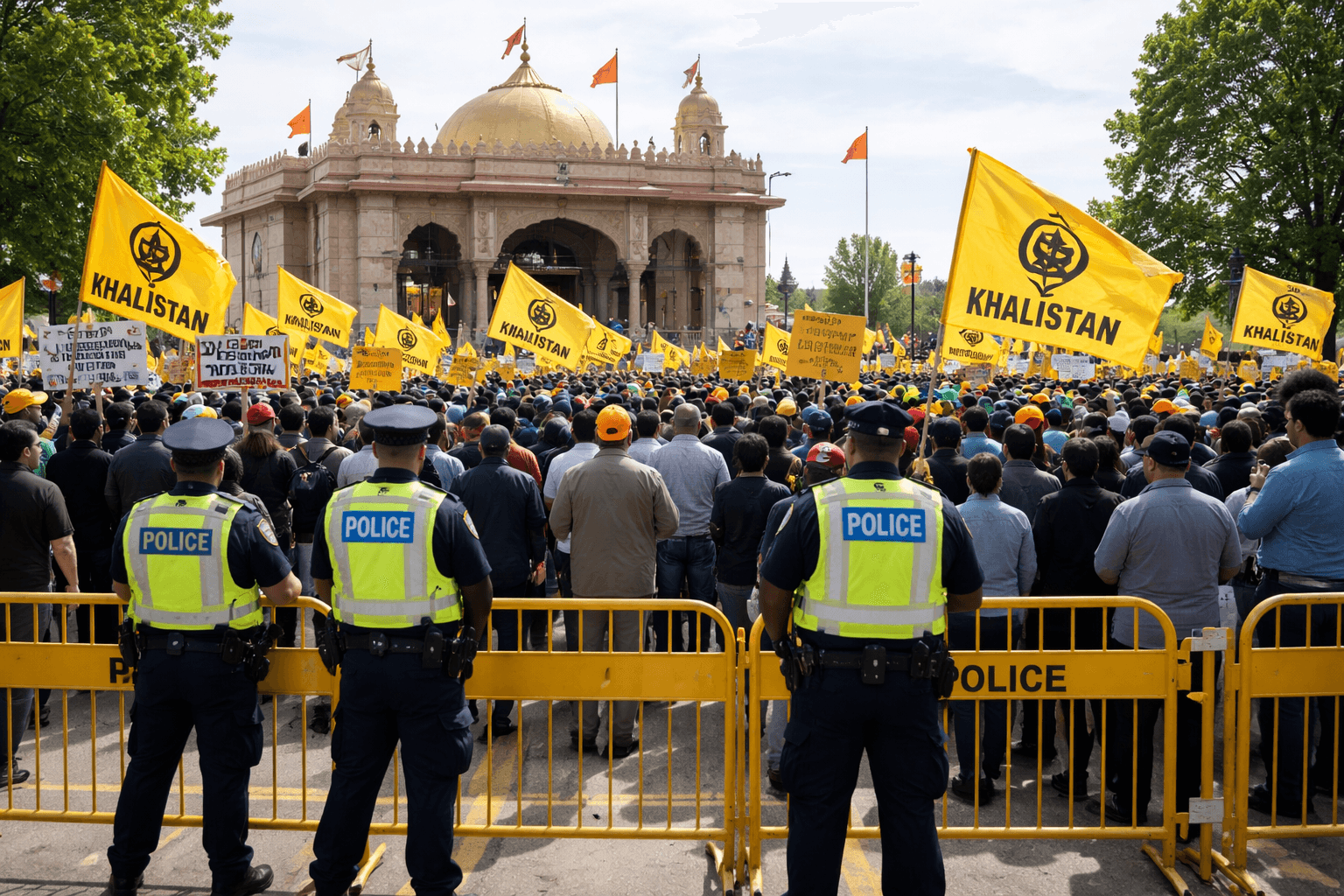
Protests linked to the pro-Khalistan group Sikhs for Justice (SFJ) outside Hindu temples in Canada have again pushed diaspora tensions into public view. On April 5, 2026, demonstrations were held near Triveni Mandir in Brampton, Ontario, and Lakshmi Narayan Mandir in Surrey, British Columbia, just days after Canada’s House of Commons passed Bill C-9, a hate-crime and access-to-worship bill that would create new criminal offences related to intimidation, obstruction, hate-motivated crime, and the public display of certain hate or terrorist symbols. The bill has not yet become law; it still requires Senate passage and royal assent.
The timing of the rallies has made the story especially sensitive. India Today, Hindustan Times, and other outlets reported that the demonstrations were called by Sikhs for Justice, an organisation that is banned in India, and that the protests were widely viewed as a reaction to Bill C-9 and the debate surrounding demonstrations outside places of worship. What is clear from the current reporting is that the protests did take place near the two temples named above, and that Canadian law enforcement had prepared in advance with public warnings and restrictions.
A key correction is important here: some social-media conversations and derivative reports have framed Bill C-9 as though it already bans all protests outside temples and churches across Canada. That is not accurate. Bill C-9, as passed by the House of Commons on March 25, 2026, proposes amendments to the Criminal Code. According to the Parliament of Canada text and the Department of Justice charter statement, the proposed law would create new offences for conduct intended to provoke fear in order to impede access to religious or cultural institutions, for intentional obstruction of lawful access, for a stand-alone hate crime offence, and for wilfully promoting hatred through the display of certain hate or terrorist symbols in public places. It is therefore more precise to say the bill targets intimidation, obstruction, and hate-related conduct, not peaceful protest in the abstract.
That distinction matters because it shapes how this story should be understood. The controversy is not simply about one protest or one community; it sits at the intersection of public order, freedom of expression, religious access, and diaspora political activism. Supporters of the bill argue it is a necessary response to rising hate incidents and intimidation around places of worship. Critics, including some civil-liberties and religious-freedom voices, have argued parts of the bill could have broader speech implications. That broader debate was already underway before the Brampton and Surrey demonstrations took place.
Ahead of the April 5 rallies, Peel Regional Police issued a public warning that “unlawful acts and criminal behaviour will not be tolerated” and added that “hate has no place here,” while also affirming support for lawful and peaceful assembly. That statement is one of the strongest verified indicators that authorities expected tensions and were preparing to manage them closely. In Surrey, reporting also indicated that the temple sought and obtained protective legal restrictions, while other reports said local enforcement kept protesters from coming within 100 metres of the premises.
Based on the available reporting, the demonstrations passed without a major violent incident on the day, though community groups said the very act of rallying near temples amounted to harassment and intimidation. Hindustan Times reported that Indo-Canadian community organisations expressed alarm and said worshippers should not be made to feel unsafe at sacred spaces. Temple-linked and Hindu community statements similarly argued that places of worship should not be turned into venues for political provocation. Those reactions reflect the central concern driving support for stronger legal safeguards: even where no mass clash occurs, repeated protest targeting around religious institutions can still create fear among devotees and local residents.
The names of the two temples involved are also important because they place the story inside a broader recent pattern of concern among Hindu organisations in Canada. Triveni Mandir in Brampton and Lakshmi Narayan Mandir in Surrey had already become the focus of advance warnings before April 5, after SFJ publicly called for “Khalistan Zindabad” rallies at those locations. Earlier coverage noted that temple authorities in Surrey were seeking court-backed protections because the city did not have the same bylaw framework being cited in Brampton-related reporting.
That broader context extends to Canada’s ongoing struggle with politically charged diaspora activism. Over the past few years, pro-Khalistan demonstrations, vandalism cases, and diplomatic friction linked to separatist activism have repeatedly strained India-Canada ties. This latest round of temple-focused protests therefore lands in an already tense environment. It is one reason the story has drawn attention not only from Indian media outlets but also from Canadian political and community observers watching how authorities balance civil liberties with safety around religious sites.
Another correction is necessary on terminology. Some reports and social posts use the word “attacked” loosely, but based on the verifiable sources currently available, the most defensible wording is that the temples were targeted by protests or demonstrations, not that they were physically attacked on April 5. That distinction matters for accuracy. Verified coverage supports that protests occurred outside or near the temples and that security measures were enforced; it does not, from the currently checked sources, establish a new act of temple vandalism or a confirmed physical assault at the demonstrations themselves.
Bill C-9 itself is likely to remain central to the discussion in the coming weeks. Parliament’s published text describes the legislation as the Combatting Hate Act, and official materials show it has already passed third reading in the House of Commons. The next formal step is the Senate, after which royal assent would be required before any new provisions take effect. That means the April 5 rallies happened during a political moment when the bill had cleared an important hurdle but was not yet enforceable as law. Any article suggesting protesters had already violated a newly enacted federal ban would therefore be overstating the current legal situation.
At the same time, the protests have reinforced why the legislation has found support among many community groups. The federal petition and justice materials tied to Bill C-9 make clear that lawmakers were responding to concern about intimidation and obstruction at places of worship, schools, and community centres used primarily by identifiable groups. Whatever one’s view of the bill’s exact drafting, the Brampton and Surrey incidents have given supporters a fresh example to point to in arguing that religious access must be protected more clearly under Canadian criminal law.
For Hindu Canadians, the concern is immediate and practical: whether families can attend temple services without being confronted by politically charged crowds nearby. For defenders of protest rights, the question is whether the state can prevent intimidation without infringing on lawful expression. Those two concerns now sit at the center of the public conversation. The police response over the weekend suggests authorities are already trying to draw that line operationally: peaceful assembly may be permitted, but intimidation, obstruction, or criminal conduct will not be.
Read more on Trumps Budget Plan.
This episode also illustrates a recurring challenge for multicultural democracies. Political conflicts rooted in homeland issues often reappear inside diaspora communities, where identity, religion, free speech, and geopolitics overlap in highly visible ways. In Canada, that overlap has become especially fraught when temples, gurdwaras, consulates, and public memorial sites become symbolic stages for wider ideological battles. The Brampton and Surrey protests were not isolated in that sense; they were the latest expression of a larger dispute that governments have struggled to contain without inflaming it further.
What happens next will depend on two parallel tracks. The first is legal: whether Bill C-9 advances through the Senate and whether any final version changes in substance before royal assent. The second is administrative: whether local police, municipalities, courts, and community leaders can prevent future demonstrations near places of worship from escalating into intimidation or confrontation. The April 5 protests did not produce the worst-case outcome many had feared, but they did underline the fragility of public trust around religious security in Canada.
For now, the verified facts are straightforward. Pro-Khalistan protesters linked to SFJ demonstrated near two Hindu temples in Brampton and Surrey on April 5, 2026. Police and local protections were in place. Bill C-9 had passed the House of Commons on March 25 but had not yet become law. The protests intensified an already charged debate over hate, intimidation, protest rights, and the protection of places of worship in Canada. Everything beyond that should be reported carefully, without exaggeration.