







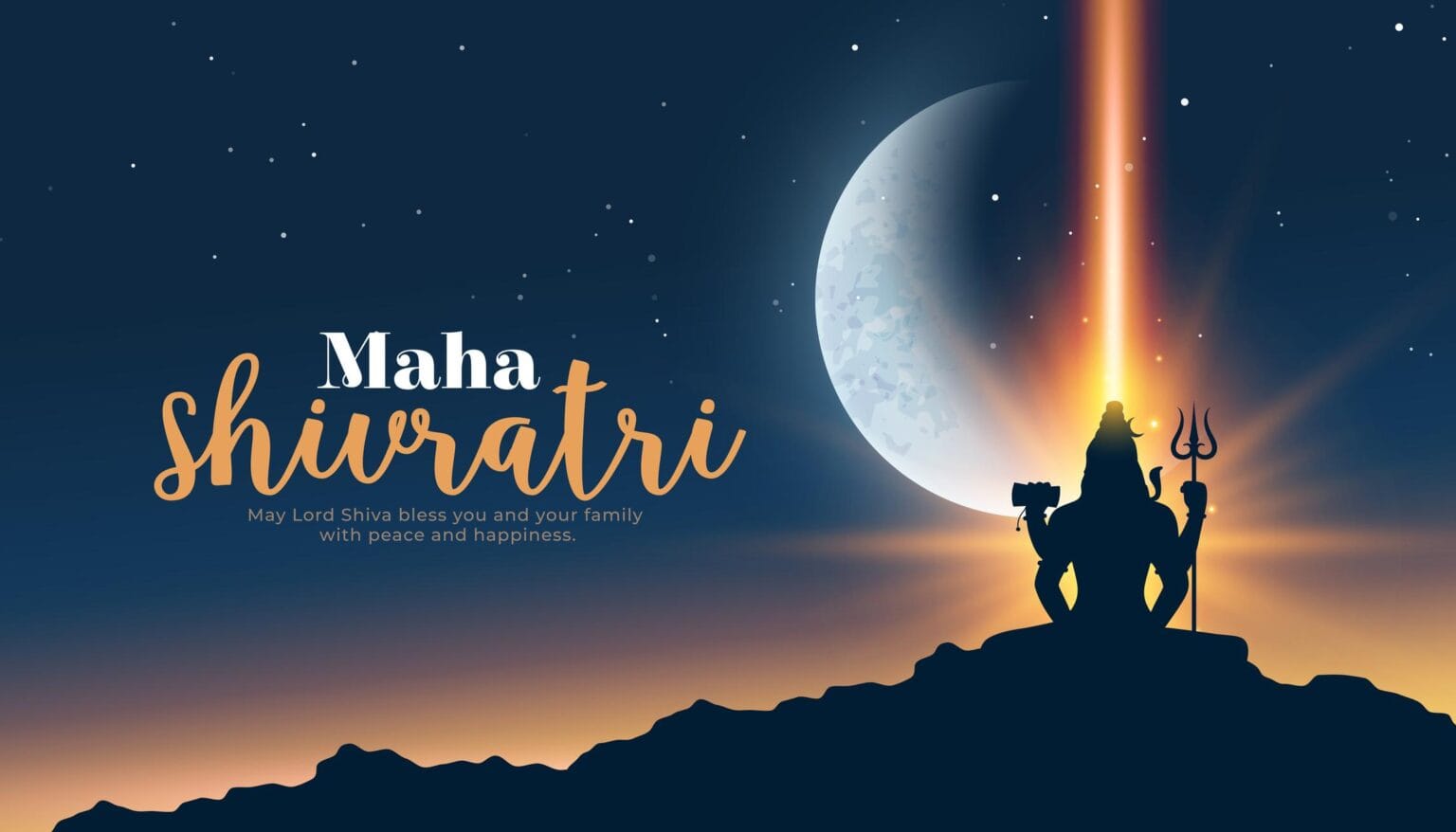
Introduction: Why Mahashivratri Is Not Just Another Festival
Mahashivratri, literally meaning “The Great Night of Shiva,” is one of the most powerful and spiritually charged observances in the Hindu calendar. Unlike festivals associated with celebration, colour, or social gathering, Mahashivratri is marked by silence, introspection, fasting, meditation, and surrender.
Celebrated on the 14th night of the dark fortnight (Krishna Paksha) in the month of Phalguna (February–March), Mahashivratri is believed to be the night when cosmic energies are at their peak, making it an unparalleled time for spiritual transformation.
This is not merely a religious event — it is a cosmic phenomenon, a psychological discipline, and a spiritual gateway that has endured for thousands of years across India and beyond.
Who Is Lord Shiva? Understanding the Core Before the Festival
One must first understand Shiva, not just as a god, but as a principle.
Shiva is:
- The Destroyer in the Hindu Trinity (Trimurti)
- The Adiyogi (first yogi)
- The Lord of Time (Mahakaal)
- The symbol of detachment, consciousness, and transformation
Unlike other deities associated with wealth, power, or prosperity, Shiva represents:
- Renunciation
- Stillness
- Awareness
- Liberation (moksha)
Mahashivratri is not about worshipping Shiva to gain something material — it is about becoming aligned with Shiva’s state of being.
Historical Origins
Vedic and Pre-Vedic Roots
The worship of Shiva predates written history. Archaeological findings from the Indus Valley Civilization (circa 2500 BCE) show seals depicting a yogic figure (often identified as Pashupati) surrounded by animals — widely believed to be an early form of Shiva worship.
The Rig Veda references Rudra, the fierce storm deity, who later evolved into Shiva — a synthesis of destruction and compassion.
By the time of the Puranas (circa 300 BCE – 500 CE), Mahashivratri had become firmly established as a night dedicated to Shiva’s supreme consciousness.
Also read – Was Mahabharat a Nuclear War?
Mythological Significance: Why This Night Is Sacred
Mahashivratri is powerful because multiple cosmic events converge on this single night. Hindu scriptures describe several major occurrences linked to this date.
1. The Night of Shiva–Parvati Union
One of the most widely believed legends states that Mahashivratri marks the divine marriage of Lord Shiva and Goddess Parvati.
This union is not symbolic of romance but of Shakti (energy) merging with Shiva (consciousness) — the balance required for creation to function.
Spiritually, it represents:
- Masculine and feminine balance
- Stillness meeting movement
- Awareness meeting energy
This is why Mahashivratri is considered auspicious for:
- Marriage
- Relationship harmony
- Inner balance
2. The Night Shiva Performed the Tandava
Another legend states that on Mahashivratri, Shiva performed the cosmic dance — the Tandava.
The Tandava represents:
- Creation
- Preservation
- Destruction
- Concealment
- Liberation
This makes the night when time dissolves, ego collapses, and transformation becomes possible.
3. The Night of Neelkanth: Churning of the Ocean (Samudra Manthan)
During the cosmic churning of the ocean, a deadly poison (Halahala) emerged that threatened to destroy all creation.
Shiva consumed the poison to save the universe, holding it in his throat — turning it blue and earning him the name Neelkanth.
Mahashivratri commemorates:
- Supreme sacrifice
- Control over ego and desire
- Responsibility over power
This story is why devotees offer water, milk, and bilva leaves — symbols of cooling and purification.
Why It Is Considered Spiritually Powerful
Mahashivratri is not powerful because of mythology alone — it is powerful because of astronomical and physiological alignment.
1. Planetary & Cosmic Alignment
Ancient yogic sciences observed that on Mahashivratri:
- The northern movement of energy (Uttarayana) intensifies
- The spinal energy naturally rises
- Meditation becomes easier even for beginners
This is why sages emphasized night-long wakefulness (jagran) — staying conscious as the body naturally inclines toward stillness.
2. Psychological & Neurobiological Impact
From a modern lens:
- Fasting increases mental clarity
- Sleep deprivation alters consciousness
- Meditation lowers ego-driven thought patterns
IT creates a controlled altered state of awareness, which yogis have used for centuries to access deeper consciousness.
Why Fasting Is Central to Mahashivratri
Fasting on Mahashivratri is not punishment — it is detachment.
By reducing food intake:
- The digestive system rests
- Energy moves upward
- The mind becomes sharper
Traditional fasting includes:
- Fruits and milk
- Water-only fast
- Complete nirjala fast (advanced practitioners)
The goal is not endurance but awareness.
The Symbolism of Shiva Lingam
The Shiva Lingam is often misunderstood as a religious idol. In truth, it represents:
- Infinite formless energy
- The axis of creation
- The union of consciousness and matter
The oval shape symbolizes the universe without beginning or end.
Offering water over the lingam signifies:
- Flow of life
- Surrender of ego
- Purification of inner energy
Why Staying Awake All Night Matters
It emphasizes night-long vigil because:
- Darkness symbolizes ignorance
- Staying awake symbolizes awareness
- Consciousness overcomes inertia
In yogic tradition, this is the night when enlightenment becomes accessible, not through effort but alignment.
Faith Across India: One Festival, Many Expressions
Mahashivratri is observed across India, but its expression varies:
- In North India: temple visits, fasting, bhajans
- In South India: abhishekam rituals
- In Kashmir: Herath festival
- In tribal regions: ancestral and nature worship
Yet the essence remains the same — Shiva as the supreme truth.
Why Mahashivratri Has Survived Thousands of Years
It has endured because:
- It is experiential, not dogmatic
- It invites introspection, not fear
- It adapts across eras
- It speaks to inner transformation, not external reward
In a world driven by consumption, Mahashivratri stands as a reminder of stillness, surrender, and self-realisation.
Why Rituals Matter on Mahashivratri (Beyond Blind Faith)
The rituals are not designed as symbolic gestures alone — they are structured spiritual technologies refined over centuries. Every action, from fasting to the holy dip, serves a physiological, psychological, and spiritual purpose.
Unlike celebratory festivals, Mahashivratri rituals are inward-facing. They strip away stimulation so awareness can rise.
The Significance of the Holy Dip
Why Bathing Is Central to the Observance
A holy dip (snan) on Mahashivratri is believed to:
- Cleanse karmic residue
- Prepare the body for spiritual practices
- Symbolise surrender of ego
In ancient India, water bodies were not only sacred but energetically calibrated spaces. Rivers were chosen based on geography, mineral composition, and flow — all of which affected the nervous system.
Why a Holy Dip Is Considered Powerful on This Day
On this day:
- Planetary positions support inward energy flow
- Cold water activates the vagus nerve
- Breath becomes controlled naturally
- Awareness increases post-bath
This is why even today, millions take ritual dips before beginning night-long worship.
Major Rivers Associated with Mahashivratri Snan
1. Ganga (Northern India)
The Ganga is believed to carry moksha-giving properties. Bathing in the river on Mahashivratri is said to dissolve lifetimes of karmic debt.
2. Kaveri (Southern India)
In South India, the Kaveri is closely associated with Shiva temples. Devotees believe the river carries subtle spiritual energy ideal for meditation.
3. Godavari (Central India)
Revered as the Ganga of the South, the Godavari holds immense importance for Shaivites, especially in Maharashtra and Telangana.
4. Narmada (Central India)
The Narmada is believed to be so pure that darshan alone grants spiritual merit — bathing on Mahashivratri is considered exceptionally potent.
The Science Behind Mahashivratri: How the Night Impacts the Mind and Body
1. Lunar Cycles, Human Biology, and Mental Stillness
Mahashivratri occurs on the darkest night of the lunar month, when the moon’s gravitational influence on the Earth is at one of its lowest points. Ancient yogic sciences observed that lunar cycles subtly affect human bodily fluids, hormonal balance, and neural activity, much like they influence ocean tides. On this night, the reduced lunar pull is believed to make the human mind less outward-seeking and more inward-focused, creating a natural inclination toward introspection.
This is one of the reasons Mahashivratri is traditionally associated with meditation, silence, and awareness rather than celebration or social activity. While modern science does not frame this in spiritual language, research acknowledges that circadian rhythms and environmental cycles can influence mood, focus, and cognitive states.
2. Fasting, Wakefulness, and Altered States of Awareness
From a physiological perspective, the practices associated with Mahashivratri create a controlled shift in consciousness. Fasting reduces digestive workload, allowing energy to be redirected toward the brain, which often results in heightened mental clarity. Staying awake through the night alters sleep cycles, temporarily reducing habitual thought loops and increasing alertness.
Cold-water bathing stimulates the nervous system and activates the vagus nerve, which plays a role in emotional regulation and calmness. When fasting, night-long wakefulness, breath control, and meditation are combined, the body enters a naturally induced altered state of awareness — a condition modern neuroscience recognises as capable of reducing ego-driven thinking and increasing self-observation. This scientific lens helps explain why Mahashivratri has long been regarded as a powerful night for inner transformation rather than ritual alone.
Mahashivratri Science FAQs
Is there any scientific basis behind Mahashivratri?
Yes. While Mahashivratri is rooted in spiritual tradition, its practices — fasting, meditation, night vigil, and cold-water bathing — have scientifically recognised effects on metabolism, nervous system regulation, mental clarity, and self-awareness.
Does the moon really affect the human body during Mahashivratri?
Scientific studies acknowledge that lunar cycles can influence sleep patterns, mood, and biological rhythms. Ancient yogic traditions expanded this observation to suggest that reduced lunar influence on Mahashivratri supports inward mental focus.
Why is staying awake all night considered important?
Night-long wakefulness temporarily disrupts habitual mental patterns, increases alertness, and encourages conscious awareness. Psychologically, it creates a reflective state rather than an automatic one.
Is fasting on Mahashivratri healthy?
Short-term fasting, when done safely, can improve metabolic efficiency, insulin sensitivity, and mental clarity. On Mahashivratri, fasting is meant to support awareness, not physical endurance.
Is Mahashivratri only about religion, or also about mental discipline?
Mahashivratri functions as both a religious observance and a psychological discipline. Its practices encourage detachment, self-regulation, and mindfulness — principles now widely supported by modern psychology.
Fasting on Mahashivratri: Rules, Science & Spiritual Purpose
Types of Fasting Practised
- Nirjala Fast – No food or water (advanced practitioners)
- Phalahar Fast – Fruits, nuts, milk
- Liquid Fast – Water, milk, herbal drinks
Fasting is not mandatory, but conscious restraint is.
Why Fasting Works on Mahashivratri
- Digestive energy is redirected to the brain
- Hunger sharpens awareness
- Reduced insulin spikes improve clarity
- Ego-driven impulses weaken
Ancient yogis understood what modern science now confirms: temporary deprivation enhances cognition and perception.
Night-Long Vigil (Jagran): The Core of Mahashivratri
Staying awake through the night is considered one of the most powerful practices of Mahashivratri.
Why Night Vigil Is Emphasised
- Night symbolises ignorance
- Wakefulness symbolises awareness
- Consciousness remains alert while the world sleeps
Spiritually, this practice trains the mind to remain aware even in darkness — a metaphor for life itself.
Abhishekam: The Sacred Bathing of Shiva Lingam
What Is Abhishekam?
Abhishekam is the ritual bathing of the Shiva Lingam using:
- Water
- Milk
- Honey
- Curd
- Ghee
- Sugarcane juice
- Bilva leaf water
Each element represents purification at different levels — physical, mental, and emotional.
Why Bilva Leaves Are Sacred
Bilva leaves are believed to:
- Cool Shiva’s energy
- Represent the three eyes of Shiva
- Symbolise surrender of ego, attachment, and ignorance
The 12 Jyotirlingas: Pillars of Cosmic Energy
The Jyotirlingas are considered the most sacred Shiva shrines in India. They represent Shiva as infinite light — without beginning or end.
Below are the most revered ones, with special Mahashivratri significance:
Kashi Vishwanath Temple
- Considered the spiritual capital of India
- Believed to grant liberation (moksha)
- Mahashivratri here is marked by all-night chants and river rituals
Somnath Temple
- First among the 12 Jyotirlingas
- Symbol of resilience and faith
- Associated with the moon god’s redemption
Mahakaleshwar Jyotirlinga
- Only south-facing Jyotirlinga
- Linked to time, death, and rebirth
- Bhasma Aarti on Mahashivratri is legendary
Kedarnath Temple
- One of the highest Shiva temples in the world
- Represents detachment and endurance
- Mahashivratri here reflects extreme devotion
Rameswaram Ramanathaswamy Temple
- Bridge between Shaivism and Vaishnavism
- Ritual baths in 22 sacred wells
- Deeply symbolic of purification
Largest and Most Visited Shiva Temples in India
Murudeshwar Temple
- Houses one of the tallest Shiva statues
- Represents Shiva’s omnipresence
Srikalahasti Temple
- Represents the element of air (Vayu)
- Associated with liberation from karmic afflictions
Baidyanath Dham
- Linked with healing and restoration
- Mahashivratri sees massive pilgrimages
Regional Observances Across India
North India
- Temple visits
- Fasting
- River baths
- All-night bhajans
South India
- Elaborate abhishekam rituals
- Classical music and chants
- Temple processions
Kashmir (Herath)
- Unique Shaivite traditions
- Worship of household deities
- Symbolic offerings in earthen pots
Tribal India
- Nature-centric Shiva worship
- Ancestor reverence
- Fire and forest rituals
Why Mahashivratri Is Still Relevant in the Modern World
In an age of distraction, burnout, and excess, Mahashivratri offers:
- Silence over noise
- Awareness over consumption
- Discipline over indulgence
- Meaning over chaos
It does not promise miracles — it offers clarity.
Common Myths About Mahashivratri (Debunked)
❌ Only saints can benefit
✔ Anyone with intent can
❌ Only fasting matters
✔ Awareness matters more
❌ It is just a religious ritual
✔ It is a psychological and spiritual process
Why Mahashivratri Is Called “The Great Night”
Because it represents:
- The death of ego
- The awakening of consciousness
- The stillness before transformation
It is the night where nothing is asked, only surrendered.
Conclusion: Mahashivratri as a Gateway, Not a Festival
Mahashivratri has survived thousands of years not because of fear or reward — but because it offers inner freedom.
It does not promise heaven.
It does not demand belief.
It only asks one thing:
Stay aware. Stay still. Stay honest.
That is why Mahashivratri is powerful.
Subscribe to our YouTube channel The Logic Stick for more video insights