







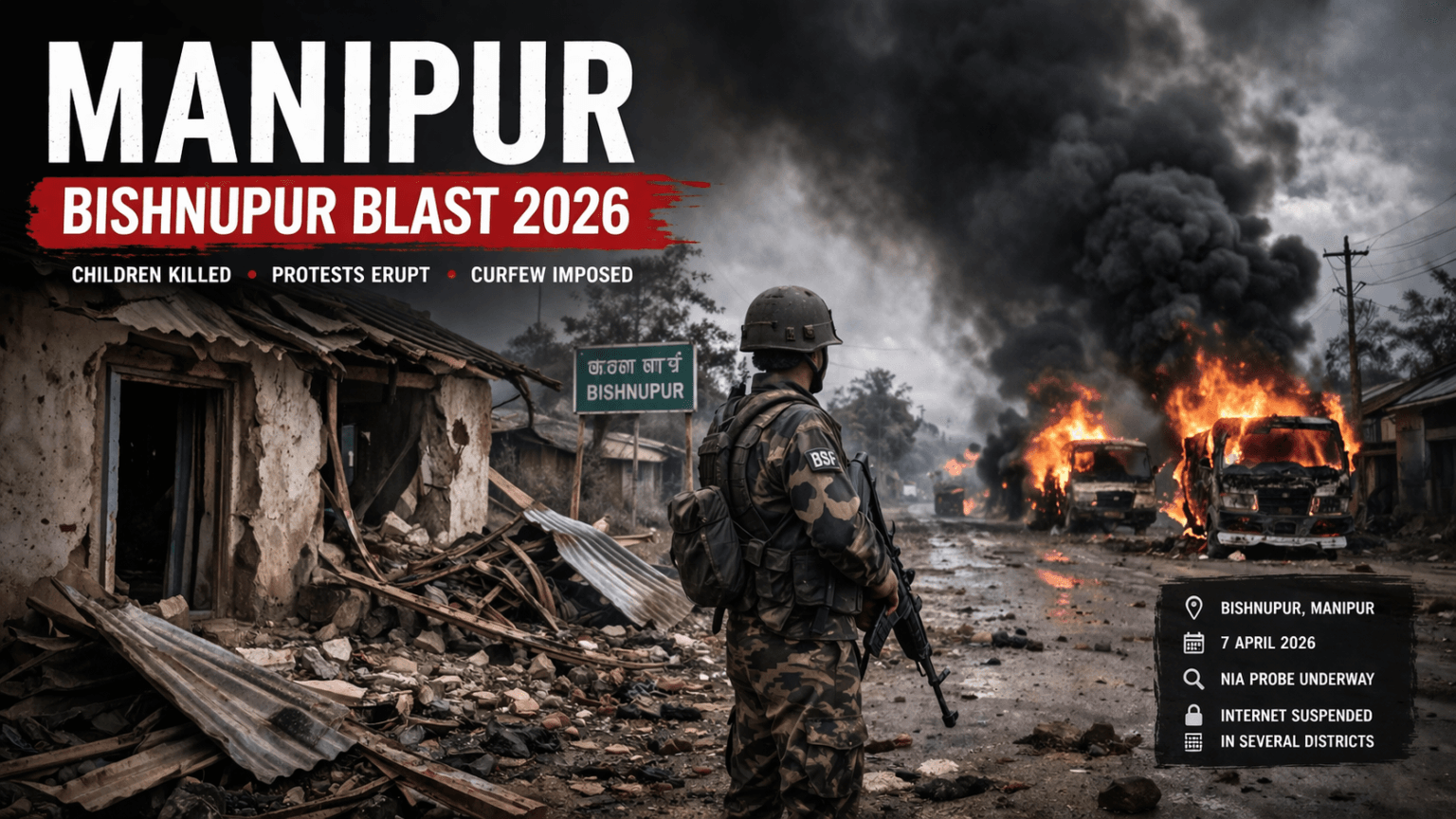
Manipur Bishnupur Blast 2026: Children Killed, Protests Erupt, and Tensions Return to a Fragile State
The Manipur Bishnupur blast 2026 has once again pushed the conflict-hit state into national focus after two children were killed in an attack on a house in Bishnupur district, triggering protests, curfew restrictions, internet suspension, and a fresh security crackdown. The incident, reported on April 7, 2026, came after months of relative calm and immediately raised fears that Manipur’s long-running ethnic conflict could enter another dangerous phase.
What makes this episode especially disturbing is that the victims were minors inside a civilian home. Their deaths quickly became the centre of public anger in the Imphal Valley, where residents questioned how such an attack could happen despite a heavy security presence in and around sensitive areas. The fallout then expanded beyond the blast itself, with violent protests, firing by security personnel, more deaths, and demands for accountability from the state leadership.
What happened in Bishnupur
According to multiple reports, the attack took place in the Tronglaobi Awang Leikai area of Bishnupur district in the early hours of April 7. Two siblings, a five-year-old boy and his five-month-old sister, were killed when an explosive struck their house while they were sleeping. Their mother was seriously injured. Current reporting broadly agrees on those core facts, though descriptions of the weapon differ across outlets, with some reports calling it a bomb attack and others describing it as a rocket attack or projectile strike. Because investigators had not publicly confirmed the exact munition at the time of reporting, the most accurate description is that an explosive or explosive projectile hit the home.
That distinction matters. In fast-moving conflict reporting, terms such as “bomb blast,” “rocket attack,” and “projectile strike” are sometimes used before forensic confirmation is complete. A corrected account should therefore avoid overstating what is not yet verified. What is firmly established is that a civilian residence in Bishnupur district was hit, two children died, and the attack reignited an already volatile situation in Manipur.
Why the incident is so significant
The Bishnupur blast is not being viewed as a standalone crime. It has landed in a state that has been scarred by ethnic violence since May 2023, when clashes between the valley-based Meitei community and the hill-based Kuki-Zo groups spiralled into one of the most serious internal conflicts seen in the region in recent years. Reuters reported that around 260 people have been killed and more than 60,000 displaced since the wider conflict began. That context explains why the killing of two children immediately triggered outrage far beyond the blast site itself.
Bishnupur is also a sensitive district because it lies close to one of the fault lines between the valley and hill areas. In such zones, even a single violent incident can rapidly take on a communal and political meaning. Residents do not interpret these attacks in isolation; they see them through the larger history of killings, displacement, barricades, armed presence, and recurring breakdowns in trust. That is why the blast quickly became a flashpoint for wider anger over security, governance, and the unresolved roots of the Manipur crisis.
Protests after the blast
After news of the children’s deaths spread, protests broke out in Bishnupur and other valley areas. Reuters reported that at least four people were killed in the violence that followed: the two children in the blast and two more people in police firing after a crowd stormed a security forces camp. Other reports later suggested that the toll from the firing rose further, underlining how quickly the unrest expanded after the original attack. Because some casualty counts evolved over time, a careful correction is to say that the post-blast unrest caused additional deaths in firing incidents, with at least two such deaths confirmed early on and some later reports putting the toll higher.
This is one of the main places where precision matters. A simple line like “four people were killed” is not wrong in the earliest confirmed reporting, but it can become incomplete once later updates revise the toll. For a publish-ready article, it is safer to state the sequence clearly: two children died in the house attack, protests followed, and security firing during the unrest caused further fatalities.
Read more on latest Iran Israel War.
Curfew, internet suspension, and NIA probe
The Manipur government responded with emergency measures. Reports said an indefinite curfew was imposed across several valley districts, including Bishnupur, and internet services were suspended to contain the fallout and prevent further escalation. There is some variation in reporting over the exact number of districts covered in the curfew orders, but Bishnupur, Imphal East, and Imphal West were consistently mentioned, with Kakching also included in several reports.
The government also decided to hand the case over to the National Investigation Agency (NIA). Chief Minister Yumnam Khemchand Singh was quoted in multiple reports as saying that the attack was a serious attempt to disturb the peace process and that the perpetrators had not yet been identified. That last point is crucial for fact-checking: while sections of the public and some community voices blamed Kuki militants, the state had not officially identified the attackers at the time those reports were published.
Who has been blamed, and what is actually confirmed
Public anger after the attack led to immediate accusations from Meitei voices that Kuki militant groups were responsible. At the same time, Kuki groups rejected those accusations. Reuters specifically reported that Kuki groups denied responsibility, while the Chief Minister said the attackers had not been identified. That means any article that definitively names the perpetrators at this stage would go beyond the verified public record.
A corrected article should therefore say this plainly: suspicions and accusations were voiced, but official confirmation of who carried out the attack was not available in the initial wave of reporting. In a conflict like Manipur’s, that is not a minor editorial detail. Premature attribution can worsen tensions, deepen misinformation, and distort public understanding of a highly sensitive event.
Public anger turns political
The fallout soon became political. Protesters tried to march toward or storm the residences of top state leaders, including the Chief Minister and the Home Minister, as public outrage widened from the attack itself to alleged security lapses. Reports described this as a sign of growing frustration with the state government’s handling of peace and security.
This is another reason the blast resonated so strongly. For many residents, the issue was no longer just the killing of two children. It became a larger question: if Manipur had already endured nearly three years of conflict, curfews, segregation, and military deployment, why are civilians still so vulnerable? The attack cut straight into that unresolved fear.
The humanitarian dimension
Beyond the politics and security language, the Bishnupur blast is first a story of civilian loss. Two children were killed in their sleep. Their mother was injured. That simple fact is what gave the incident its emotional force and what made the anger across the valley so immediate.
In prolonged conflicts, civilians often become statistics. But incidents like this cut through the numbness because they show how unstable everyday life remains. A home, a bed, a sleeping family, and then an explosion. That is why the Bishnupur attack became more than a local crime story. It was read as evidence that normalcy in Manipur remains shallow and reversible.
What the blast says about Manipur in 2026
The larger significance of the Manipur Bishnupur blast 2026 lies in what it reveals about the state’s security environment. Months of relative calm had created some hope that violence might be receding. But Reuters described the incident as a flare-up after a period of comparative peace, showing how fragile the situation remains.
For policymakers, this incident raises several urgent questions. Has the state merely contained visible violence without resolving the underlying conflict? Are intelligence and area domination measures failing to protect civilians in vulnerable districts? Can peace return without credible accountability and political dialogue? The blast does not answer these questions, but it puts them back at the centre of national attention.
What a corrected reading should avoid
A fact-checked reading of this story should avoid a few common mistakes. First, it should not state with certainty that a specific group carried out the attack unless investigators officially confirm that. Second, it should not present the exact weapon type as settled if reporting still varies between bomb and rocket descriptions. Third, it should be careful with casualty totals from the subsequent unrest, because those figures changed as the situation evolved.
That does not weaken the story. It makes it stronger. In a conflict zone, the most reliable article is often the one that clearly separates what is confirmed, what is alleged, and what remains under investigation.
Conclusion
The Manipur Bishnupur blast 2026 was a brutal reminder that peace in Manipur remains dangerously fragile. Two children were killed in an attack on a home in Bishnupur district, their mother was injured, protests erupted, more people died in the unrest that followed, and the state was pushed back into curfew-and-crackdown mode. The investigation has been handed to the NIA, but the identity of the attackers had not been officially established in the initial verified reporting.
For now, the corrected bottom line is this: the Bishnupur attack was real, deadly, and politically explosive; the victims were two children; the unrest that followed exposed deep public anger; and the incident has underlined how unresolved Manipur’s conflict still is in April 2026.