







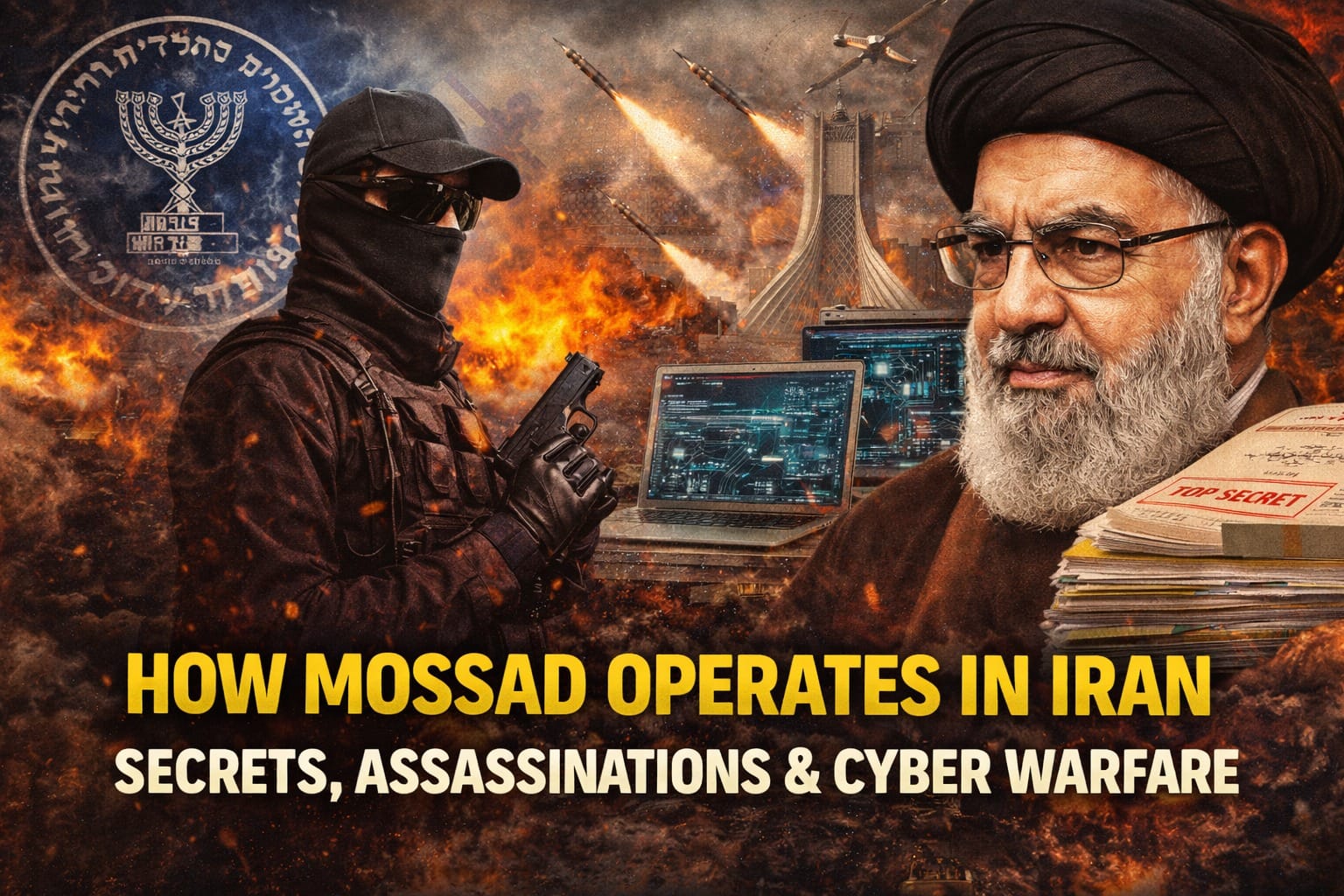
5 Unbelievable Mossad Operations in Iran
The Mossad — Israel’s national intelligence agency — is one of the most effective and feared spy agencies in the world. Unlike most national intelligence services, Mossad is known not just for gathering secrets, but for conducting bold operations across hostile territory, including inside Iran. For decades, it has operated deep within Iranian society, military infrastructure, networks, and digital systems — often under the very nose of the Islamic Republic.
With the recent 2026 assassination of Supreme Leader Ayatollah Ali Khamenei during a joint Israeli-US military strike, Mossad’s role in intelligence gathering and covert operations in Iran is once again under global scrutiny. This article explores how Mossad has operated in Iran, its tactics, major historic operations and milestones, and why its intelligence capabilities are considered stronger than many state agencies combined.
Understanding Mossad: Israel’s Elite Intelligence Powerhouse
The Mossad — Hebrew for the “Institute for Intelligence and Special Operations” — was established in 1949 and is one of the “big three” Israeli intelligence services alongside Shin Bet (internal security) and Aman (military intelligence). Its official mission includes:
- Collecting foreign intelligence
- Undertaking covert operations
- Counterterrorism
- Covert diplomatic efforts
Over the decades, Mossad built a reputation for daring operations, unconventional tactics, and precise execution.
Also read – Anti-Islamic Protests In Iran Explained
Deep Espionage in Iran: History and Context
1940s–1970s: Early Penetration and Training SAVAK
Mossad’s involvement in Iran predates the 1979 Islamic Revolution. In the 1950s and 1960s, the agency played a role in training Iranian intelligence and security forces, including SAVAK — Iran’s notorious secret police. At that time, Mossad was involved in shaping early forms of Iranian counterintelligence and infiltration cells, although relations shifted drastically after political realignments in the 1970s.
1980s–2000s: Shadow War After the Revolution
After the 1979 Revolution and the severing of diplomatic ties, Mossad’s focus shifted to strategic infiltration, human intelligence networks, and counter-nuclear espionage. Iranian efforts to develop a nuclear program made Tehran a top priority for Israeli intelligence. According to historical reporting, Mossad maintained safe houses and recruited assets inside Iran throughout these decades.
Mossad’s Tactics: How It Works Inside Iran
Mossad operates using a blend of human intelligence (HUMINT), technical means, cyber operations, sabotage, and covert paramilitary action. Here’s how those methods play out inside Iran:
1. Human Intelligence and Local Networks
Mossad invests heavily in HUMINT — recruiting local sources embedded within Iranian society and, reportedly, even within Iranian security apparatuses. Former Iranian officials have acknowledged cases of Iranian intelligence personnel acting as double agents, supplying information to Israel’s Mossad.
Recruited agents often hold technical, academic, or military backgrounds that provide access to strategic facilities, personnel patterns, or critical data about missile and nuclear programs.
2. Cyber and Digital Infiltration
Mossad doesn’t rely solely on human assets. It uses sophisticated cyber capabilities to infiltrate digital systems, hack networks, and gather intelligence from digital footprints. This was central in tracking Supreme Leader Khamenei’s movements: Iranian traffic cameras and surveillance systems in Tehran were reportedly hacked for years, giving Israel continuous visibility into key Iranian leaders’ daily patterns just before the strike that killed Khamenei.
In past decades, Mossad and allied intelligence also played roles in cyber sabotage such as the Stuxnet attack, which damaged Iranian nuclear centrifuges — one of the most famous examples of hybrid cyber-physical espionage.
3. Document Theft and Intelligence Hoarding
One of Mossad’s most spectacular operations was the 2018 infiltration of a Tehran warehouse holding Iran’s nuclear archive. In that mission, fewer than two dozen Mossad agents infiltrated the facility and smuggled out more than 100,000 documents and computer files — revealing years of Iran’s nuclear weapons research and shocking global intelligence communities.
This captured archive is widely credited with transforming global understanding of the extent of Iranian nuclear ambitions and played a role in diplomatic pressure against Tehran.
4. Covert Technology Sabotage Inside Iran
In June 2025, Mossad reportedly built and operated a covert drone base inside Iran, smuggling drone parts in suitcases, vehicles, and shipping containers. These drones then disabled Iranian air defenses and missiles before Israeli airstrikes — dramatically altering the battlefield.
Such operations required months of planning, logistics coordination and high-risk infiltration — lighting the way for Mossad’s modernization from purely intelligence gathering to hybrid warfare capabilities.
5. Assassinations and Targeted Eliminations
Mossad has been linked to several high-profile assassinations of Iranian nuclear scientists over the last decade — using methods ranging from remote-controlled weapons to roadside bombs and covert strikes. These operations often remain officially unacknowledged due to Mossad’s clandestine nature, but they have been widely reported by analysts and media.
Even in 2025 and 2026, Mossad’s methods contributed to the precision timing and targeting of aerial strikes that killed top Iranian officials, including the Supreme Leader — using combined intelligence from Mossad and the CIA.
Timeline of Mossad’s Most Notable Iran Operations
2010–2015: Early Cyber Sabotage
- Stuxnet and related cyber tools targeted Iranian nuclear infrastructure, slowing down centrifuge operations and hampering uranium enrichment.
2018: Tehran Nuclear Archive Theft
- A small Mossad team infiltrated a Tehran warehouse and smuggled out tens of thousands of documents detailing Iran’s nuclear weapons history.
2020–2022: Targeted Eliminations
- Mossad is widely believed to have orchestrated several operations against Iranian nuclear scientists and key military figures.
2025: Deep Covert Drone Deployment and Operation “Rising Lion”
- Mossad agents smuggled drone parts into Iran and operated a covert drone base that dismantled air defenses, enabling a major Israeli air campaign against missile sites and infrastructure.
2026: 60-Second Strike on Supreme Leader Khamenei
- Intelligence from Mossad’s networks, hacked Tehran surveillance systems, and US cooperation enabled a precision strike that killed Supreme Leader Khamenei in a coordinated air raid.
This timeline reflects decades of buildup and experimentation — from stealth and infiltration to full hybrid operations involving cyber, drones, deep cover, and human agents.
Mossad’s Unmatched Capabilities: Why It’s Feared
Several factors explain Mossad’s reputation as one of the world’s strongest intelligence services, especially regarding Iran:
1. Deep Penetration Over Decades
Mossad has spent decades building operational networks across Iranian society — not just in military or government sectors, but among academics, engineers, minorities and industrial fields. This kind of long-term infiltration is rare and invaluable for intelligence depth.
2. Technology Integration
Unlike many traditional spy agencies, Mossad uses cutting-edge technology — from drones to cyber warfare, signal intelligence, and digital pattern recognition — to supplement human networks.
The reported hacking of Iran’s traffic camera network, which gave intelligence on Khamenei’s movements, demonstrates how tech and HUMINT are fully integrated.
3. Hybrid Warfare Approach
Mossad doesn’t just observe: it shapes outcomes. From preliminary sabotage in the 2025 campaign to enabling precision strikes in 2026, Mossad’s actions have direct battlefield effects.
4. Strategic Partnerships
Mossad’s cooperation with the CIA and other Western intelligence expands its reach and capabilities. The 2026 strike on Khamenei reflects years of joint intelligence sharing, as reported by financial and strategic press outlets.
5. Psychological Impact
Mossad operations often send messages beyond mere tactics — whether it’s demonstrating the ability to enter Tehran undetected or broadcasting covert messages to Iranians undermining confidence in the regime.
6. Ruthless Precision
From stealing archives to high-value strikes, Mossad’s long record of targeting exact personnel or technologies makes it uniquely feared among intelligence agencies. Its success rate in strategic operations is often cited in comparison with peer agencies.
Controversies and Iranian Reactions
Tehran has responded to Mossad’s activities with intense counter-espionage efforts:
- Iran has executed people it accuses of spying for Mossad, including individuals arrested for allegedly transmitting military coordinates and intelligence to the agency.
- Iranian security forces have arrested suspected Mossad-linked operatives during conflicts, reflecting Tehran’s belief that deep networks exist.
- State media frequently warns of deep infiltration and espionage threats as part of its legitimacy narrative.
These reactions underscore how seriously Iran views the Mossad threat.
Why Mossad Is Different from Other Spy Agencies
Compared with counterparts like the CIA or MI6, Mossad’s strategy is uniquely:
Tactical and Operational
It doesn’t just gather intelligence — it acts on it with autonomous covert missions.
Integrated into Military Strategy
Mossad isn’t just a bureaucratic agency; it’s linked directly with Israel’s defense planning and military execution.
Risk-Acceptant
Mossad’s operations often involve high personal risk — smuggling weapons, operating drones from inside enemy territory, and deep infiltration.
Psychologically Effective
Iranian government narratives about Mossad’s reach are part of its deterrent and propaganda environments, showing that Mossad’s impact is both material and psychological.
Conclusion: Mossad’s Legacy in Iran
Mossad’s presence in Iran is not theoretical — it is deep, historic, and operational. From early infiltration and espionage to document theft, cyber warfare, assassination campaigns, and direct involvement in the strike that killed Supreme Leader Khamenei, Mossad has consistently operated where few intelligence agencies dare.
Its strength lies not just in gathering secrets, but in shaping events — from strategic sabotage to battlefield preparation to high-value targeting — redefining modern intelligence and hybrid warfare. As the Middle East conflict evolves further, Mossad will likely continue playing a pivotal role in the shadows that few observers fully see — but many feel.
Subscribe to our YouTube Channel The Logic Stick for more video insights