






Mounjaro Leads India’s Obesity Drug Sales as Generic Semaglutide Gains Ground
India’s fast-growing market for obesity and diabetes injections is entering a new phase. Mounjaro, Eli Lilly’s tirzepatide-based drug, is still the country’s top-selling medicine by value, but its early dominance is now being challenged by a wave of cheaper generic semaglutide products that entered the market after patent expiry in March 2026.
That shift matters because India is one of the world’s most price-sensitive pharmaceutical markets. When a premium therapy like Mounjaro faces competition from far cheaper alternatives, the result is not just a corporate battle. It changes how doctors prescribe, how patients access treatment, and how the country’s obesity-drug market may evolve over the next year.
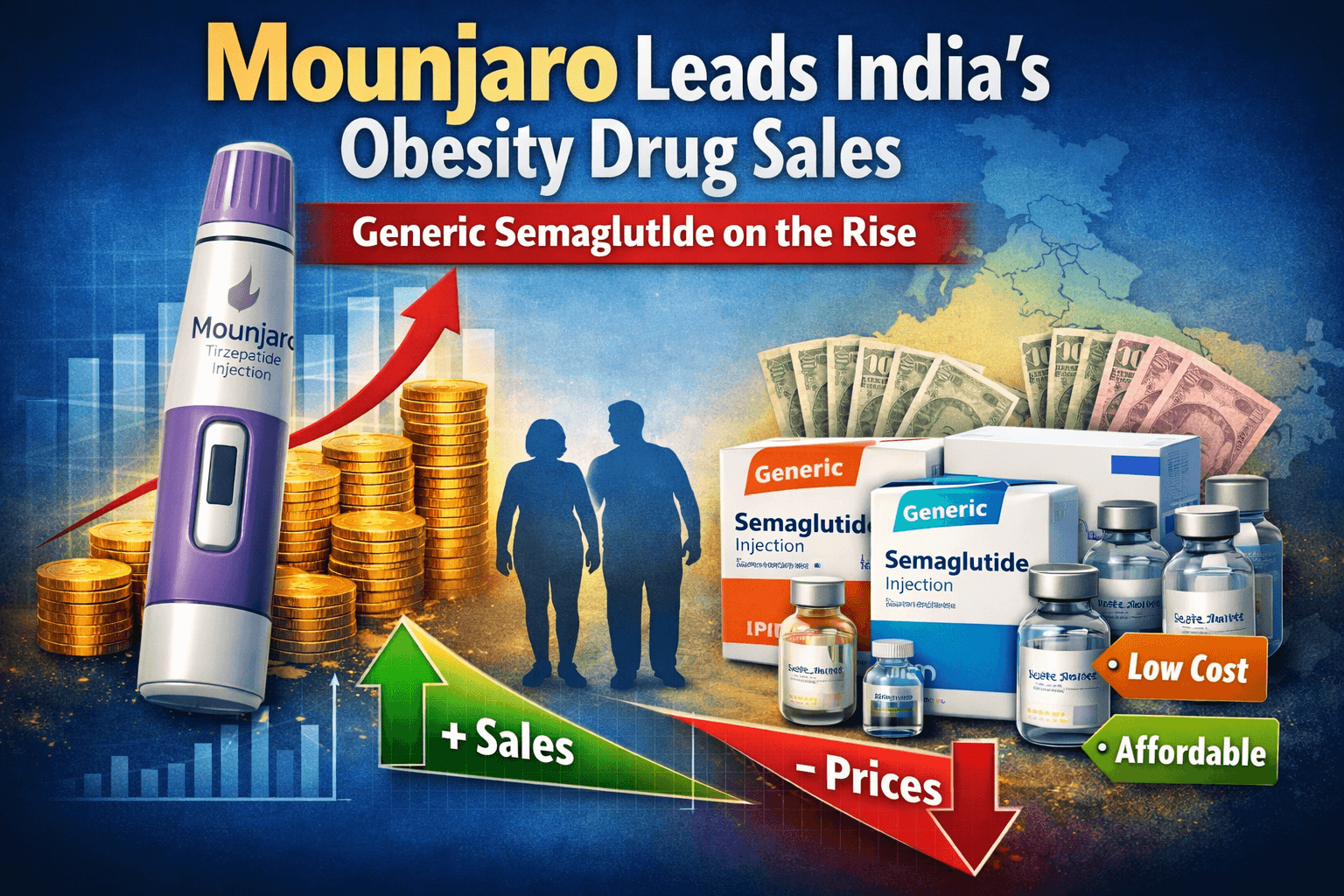
The core story is simple: Mounjaro still leads, but semaglutide is gaining momentum quickly. Pharmarack’s latest PharmaTrac data, cited by India Today and The Economic Times, showed Mounjaro posting Rs 114 crore in March 2026 sales, down from about Rs 135 crore in February. Even after that decline, it remained India’s top-selling drug by value.
The pressure is coming from two directions. First, Novo Nordisk has cut prices on Ozempic and Wegovy in India to defend share. Second, Indian drugmakers have launched generic semaglutide products at dramatically lower prices after the patent expired.
Why Mounjaro Took an Early Lead
Eli Lilly launched Mounjaro in India in March 2025, beating Novo Nordisk to a major market opportunity. Reuters reported at launch that the drug was priced at Rs 3,500 for a 2.5 mg vial and Rs 4,375 for a 5 mg vial, with patients on weekly dosing potentially spending around $200 a month at the 5 mg level.
That pricing made Mounjaro expensive by Indian standards, but the drug had two advantages. The first was timing: it arrived before the semaglutide market opened up to a flood of cheap domestic rivals. The second was differentiation: tirzepatide is not just another GLP-1 medicine. Lilly has consistently positioned it as a dual GIP/GLP-1 receptor agonist, a distinction the company says gives it meaningful clinical advantages in blood sugar control and weight management. The Economic Times quoted Lilly India head Winselow Tucker saying tirzepatide remains the only approved dual GIP/GLP-1 receptor agonist for type 2 diabetes and chronic weight management.
That combination helped Mounjaro rise quickly. Reuters reported that it became India’s top-selling drug by value within months of launch, a striking achievement in a crowded pharmaceutical market.
What Changed in March 2026
The turning point came when Novo Nordisk’s India patent on semaglutide expired in March 2026. Reuters reported on March 19 that the expiry was expected to trigger a shake-up, allowing local companies to launch cheaper generics and intensifying worries about misuse and uneven oversight in an overcrowded market.
That is exactly what followed. Reuters reported on March 23 that Indian drugmakers rapidly rolled out semaglutide products in both vial and pen formats. Among the examples cited: Glenmark launched GLIPIQ, with vial-based monthly usage estimated at roughly Rs 1,300 to Rs 1,760, while Eris Lifesciences launched Sundae with a starting price of Rs 1,290 per month for multi-dose vials.
This pricing gap is the most important fact in the market today. According to The Economic Times, Mounjaro costs around Rs 13,000 per month for the base dose, while Novo’s Ozempic and Wegovy start around Rs 5,660, and generic semaglutide is available from roughly Rs 1,300 for vials and Rs 1,800 for injectable pens for a month’s supply.
In a market like India, that difference is not marginal. It is transformative.
Read more on Adam Back denies claims of being Satoshi Nakamoto after a new investigation.
The Numbers Behind the Shift
The March sales data shows why analysts are taking the generic wave seriously. While tirzepatide sales fell from about Rs 135 crore to Rs 114 crore, semaglutide sales rose from Rs 48 crore in February to Rs 59 crore in March, according to PharmaTrac data cited by The Economic Times.
The same report said Eli Lilly’s market share slipped to 56% from 61%, while Novo Nordisk held about 25% and Cipla, its marketing collaborator in India, saw a slight dip to 10% from 12%. Domestic manufacturers were already making visible gains; ET reported that Torrent captured 3% of the Rs 1,600-crore GLP-1 agonist market within the first 10 days of launch.
That does not mean Mounjaro has lost its lead. It has not. But it does mean the category is no longer a one-horse race.
India Today described the market as shifting rapidly as low-cost semaglutide generics disrupt pricing, boost volumes, and intensify competition among both multinational and domestic drugmakers. Its report said more than 20 Indian drugmakers were already in the market with generic versions soon after patent expiry.
Novo Nordisk’s Countermove
Novo is not standing still. Reuters reported on March 31 that the company cut prices again in India to better compete with generics. The 1 mg weekly shot of both Ozempic and Wegovy was repriced to Rs 2,275, with Wegovy’s 0.5 mg dose cut to Rs 2,025. Reuters also noted that Ozempic is available in three dose strengths in India, while Wegovy has five.
This matters for two reasons. First, it narrows the gap between branded semaglutide and generics, even if generics remain cheaper. Second, it puts additional pressure on Lilly, which has indicated it is not rushing into a price cut. ET quoted Lilly’s Tucker as saying there are currently no generics of tirzepatide and that Lilly remains confident in the differentiated benefits of its molecule.
That is a defensible strategy if doctors and patients continue to believe tirzepatide’s efficacy justifies the premium. But it is also a risky one in a country where cost heavily shapes adoption.
What Doctors and Analysts Are Watching
The debate now is not whether semaglutide will grow, but how far and how fast. ET cited PharmaTrac’s Sheetal Sapale saying that branded generics have made the semaglutide molecule stronger and that both innovator and generic semaglutide are far more economical than tirzepatide. The same report said a few aggressive launches in April could push semaglutide sales volumes up another two to three times before the market stabilizes over the following few months.
Analyst Vishal Manchanda of Systematix Group told ET he expects semaglutide to dominate the market over the next 12 to 14 months, estimating that about 80% of weight-loss patients may eventually be on semaglutide versus 20% on Mounjaro. That is an analyst forecast, not a settled outcome, but it captures the direction of market sentiment.
The logic behind that forecast is straightforward. Semaglutide now has three strengths in India: lower prices, multiple brands, and wider access points. Mounjaro still has clinical differentiation and premium positioning, but price alone can shift prescription behavior at scale.
The Bigger Public Health Question
There is also a broader healthcare issue beneath the commercial story. Drugs like Mounjaro, Ozempic, and Wegovy are often discussed in popular culture as weight-loss injections, but in medical practice they are tied closely to diabetes, obesity, and metabolic health. Reuters noted when Ozempic launched in India in December 2025 that the medicine also helps with weight loss in people with diabetes and has benefits beyond glycemic control. Reuters also reported that Wegovy had already been launched in India in June 2025.
As these drugs become cheaper, access may widen well beyond wealthy urban patients. That could be positive for people with real medical need. But Reuters also flagged concerns around misuse and uneven oversight as the market becomes overcrowded after patent expiry.
That concern is serious. A flood of brands, aggressive marketing, and public fascination with fast weight loss can create conditions for irrational demand. In India, where obesity and diabetes are both rising, the challenge is to expand access without turning these medicines into casual consumer products.
What This Means for India’s Drug Market
The most accurate conclusion right now is this: Mounjaro remains the market leader, but its once-uncontested momentum has been broken. That is the key correction that needs to be made to any overhyped reading of the story.
It would be wrong to say generic semaglutide has already overtaken Mounjaro. The current data does not show that. Mounjaro still leads India’s drug sales by value.
It would also be wrong to treat this as purely a battle between Mounjaro and “cheap copies.” The reality is more layered. Novo Nordisk remains a major player with Ozempic and Wegovy, and its own price cuts are helping intensify pressure on Lilly.
The more precise reading is that India’s GLP-1 market is fragmenting quickly. Premium branded tirzepatide is defending its lead. Branded semaglutide from Novo is becoming cheaper. Domestic generic semaglutide is surging. And doctors, distributors, and patients are recalibrating in real time.
Conclusion
Mounjaro’s rise in India was one of the most striking pharmaceutical success stories of the past year. But the market has now entered a tougher, more competitive phase. Patent expiry has unlocked a generic semaglutide wave that is already changing prices, volumes, and expectations.
For now, Mounjaro is still on top. But the story is no longer about one blockbuster drug dominating a new category. It is about what happens when a premium therapy collides with India’s generic machine.
That collision is now underway, and it could redefine obesity-drug access in the country far faster than many expected