







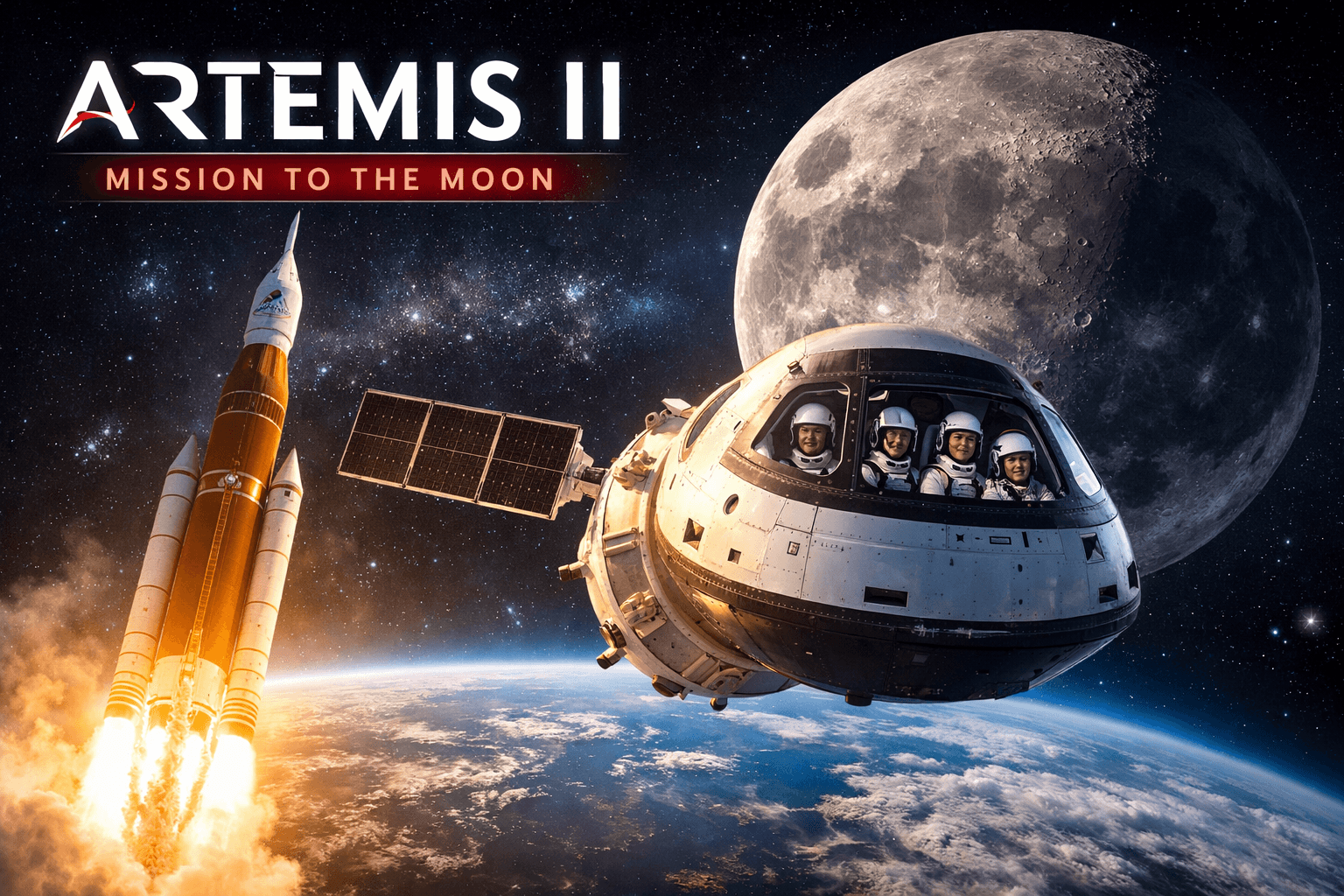
NASA Artemis II Mission Marks Historic Return to Deep Space as Moon Program Enters a New Phase
NASA’s Artemis II mission has become one of the most important space stories of 2026 because it marks humanity’s first crewed mission around the Moon region in more than 50 years. The mission lifted off from Launch Complex 39B at NASA’s Kennedy Space Center in Florida at 6:35 p.m. EDT on April 1, 2026, sending four astronauts aboard the Orion spacecraft on a planned test flight around the Moon and back. NASA describes the flight as an approximately 10-day mission, and says it is the first crewed mission of the Artemis program.
That alone makes Artemis II historic. But the mission matters for a much bigger reason: it is not just about repeating Apollo-era glory. NASA is using Artemis II to test the systems, operations, and crew procedures needed for a broader lunar program that now has an updated structure. Under NASA’s latest architecture, Artemis II is the deep-space flyby test, Artemis III in 2027 is planned as a low-Earth-orbit rendezvous and docking demonstration, and Artemis IV in 2028 is the mission now positioned for a lunar landing. That revised structure is one of the most important facts people often miss when discussing Artemis today.
The crew aboard Artemis II includes Reid Wiseman, Victor Glover, Christina Koch, and Jeremy Hansen of the Canadian Space Agency. Their presence is historic in its own right. Reuters notes that Glover is the first Black astronaut assigned to a lunar mission, Koch is the first woman assigned to a moon-bound mission, and Hansen is the first Canadian and the first non-U.S. citizen to participate in a lunar mission. NASA’s launch release confirms all four names and identifies Artemis II as the first crewed lunar flyby in more than five decades.
Artemis II is not a Moon landing mission. That point needs to be stated clearly because many readers still assume “return to the Moon” means astronauts will land during this flight. NASA says the mission is a planned test flight around the Moon and back, designed to demonstrate key systems with crew aboard for the first time. In other words, Artemis II is the human test mission that must work before NASA attempts more complex landing operations later in the program.
What makes this mission especially significant is that it is the first time since Apollo 17 in 1972 that humans have traveled beyond low Earth orbit toward the Moon. That gap of more than half a century explains why Artemis II has drawn intense attention from space agencies, scientists, and the public worldwide. AP described it as humanity’s first lunar voyage in over 50 years, while NASA framed it as the first crewed lunar flyby in more than 50 years. Both descriptions point to the same reality: a generational milestone in human spaceflight has now happened.
The launch itself was a major technical event. NASA’s live mission updates say the opening launch window was set for 6:24 p.m. EDT, but the actual liftoff occurred at 6:35 p.m. EDT. The agency’s update log shows the SLS rocket clearing the tower, reaching supersonic speed, passing maximum dynamic pressure, and then continuing through booster separation and upper-stage operations. NASA later confirmed that the mission entered flight successfully and that Orion began the sequence of orbital operations planned before heading out toward the Moon.
Soon after launch, NASA reported that the perigee raise maneuver had been completed successfully, refining Orion’s orbit around Earth. Later, the agency said the apogee raise burn was also completed, continuing to fine-tune the spacecraft’s orbit. Those may sound like routine phrases, but they are part of the careful, step-by-step sequence required before a crewed spacecraft leaves Earth orbit for a lunar flyby. Artemis II is being flown like a true test mission, with each maneuver confirming another layer of system performance before the next stage begins.
NASA has also highlighted one of the mission’s most important demonstrations: proximity operations. According to the agency, the Artemis II crew is scheduled to manually maneuver Orion relative to the rocket’s upper stage after separation, using onboard navigation sensors and control systems. During this demonstration, the crew will guide the spacecraft through a series of precise moves, including stopping at roughly 300 feet and then at about 30 feet from the upper stage to evaluate Orion’s handling qualities. This matters because future lunar missions will require complex rendezvous and docking tasks, and NASA wants real crew experience with those systems before moving deeper into the landing architecture.
Read more about Shroud of Turin having Indian Traces.
The mission is also a live test of the life-support systems in Orion with astronauts aboard. NASA’s launch release states that one of Artemis II’s goals is to demonstrate life-support systems with crew for the first time. That may not sound as dramatic as a Moon landing, but it is one of the most important reasons this mission exists. A lunar program is only as credible as the spacecraft’s ability to keep people safe, healthy, and functional in deep space. Reuters, AP, and NASA all point to this role of Artemis II as the practical foundation for what comes next.
In fact, early flight updates already showed why test missions matter. NASA’s apogee raise update noted that while the crew began preparing Orion for life in space, they reported a blinking fault light during a checkout of the toilet, and the ground team began working with them to resolve it. That detail may seem minor, but it underscores the reality of crewed exploration: spaceflight is not only about spectacular launch visuals; it is also about systems reliability, troubleshooting, and learning how hardware performs under real conditions with people onboard.
Another important correction to the broader Artemis story involves the mission sequence ahead. Many earlier summaries of Artemis still repeat the old framework in which Artemis III would be the next Moon landing. NASA’s official 2026 update changed that. The agency now says Artemis III, planned for 2027, will test integrated operations in low Earth orbit between Orion and one or both commercial landers from SpaceX and Blue Origin. NASA says that mission will focus on rendezvous, docking, in-space tests of docked vehicles, integrated checkouts of life support, communications and propulsion systems, and testing of the new xEVA suits. The next planned landing step, under this updated architecture, is Artemis IV in 2028.
That revised timeline tells us something deeper about Artemis. NASA is choosing a more incremental approach instead of trying to compress too many firsts into one mission. In its February update, the agency said it wants the sequence of flights to represent a step-by-step buildup of capability, with each mission making progress without taking unnecessary risk. That language matters because it shows NASA is explicitly prioritizing reliability and crew safety over flashy schedules. Artemis II fits perfectly into that philosophy: prove the spacecraft, prove the crew systems, prove the operations, then move forward.
The geopolitics also matter. NASA’s February architecture update explicitly referred to increasing competition from major geopolitical rivals and said the United States needs to move faster and eliminate delays. While Artemis is fundamentally a science and exploration program, it is also part of a wider strategic race over leadership in cislunar space and future lunar operations. That does not reduce the mission’s scientific value; it simply means Artemis II sits at the intersection of exploration, industrial capability, and national strategy.
Still, the emotional force of Artemis II is what makes the mission resonate so strongly with the public. The last time humans traveled to the Moon region, the world was in a very different era. Now, in 2026, a new generation is watching astronauts fly beyond low Earth orbit again, this time aboard a spacecraft and rocket stack developed for a long-term program rather than a one-off sprint. NASA’s own wording makes that clear: Artemis II is meant to lay the foundation for an enduring presence on the Moon ahead of future missions to Mars. That is a very different ambition from Apollo’s flags-and-footprints model.
So what, exactly, is “up with” Artemis II? The answer is that the mission is no longer just a promise or a delayed program milestone. It is in flight, and it has already become the clearest sign yet that NASA’s Moon program is entering a real operational phase. Artemis II is proving Orion with crew aboard, validating mission procedures, testing deep-space operations, and feeding directly into a newly revised mission structure that stretches toward a landing in 2028 and beyond.
If Artemis II succeeds as planned, it will be remembered not simply as the first crewed lunar flyby in more than 50 years, but as the mission that turned Artemis from a concept into a functioning pathway. Apollo proved humans could go to the Moon. Artemis II is helping prove NASA can build the system to go back deliberately, sustainably, and with the next missions already mapped out more carefully than before.