







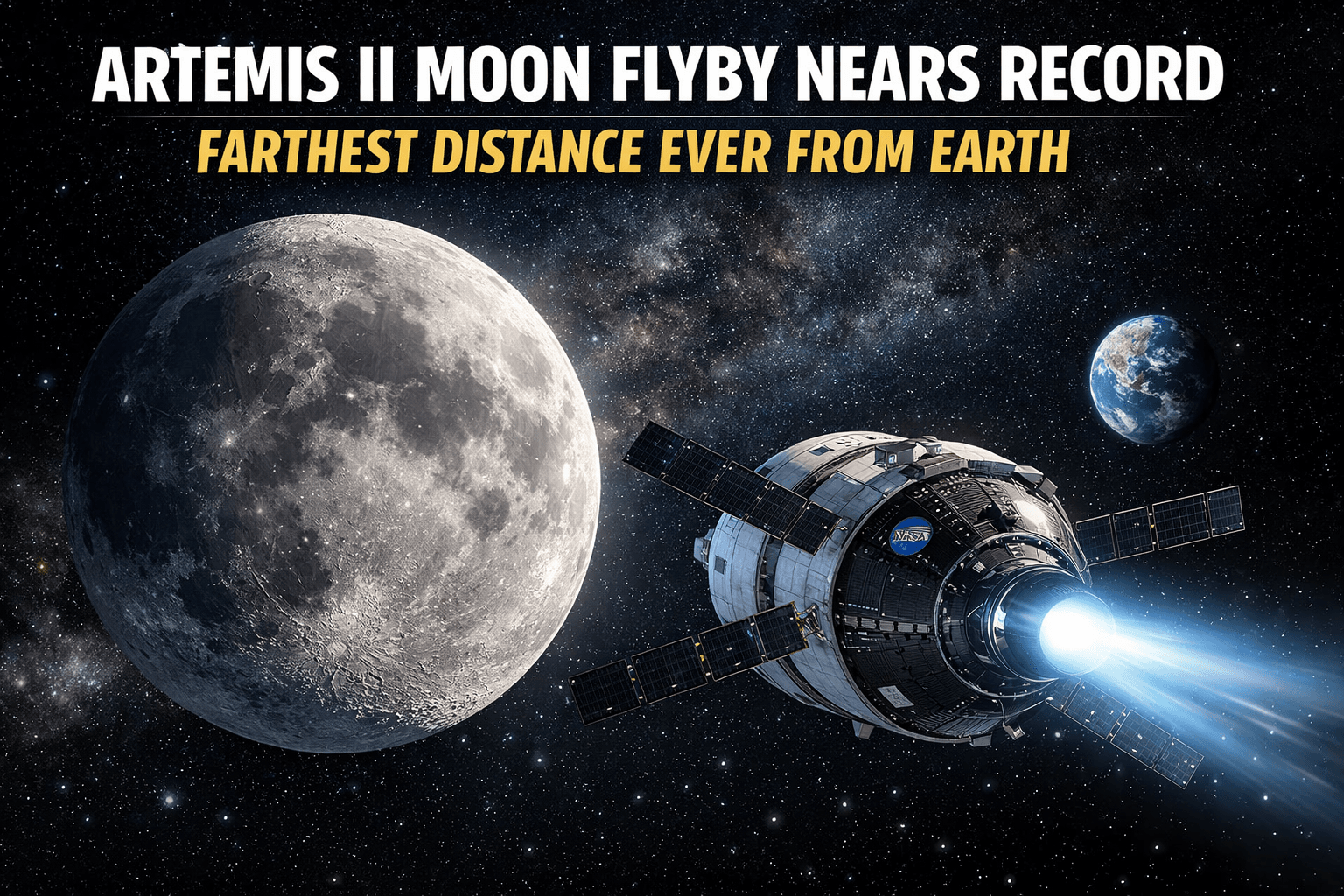
NASA Artemis II Moon Flyby Nears Record as Crew Approaches Farthest Human Distance From Earth
NASA’s Artemis II mission has reached one of the most important phases of its flight: the Orion spacecraft carrying four astronauts has entered the Moon’s sphere of influence and is moving toward a historic lunar flyby that is set to take the crew farther from Earth than any humans have ever traveled. The mission, launched on April 1, 2026, is NASA’s first crewed lunar mission since Apollo 17 in 1972 and the first mission in the Artemis program to carry astronauts aboard the Space Launch System rocket and Orion spacecraft.
That distinction matters because this is not a Moon landing mission. Artemis II is a crewed lunar flyby test flight designed to validate deep-space systems, crew operations, navigation, communications, life support, and Orion’s performance before later Artemis missions attempt more complex objectives. NASA officially describes Artemis II as a “crewed lunar flyby,” with a mission duration of 10 days and a launch date of April 1, 2026.
The four astronauts aboard Artemis II are NASA astronauts Reid Wiseman, Victor Glover, and Christina Koch, along with Canadian Space Agency astronaut Jeremy Hansen. Their flight marks the first time in more than 50 years that humans have traveled toward and around the Moon, and it also underscores the international character of the Artemis program, with Canada represented on this historic deep-space mission.
What makes the latest phase especially significant is that Orion has moved into the region where the Moon’s gravity exerts more force on the spacecraft than Earth’s. That means Artemis II has effectively transitioned into the critical part of its lunar encounter. NASA’s own mission updates said the crew was preparing for the lunar flyby on flight day 6, while reporting in real time on April 6 confirmed that the spacecraft had entered the Moon’s gravitational sphere of influence.
This is the key factual point that must be stated clearly: Artemis II has not landed on the Moon, nor is it designed to do so. The mission’s main objective is to fly around the Moon and return safely to Earth, proving that Orion and its systems can support humans in deep space. Any article suggesting the crew “reached the Moon” should be understood in the context of a lunar flyby trajectory and entry into the Moon’s sphere of influence, not a touchdown on the lunar surface.
According to Reuters, Artemis II is expected to reach a maximum distance from Earth of about 252,757 miles, which would place the crew roughly 4,102 miles beyond the record set by the Apollo 13 crew in 1970. AP similarly reported that Mission Control expected Artemis II to exceed Apollo 13’s record of 248,655 miles by more than 4,100 miles. That would make the Artemis II astronauts the farthest-flying humans in history.
The record aspect is drawing attention worldwide because it highlights how ambitious this mission is even without a lunar landing. Artemis II is using a free-return lunar trajectory, a path that takes advantage of Earth’s and the Moon’s gravity to carry the spacecraft around the Moon and naturally bring it back toward Earth with minimal propulsion demands. AP noted that this is the same general kind of trajectory associated with Apollo 13 after that mission’s oxygen tank explosion forced an aborted landing attempt. In Artemis II’s case, however, the free-return route is a planned mission design rather than an emergency measure.
NASA has framed Artemis II as a direct stepping stone to later missions in the Artemis architecture. The agency says the mission builds on the success of uncrewed Artemis I in 2022 and is intended to demonstrate a broad range of capabilities needed on deep-space missions. Orion’s performance on this flight is especially important because the spacecraft is the vehicle NASA plans to use to carry astronauts to the Moon and eventually support later exploration goals tied to Mars.
The mission is also historic because it is the first time the Orion spacecraft and the SLS rocket have flown with crew on board. NASA’s launch release on April 1 said the SLS lifted off from Kennedy Space Center at 6:35 p.m. EDT, sending the crew on a planned test flight around the Moon and back. That launch formally opened a new crewed chapter in NASA’s post-Apollo lunar exploration effort.
As Orion approaches and passes the Moon, the crew is expected to experience one of the most dramatic phases of the mission: a far-side flyby that includes periods of darkness and communications disruption as the Moon blocks direct contact with NASA’s Deep Space Network. Reuters reported that the flyby would include brief communications blackouts and that the astronauts would use professional cameras to document the Moon, sunlight around its edges, and Earth in the distance.
NASA has been explicit that the lunar flyby is not just a symbolic sightseeing event. The crew has prepared for lunar observations and scientific documentation during the mission. NASA’s flight day updates noted that the crew reviewed flyby plans, while AP reported that the astronauts studied lunar geography for years and were preparing to observe features including the Orientale Basin, Apollo-era landing regions, and parts of the lunar south polar region that could matter for future Artemis operations.
That observational work is relevant to what comes next in the Artemis program. NASA’s broader Moon campaign is aimed at establishing a sustained human presence at and around the Moon, with later missions expected to develop cislunar operations, surface systems, and technologies applicable to Mars. Artemis II is therefore not only a test of hardware but also a test of how astronauts work, observe, communicate, and respond during a demanding deep-space mission.
Read more on military budget US.
Another reason the mission matters is representation. Christina Koch’s role is historic, and Victor Glover’s participation is also widely recognized as a milestone within NASA’s human spaceflight program. Jeremy Hansen’s inclusion means a Canadian astronaut is part of humanity’s latest journey toward the Moon. Together, the crew reflects NASA’s effort to position Artemis as both a scientific and international exploration program.
The timeline of the mission has also been closely watched because of how compressed and precise lunar flyby missions are. NASA’s Artemis II mission page lists the mission duration as 10 days. NASA’s mission blog and media schedule indicated that the Moon flyby activities were centered on April 6, after launch on April 1, and AP reported that the splashdown is expected in the Pacific after the return leg concludes later in the week.
From an operational standpoint, Artemis II is providing NASA with the most consequential crewed systems test since the Apollo era. The agency is evaluating how Orion handles navigation, propulsion updates, cabin conditions, astronaut workflows, and communications over the long distance between Earth and the Moon. NASA’s recent flight day updates described the crew carrying out manual piloting demonstrations, suit evaluations, correction-burn planning, and lunar flyby preparations, all of which are part of the mission’s technical objectives rather than mere ceremonial milestones.
The public imagination around Artemis II is understandably centered on the record distance, but the mission’s deeper value lies in risk reduction for future flights. Artemis III and later missions depend on proving that Orion can safely carry astronauts beyond low Earth orbit and bring them home. NASA’s Artemis II mission description makes clear that this flight is meant to demonstrate the capabilities needed for those future deep-space missions.
It is also important to keep the near-term Artemis roadmap accurately framed. NASA’s official Artemis II page does not present this mission as a surface landing attempt. Instead, it places Artemis II within a progressive sequence following Artemis I. News coverage from Reuters described Artemis II as a first crewed test flight of the Artemis program, while AP characterized it as NASA’s first astronaut moonshot since Apollo 17 and a step toward later landings near the lunar south pole.
For readers looking for the simplest verified takeaway, it is this: NASA’s Artemis II crew is flying around the Moon, not landing on it; the spacecraft has entered the Moon’s gravitational sphere; and the mission is on track to set a new record for the farthest distance humans have ever traveled from Earth. Those are the central facts supported by NASA’s mission materials and by current reporting from Reuters and AP.
The mission’s symbolism is powerful. More than half a century after the last crewed lunar-era flight of the Apollo program, humans are once again moving through cislunar space aboard a spacecraft built for the next era of exploration. Artemis II represents a bridge between the memory of Apollo and the operational future NASA hopes to build at the Moon. Whether measured in miles, mission architecture, or public imagination, this flight is already one of the most consequential space missions of the decade.
If Orion completes its flyby and return as planned, Artemis II will stand as proof that NASA’s human deep-space systems are ready for the next stage. For now, the world is watching as four astronauts push beyond an Apollo benchmark and take humanity farther from Earth than ever before.