







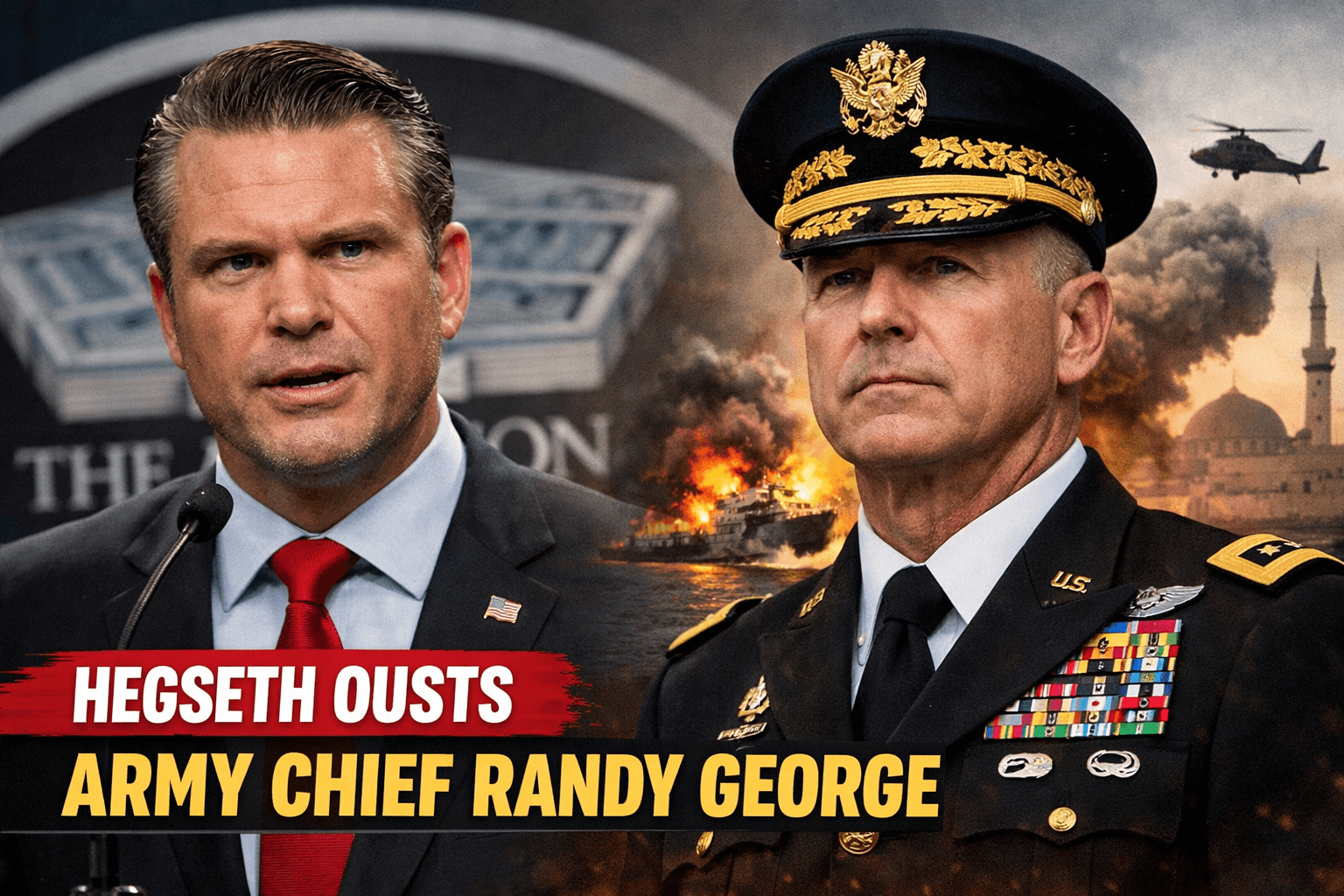
Pentagon Shocker: Pete Hegseth Forces US Army Chief Randy George to Step Down Amid Ongoing Iran Conflict
In a dramatic and highly unusual move, U.S. Defense Secretary Pete Hegseth has asked Army Chief of Staff General Randy George to step down and retire immediately, triggering a major leadership shake-up within the Pentagon. The decision comes at a critical time, as the United States remains engaged in active military operations related to the ongoing conflict involving Iran.
The abrupt removal of the U.S. Army’s top uniformed officer has raised serious questions about military stability, leadership continuity, and the broader strategic direction of the Pentagon under Hegseth’s leadership.
What Happened: Sudden Removal Confirmed
General Randy George, who has served as the 41st Chief of Staff of the U.S. Army since August 2023, has been asked to retire “effective immediately.”
The Pentagon confirmed the development but did not provide any official reason for his removal.
According to multiple reports, including Reuters and other international outlets, the decision was taken directly by Defense Secretary Pete Hegseth and communicated without prior warning to senior Army leadership.
General George still had more than a year remaining in what is typically a four-year term, making his early exit particularly significant.
His departure is not being described as voluntary in most reports, but rather as a forced retirement—adding to the seriousness of the development.
Part of a Broader Pentagon Shake-Up
The removal of General George is not an isolated incident. It is part of a wider pattern of leadership changes within the U.S. Department of Defense since Pete Hegseth assumed office.
Reports confirm that:
- More than a dozen senior generals and admirals have been removed under Hegseth’s leadership
- Two additional senior officers—General David Hodne and Major General William Green—were also removed alongside George
- Several top military leaders have been replaced or asked to step down in recent months
This pattern suggests a deliberate restructuring of military leadership at the highest levels.
Analysts believe this could reflect an effort to align the armed forces more closely with the current administration’s strategic and ideological priorities.
No Official Reason Provided
One of the most striking aspects of this development is the lack of a clear explanation.
The Pentagon has not disclosed why General George was asked to step down.
However, multiple reports suggest possible underlying factors:
- A desire for leadership aligned with the administration’s vision
- Internal disagreements over military priorities or direction
- Broader efforts to reshape Pentagon leadership
While these factors are widely discussed, it is important to note that none have been officially confirmed by the Department of Defense.
Timing: Removal During Active Conflict
The timing of the decision has intensified scrutiny.
The United States is currently engaged in military operations connected to the Iran conflict, with ongoing strikes and troop deployments in the region.
At the same time:
- Global discussions are underway involving dozens of countries regarding the Strait of Hormuz, a critical global oil route
- The conflict has already disrupted energy markets and heightened geopolitical tensions
Removing the Army Chief of Staff during such a period is highly unusual and has raised concerns about operational continuity.
Who Is General Randy George?
General Randy George is a highly experienced military leader with decades of service.
Key facts:
- Became U.S. Army Chief of Staff in August 2023
- Nominated by former President Joe Biden and confirmed by the Senate
- Served in Iraq and Afghanistan
- Previously worked as a senior military aide to former Defense Secretary Lloyd Austin
As Army Chief, George was responsible for:
- Overseeing the readiness and operations of the U.S. Army
- Managing personnel and strategic planning
- Leading modernization efforts
His removal creates a significant leadership gap at a critical time.
Who Will Replace Him?
Following George’s departure, General Christopher LaNeve, the Vice Chief of Staff of the Army, is expected to take over as acting Army Chief.
Reports suggest that LaNeve is considered closely aligned with Hegseth’s leadership approach, although no permanent appointment has yet been officially confirmed.
Why This Move Is Unusual
The sudden removal of a sitting Army Chief of Staff during an active conflict is rare in modern U.S. history.
Typically, such transitions are:
- Planned months in advance
- Coordinated to ensure continuity
- Announced with clear reasoning
In contrast, this move was:
- Immediate
- Unexplained
- Part of a larger pattern of abrupt leadership changes
Experts warn that such actions could impact:
- Military morale
- Command stability
- Strategic coordination
Rising Tensions Within the Pentagon
The decision has also highlighted growing tensions within the U.S. defense establishment.
Reports indicate that:
- Senior Army leaders were not informed in advance of the decision
- Friction exists between Hegseth and sections of the military leadership
- Differences over policy direction and leadership priorities may be contributing factors
These internal dynamics could have long-term implications for civil-military relations in the United States.
Read more on Raghav chadha removed from AAP.
Global and Strategic Implications
The removal of the Army Chief of Staff is being closely watched internationally.
At a time of heightened geopolitical tension:
- Allies may question stability within U.S. military leadership
- Adversaries may interpret the move as internal disruption
- Ongoing military operations could face coordination challenges
Given the U.S. military’s global role, leadership continuity is critical—not just domestically, but for international security.
Political Context and Leadership Direction
The move also reflects a broader shift in how the Pentagon is being managed under Pete Hegseth.
Reports indicate that Hegseth has:
- Replaced multiple senior officials
- Pushed for structural and ideological changes
- Sought leadership aligned with his strategic vision
This approach has drawn both support and criticism.
Supporters argue that decisive leadership is necessary to modernize the military and respond to evolving threats.
Critics, however, warn that frequent leadership changes could undermine institutional stability.
What Happens Next?
Several developments are expected in the coming weeks:
1. Permanent Appointment
A new Army Chief of Staff may be formally nominated.
2. Further Leadership Changes
Additional restructuring within the Pentagon cannot be ruled out.
3. Strategic Clarity
The administration’s military direction may become clearer as new leadership takes shape.
Conclusion
The decision by Defense Secretary Pete Hegseth to ask General Randy George to step down marks a significant moment in U.S. military leadership.
While the official reasons remain undisclosed, the broader context points to a major restructuring within the Pentagon.
At a time of ongoing conflict and global uncertainty, the move raises important questions about stability, strategy, and the future direction of the U.S. armed forces.
How this transition unfolds in the coming weeks will be critical—not just for the United States, but for the global security landscape.