







PM Modi’s 6 Big Promises to Bengal: What He Actually Said Ahead of the 2026 Assembly Elections
Prime Minister Narendra Modi has placed governance, law and order, corruption, and state employee pay at the center of the BJP’s pitch in West Bengal, unveiling what he called six guarantees at a public rally in Haldia on April 9. The promises came as campaigning intensified ahead of the 2026 West Bengal Assembly election, which will be held in two phases on April 23 and April 29, with counting scheduled for May 4.
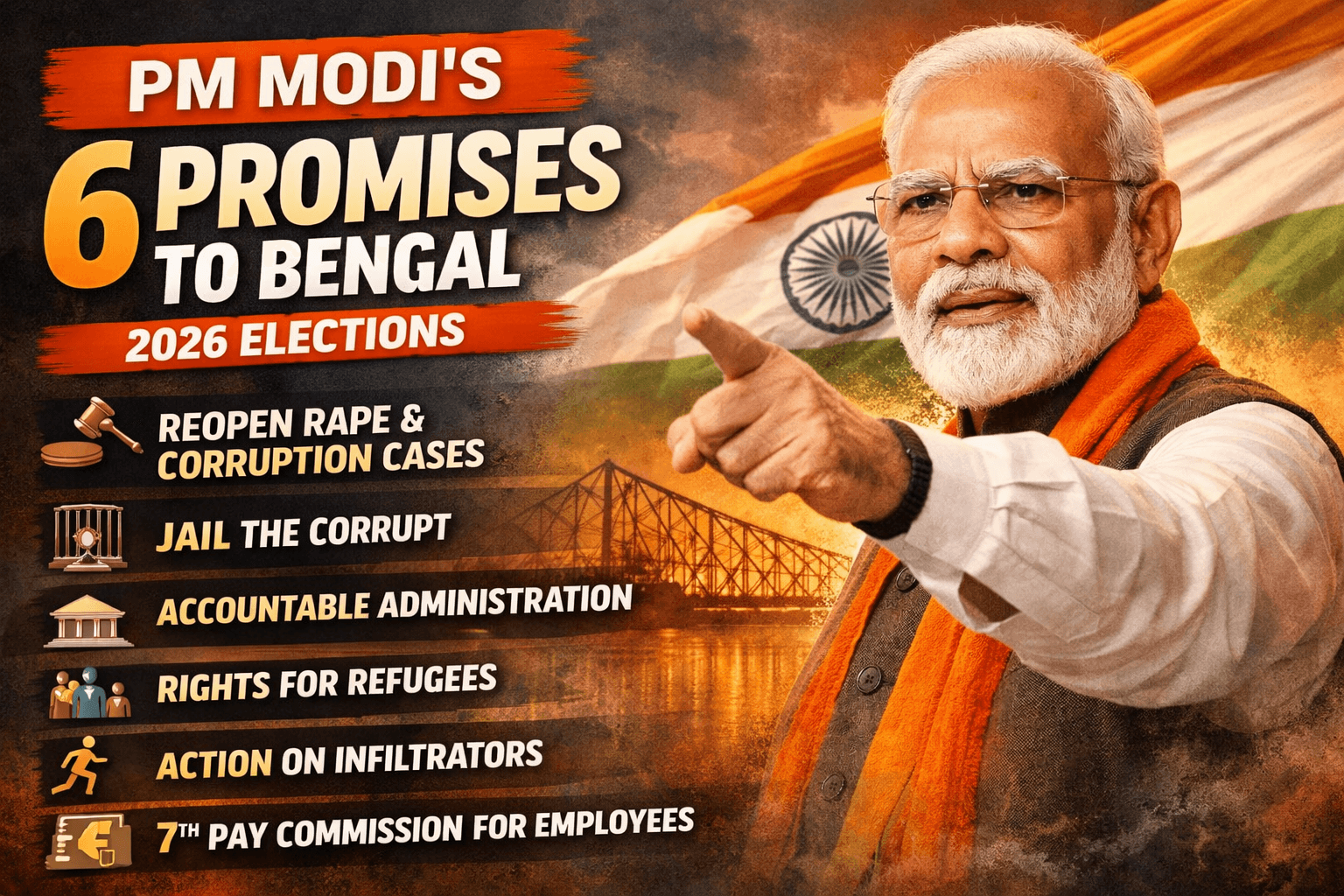
The corrected picture is simpler than some campaign summaries suggest. Modi’s message in Haldia was not a broad manifesto speech covering every possible BJP promise for Bengal. It was a focused political pitch built around six specific assurances: replacing what he described as an atmosphere of fear with trust, making the administration answerable to the public, reopening corruption- and women-related cases, punishing the corrupt, granting constitutional rights to refugees while acting against infiltrators, and implementing the 7th Pay Commission for West Bengal government employees if the BJP forms the government.
That distinction matters because campaign reporting around Bengal has quickly blended Modi’s speech with the BJP’s separate manifesto released the next day by Union Home Minister Amit Shah. The manifesto includes additional promises such as monthly financial support for women and unemployed youth, free travel for women on government buses, integration with Ayushman Bharat, and a pledge to implement the 7th Pay Commission within 45 days. Those are part of the party’s larger election platform, but they were not the full content of Modi’s six-point Haldia guarantee speech.
The first promise: replacing fear with trust
Modi’s first guarantee was framed around law and order. According to reports of the Haldia rally, he said a BJP government would replace the prevailing atmosphere of fear with trust and restore faith in the rule of law. This line was central to the BJP’s attempt to portray the election as a contest over governance and security rather than only welfare or identity politics.
In practical political terms, this was a direct attack on the ruling Trinamool Congress government. Modi accused the state administration of allowing fear, coercion, and criminality to shape public life. That charge also appeared in related campaign coverage from the same day, where he described parts of Bengal as suffering from “mafia raj” and “syndicate” control.
The second promise: an accountable administration
The second guarantee focused on the administrative machinery. Modi said that under a BJP government, the administration would be fully answerable to the public it serves. This is a governance promise rather than a welfare pledge, and it fits the BJP’s effort to argue that Bengal needs institutional change, not just programmatic announcements.
This also connects with the BJP’s “double-engine government” argument, which Modi repeated in Bengal campaign speeches. He argued that West Bengal would benefit if the same political formation governed both the Centre and the state. While that is a political slogan rather than a measurable policy outcome on its own, it helps explain why accountability and administrative responsiveness were emphasized so strongly in his speech.
The third promise: reopening scam, corruption, and rape-related files
One of the strongest lines from the speech was Modi’s promise that files related to every scam, every act of corruption, every injustice committed against women, and every rape case would be reopened. This was a major campaign signal because it tied anti-corruption politics directly to women’s safety and criminal justice.
This is also one of the most important factual clarifications. The promise was not described in reliable reports as a blanket reopening of every criminal case in the state. It was specifically framed around scams, corruption, injustices against women, and rape cases. That narrower formulation is more accurate and closer to the wording reported from the rally.
The fourth promise: jail for the corrupt
Modi’s fourth assurance was that those involved in corruption under TMC rule would face the law. Reports quoting the speech say he declared that whoever engaged in corruption, whether minister or lower-level worker, belonged in jail and would not be able to evade accountability under a BJP government.
This point is related to the third guarantee but is not identical to it. The third was about reopening files and investigations; the fourth was about punishment and prosecution. Separating the two is important because campaign write-ups sometimes collapse them into one broad anti-corruption theme, when Modi presented them as distinct promises.
The fifth promise: refugee rights and action against infiltrators
Modi’s fifth guarantee dealt with one of the BJP’s most politically loaded themes in Bengal: refugees and infiltration. Reports on the speech say he promised that refugees would be granted constitutional rights while infiltrators would be driven out and not permitted to remain in India.
This is another point where precision matters. The speech, as reported, did not simply promise a generalized border crackdown. It paired two ideas together: protection or constitutional rights for refugees, and removal of infiltrators. That formulation mirrors the BJP’s long-standing attempt in Bengal to differentiate between communities it describes as persecuted refugees and those it labels illegal infiltrators.
The sixth promise: 7th Pay Commission for state employees
The final and perhaps most immediately tangible promise was the pledge to implement the 7th Pay Commission for West Bengal state government employees if the BJP forms the government. Economic Times reported that Modi made this announcement in Purba Midnapur on April 9, and the party’s manifesto released on April 10 said the recommendations would be implemented within 45 days if BJP comes to power.
This promise has political weight because West Bengal is still reported to be operating under its 6th Pay Commission, unlike the Centre, which moved to the 7th Pay Commission years ago and is already discussing the next cycle through the 8th Central Pay Commission. That gap gives the BJP a clear way to appeal to government employees, teachers, and pensioners.
Read more on Kashmir Saffron Crisis 2026
The election backdrop
The timing of these promises is crucial. According to Hindustan Times’ election live coverage, polling for the 294-member West Bengal Assembly will take place in two phases on April 23 and April 29, and votes will be counted on May 4. That means Modi’s Haldia speech came just before the final stretch of campaigning in one of the country’s most politically consequential state elections.
The BJP followed Modi’s speech by releasing its formal Bengal manifesto on April 10. That document widened the party’s offer to voters beyond the six guarantees, including promises such as ₹3,000 monthly assistance for women heads of families, ₹3,000 for unemployed youth, DA-related commitments, 33 percent reservation for women in state government jobs, UCC implementation within six months, and integration of the state health scheme with Ayushman Bharat.
Still, Modi’s six guarantees remain the sharper political message because they compress the BJP’s Bengal campaign into six emotionally and electorally potent ideas: security, accountability, justice, punishment for corruption, citizenship-linked protection, and salary reform. That structure appears designed to speak at once to women voters, state employees, border-area constituencies, and anti-incumbency sentiment. This is an inference from the content and sequencing of the promises rather than a quoted claim by the party.
Conclusion
The corrected takeaway is that PM Modi did make six specific promises in Bengal, and the most reportable among them were the reopening of corruption and rape-related files and the immediate implementation of the 7th Pay Commission if BJP forms the government. But those remarks were part of a targeted Haldia rally speech, not the entirety of the BJP’s Bengal election agenda. The broader election platform was released separately the next day by Amit Shah.
That makes the most accurate headline frame this: Modi’s six guarantees were a campaign message aimed at projecting a tougher state administration and a cleaner political order, while the BJP manifesto expanded that appeal into a fuller welfare-and-governance package. Both are part of the same election effort, but they should not be treated as the same document or the same event.