







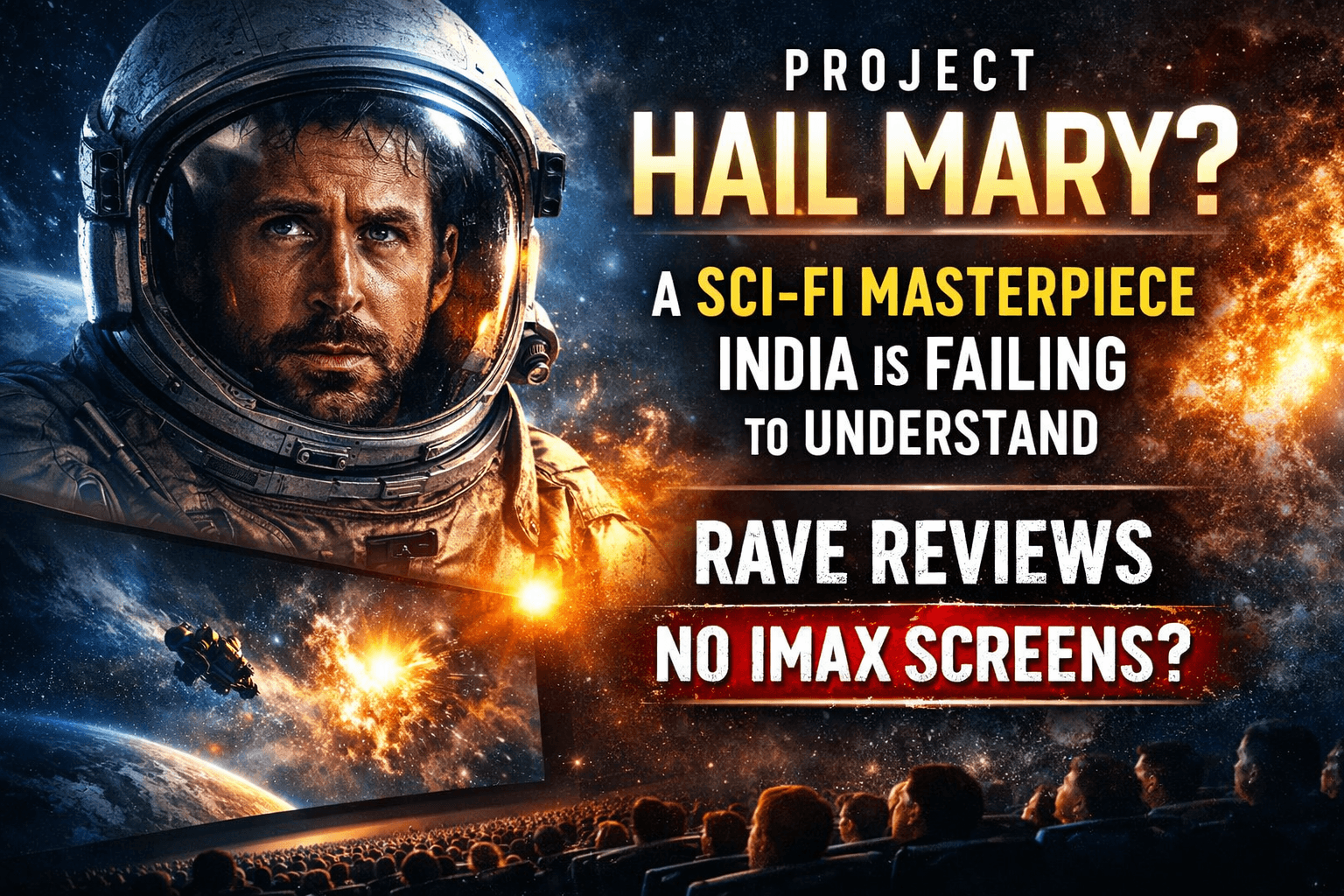
Project Hail Mary review: Story, IMDb ratings, Ryan Gosling cast brilliance, and why India is missing the real cinematic experience.
Introduction: This Isn’t Just a Film—It’s a Test of How We Watch Cinema
Every few years, a film comes along that quietly challenges everything we think we know about cinema.
Project Hail Mary is one of those films.
On the surface, it’s a sci-fi story about saving Earth. But underneath, it’s a deeply human film about loneliness, intelligence, trust, and survival—wrapped in one of the most scientifically grounded narratives Hollywood has produced in years.
Globally, it’s being praised. Audiences are calling it one of the most immersive theatrical experiences since Interstellar.
But in India, the conversation has shifted from “How good is the film?” to
“Why aren’t we being allowed to watch it the way it was meant to be seen?”
What Project Hail Mary Is Really About (Beyond the Plot)
At its core, the film follows Ryland Grace, a school teacher turned astronaut who wakes up alone on a spaceship with no memory.
As his memory returns, so does the weight of reality:
- The Sun is dying
- Earth is on the brink of extinction
- He is humanity’s last surviving mission
But what makes Project Hail Mary different is this:
It is not about action. It is about problem-solving.
The film spends time on:
- Scientific experimentation
- Logical reasoning
- Trial and error
- The psychology of isolation
And then comes its most powerful layer—connection in isolation.
Without giving away spoilers, the film introduces a relationship that completely transforms the narrative. It shifts from survival to something far more emotional:
Understanding life beyond language, culture, and biology.
That is where the film becomes extraordinary.
The Science Behind Project Hail Mary: Why It Feels Real, Not Fiction
One of the biggest reasons Project Hail Mary stands out is its commitment to hard science fiction.
Unlike typical sci-fi films that rely on imagination over logic, this film builds its narrative around:
- Astrophysics
- Microbiology
- Energy systems
- Space travel limitations
The central concept revolves around a microorganism threatening the Sun’s energy output—a fictional idea, but rooted in real scientific frameworks.
What makes this powerful is:
the film doesn’t just show science—it walks you through it.
Every solution:
- Is tested
- Fails
- Evolves
This process makes the audience feel like participants, not spectators.
And that’s rare.
IMDb Ratings & Global Reception: A Rare Consensus Hit
Unlike many modern releases that divide audiences, Project Hail Mary has achieved something rare:
Strong alignment between critics and audiences.
- IMDb rating: ~8.2/10 (early trend, strong for a sci-fi original)
- Audience reception: Highly positive
- Word-of-mouth: Driving demand globally
This is important.
Because in today’s algorithm-driven world, films succeed not just on marketing—but on how strongly people recommend them after watching.
And Project Hail Mary is being recommended heavily.
Ryan Gosling’s Performance: Carrying the Film Alone
This is not a typical ensemble film.
Ryan Gosling carries large portions of the movie almost entirely on his own.
And that’s where the risk was.
Because:
- There are long stretches with minimal dialogue
- The film relies on internal conflict
- The audience must stay engaged without constant action
Gosling delivers a performance that is:
- Intellectually convincing
- Emotionally grounded
- Subtly humorous
He doesn’t overact. He doesn’t dramatize.
He makes you believe that this man is:
smart enough to save Earth, yet human enough to break under pressure.
Why This Film Is Actually Worth Watching (Beyond Hype)
Let’s strip away the marketing and hype.
Here’s why Project Hail Mary genuinely works:
1. It Respects the Audience’s Intelligence
This film doesn’t spoon-feed.
It expects you to:
- Think
- Observe
- Connect dots
And that’s rare in mainstream cinema.
2. It Makes Science Feel Emotional
Most sci-fi films show science.
This one makes you feel science.
Every experiment carries stakes.
Every solution feels earned.
3. It Builds Tension Without Action
There are no constant explosions or chase sequences.
Yet, the tension is constant.
Because the stakes are:
existential, not physical.
4. It Creates One of the Most Unique Relationships in Sci-Fi
Without revealing details, the film introduces a bond that:
- Breaks language barriers
- Redefines communication
- Feels surprisingly emotional
And that’s what people are talking about after the film ends.
The IMAX Experience: This Film Was Built for It
Here’s the truth most people are missing:
Project Hail Mary is not just a film—it’s an IMAX-designed experience.
- Wide frame compositions
- Depth-heavy visuals
- Sound design that surrounds you
Watching it on a regular screen is like:
watching a 4K film in 480p.
Read more on Kash Patel getting Cyber Attacked.
The Real Issue: What India Is Not Understanding
Now let’s address the core issue directly.
This is not just about screen allocation.
It’s about mindset.
India Still Treats Screens as Quantity, Not Experience
The current system prioritizes:
- Number of shows
- Immediate box office returns
- Local dominance
But films like Project Hail Mary don’t work that way.
They depend on:
- Premium formats
- Visual immersion
- Word-of-mouth growth
This Is Not a Mass Film—It’s an Experience Film
And that’s where the disconnect is.
India’s distribution system often asks:
“How many people will watch it?”
But the right question should be:
“How should people watch it?”
Audience Demand Proved the Point
When:
- Fans started demanding IMAX screens
- Social media pushed back
- Late-night and 3:45 AM shows were introduced
It became clear:
The demand was always there.
The system just didn’t respond fast enough.
Screen Politics vs Cinema Experience
This situation highlights a bigger problem:
- Limited IMAX screens
- High competition
- Distribution control
And the result?
Even a globally loved film struggles to reach audiences properly.
Comparison: Why This Feels Like Another Interstellar Moment
People are comparing Project Hail Mary to Interstellar—and not without reason.
But here’s the difference:
- Interstellar was philosophical
- Hail Mary is practical + emotional
It’s easier to understand.
More engaging for modern audiences.
And in many ways, more re-watchable.
Final Verdict: Should You Watch Project Hail Mary?
Yes—but with one condition.
Watch it the way it was meant to be watched.
Not on:
- Small screens
- Poor projection
But on:
- IMAX
- High-quality theatre setups
Because this film is not just content.
It’s an experience.
Conclusion: A Film That Deserved Better in India
Project Hail Mary is not failing.
The system around it is.
It is:
- Smart
- Emotional
- Visually stunning
- Universally appreciated
And yet, in India, the biggest conversation is not about its brilliance.
It’s about:
why audiences had to fight just to experience it properly.
And that says more about the industry than the film