




Introduction: Why Putin in India Matters
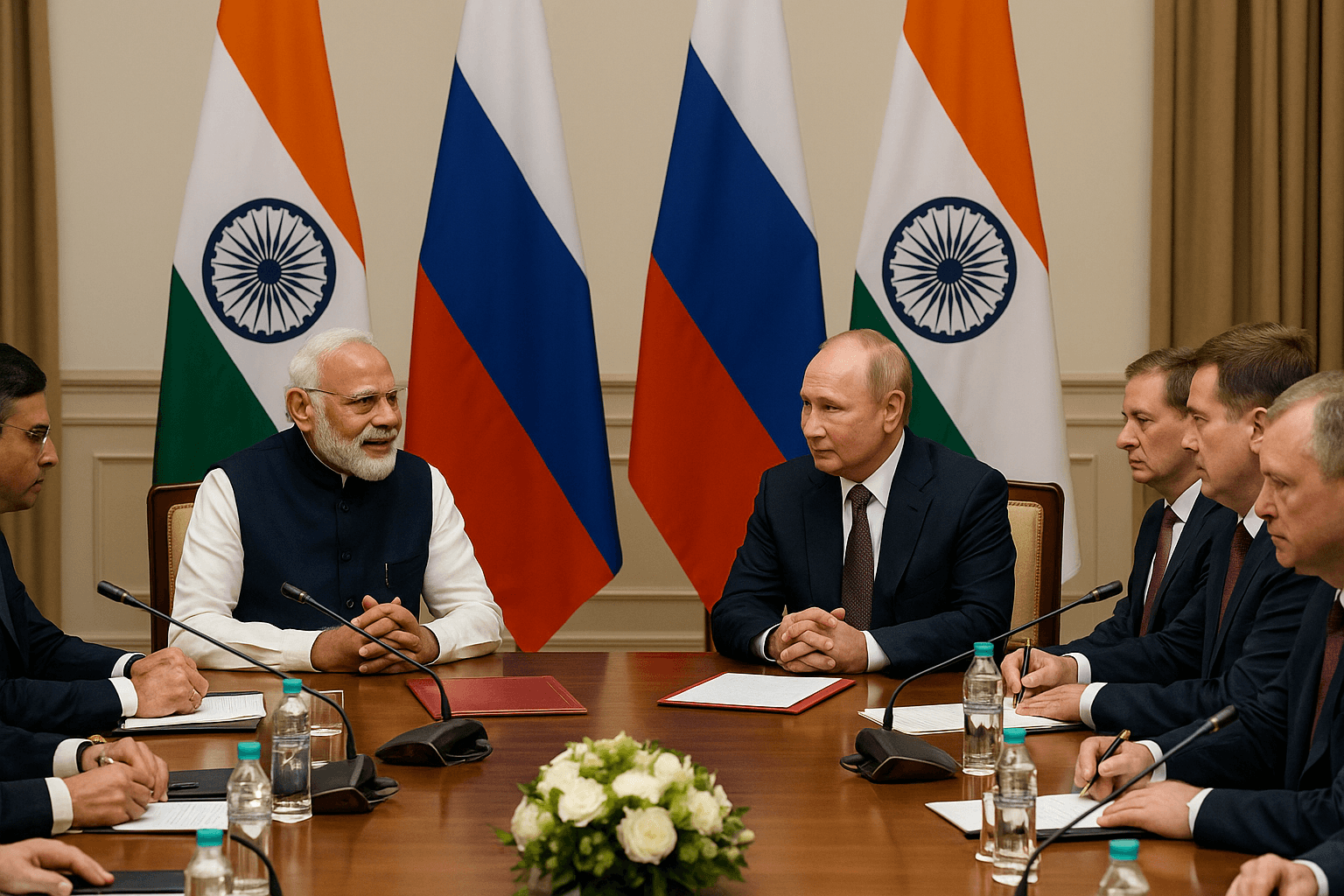
On December 4–5, 2025, Russian President Vladimir Putin arrived in New Delhi, marking his first visit to India since the full-scale invasion of Ukraine in 2022. Al Jazeera+2mint+2
The visit carried enormous symbolic and strategic weight. At a time when Russia faces heavy western sanctions, and India is under pressure from the United States to curtail deepening energy and defense ties with Moscow, the summit served as a reaffirmation of the longstanding — and evolving — “Special and Privileged Strategic Partnership” between India and Russia. mint+2Sky News+2
It was also a pivotal moment for both countries to deepen cooperation across sectors ranging from energy and nuclear power to defence, trade, and high-technology manufacturing — while sending a clear signal about India’s strategic autonomy. Reuters+2theguardian.com+2
Arrival & Welcome: The Tone of the Visit from the Start
- Putin landed at Palam Technical Airport on the evening of December 4. He was personally received by Prime Minister Narendra Modi, who broke with diplomatic protocol — a gesture widely seen as emphasising warmth and trust. Sky News+2The Times of India+2
- In a vivid display of camaraderie, Modi and Putin reportedly “carpooled” from the airport to the Prime Minister’s residence for a private dinner — echoing their previous such gesture during the Shanghai Cooperation Organisation summit earlier this year. The Times of India+1
- At that dinner, Modi presented Putin a Russian-language edition of the Bhagavad Gita — a symbolic gift underscoring cultural respect and shared heritage. The Times of India+1
- The next morning, December 5, Putin received a ceremonial welcome at the presidential palace (Rashtrapati Bhavan) — with a guard of honour, and the presence of India’s President Droupadi Murmu. www.ndtv.com+1
These early gestures set a tone of warmth, mutual respect, and political signalling — not just between two leaders, but between two nations.
Also read – Epstein Files New Emails & Trump: Complete Timeline
Summit Talks: Agenda and Strategic Themes
The core of the visit was the 23rd annual India–Russia Summit, held at Hyderabad House in New Delhi. Kremlin+2mint+2
The broad agenda included:
- Trade and economic cooperation — expanding bilateral trade beyond traditional defence and oil sectors. Reuters+2The Times of India+2
- Energy security — especially oil and fuel supplies, nuclear energy cooperation, and potential new reactors. mint+2Al Jazeera+2
- Defence and military cooperation — reframing links toward joint research, co-development and co-production of advanced defence platforms. Al Jazeera+2The Times of India+2
- High-tech collaboration — cooperation in space, artificial intelligence (AI), advanced manufacturing, and nuclear technology. mint+2Wikipedia+2
- Investment, trade liberalisation and trade architecture — including an early free-trade agreement (FTA) between India and the Eurasian Economic Union (EAEU), bilateral settlement mechanisms in national currencies, and improved mobility / labour cooperation. mint+2The Times of India+2
- Civil nuclear cooperation and future energy projects, including potential new reactors and small modular/floating nuclear plants. mint+1
- Global and regional geopolitical issues — including the war in Ukraine, global energy supply, and broader cooperation via multilateral fora (e.g. BRICS, SCO). mint+2Financial Times+2
According to joint statements, the leaders described the summit as “historic” — marking 25 years of their strategic partnership. mint+1
Major Agreements and Deals Signed
The summit resulted in an array of agreements, Memoranda of Understanding (MoUs), and a roadmap for future cooperation. Key outcomes:
🔹 Economic Cooperation & Trade Expansion
- India and Russia unveiled a new economic cooperation programme, with an ambitious target: raise bilateral trade to US$100 billion by 2030. Reuters+2The Times of India+2
- Multiple MoUs were exchanged covering diverse sectors: trade and commerce, migration & mobility, maritime cooperation, health and food safety, fertilisers, academic exchanges, media cooperation, and people-to-people ties. mint+1
- Both countries agreed to continue developing systems for bilateral settlements using their national currencies (rupee–ruble) to insulate trade from US dollar dominance and potential sanctions. mint+2The Times of India+2
- There is agreement to expedite a Preferential Trade Agreement (PTA) / Free-Trade Agreement (FTA) between India and the Eurasian Economic Union — reducing trade barriers and facilitating easier movement of goods, services and capital. mint+2The Times of India+2
🔹 Energy & Civil Nuclear Cooperation
- Russia committed to uninterrupted fuel (oil, gas, coal) supplies to India — explicitly defying US pressure to cut energy ties. Al Jazeera+2theguardian.com+2
- Both leaders discussed expanding nuclear cooperation. Plans include building a second Russian-designed nuclear power plant in India, along with potential deployment of small modular reactors (SMRs) and even floating nuclear power plants. mint+2The Times of India+2
- The two nations also committed to cooperation in upstream technologies: oil and gas production, refining, petrochemicals, LNG/LPG infrastructure, and potentially underground coal-gasification. mint+1
🔹 Defence & Security Collaboration
- Though no blockbuster single-armament deal was highlighted, the summit marked a shift: the India–Russia defence partnership will now emphasise joint research and development (R&D), co-development, and co-production of advanced defence platforms rather than just supply-based deals. Al Jazeera+2mint+2
- In the context of earlier deals, speculation is high that India may pursue additional units of the S-400 Triumf air-defence missile system or other advanced systems — given past intentions to acquire more such systems. Wikipedia+2The Times of India+2
🔹 High-Tech, Industrial, and Strategic Sectors
- The summit reaffirmed cooperation in space, artificial intelligence (AI), high-technology manufacturing, and other critical industries. mint+2Financial Times+2
- Both sides invited Indian companies to explore business in Russia; Russian authorities signalled interest in balanced trade and industrial cooperation. mint+1
- Media cooperation emerged as an unexpected but symbolic highlight: a media deal was signed, coinciding with the launch of a local service of the Russian state-backed broadcaster RT India. Wikipedia+2AP News+2
Public Messaging & Geopolitical Significance
- Putin declared that Russia was committed to “uninterrupted shipments” of fuel to India — including oil, gas, and coal — underscoring Russia’s reliability as a supplier to support India’s rapidly growing economy. Al Jazeera+2The Economic Times+2
- Modi — while defending India’s historical relationship with Russia — emphasised India’s desire for peace, especially in the context of the war in Ukraine. He reaffirmed India is “on the side of peace” and welcomed efforts for a peaceful resolution. The Times of India+2mint+2
- For India, the summit signals strategic autonomy: despite U.S. pressure and sanctions, New Delhi appears determined to maintain and even deepen its ties with Moscow. For Russia, India remains a critical partner — both economically and geopolitically. Financial Times+2TIME+2
- The breadth of agreements — from energy and trade to defence, nuclear, high-tech, and even culture/media — shows that the relationship is no longer about a narrow set of defence/oil deals. It is evolving into a multi-dimensional strategic alliance for the 21st century.
Notable Symbolic Gestures & Soft-Power Elements
- The “carpool moment” — Modi and Putin travelling together by car from the airport — became an image of personal rapport and informality, something uncommon in diplomatic visits. The Times of India+1
- The gift of the Bhagavad Gita (in Russian) to Putin signalled cultural respect, soft-power diplomacy, and shared philosophical values. The Times of India+1
- Putin’s visit to Rajghat to pay tribute to Mahatma Gandhi underscored the historical respect and symbolic acknowledgement of Indian heritage. The Times of India+1
- The banquet at Rashtrapati Bhavan, hosted by the President of India, and attended by prominent political figures such as MP Shashi Tharoor, reflected ceremonial diplomacy and the importance New Delhi attached to the visit. mint+1
These gestures — alongside robust agreements — combined symbolism and substance, conveying a message to both domestic and global audiences.
Challenges, External Pressures & Strategic Balancing
The visit did not occur in a vacuum. Several external factors and pressures loomed large, making the summit geopolitically sensitive:
⚠️ U.S. Pressure and Sanctions
- The United States — which has imposed secondary tariffs on Indian goods in response to India’s purchase of discounted Russian oil — had been pressing India to cut back on energy imports from Russia. theguardian.com+2TIME+2
- By committing to uninterrupted fuel supplies, Russia sent a clear signal that it does not intend to allow sanctions or external pressure to disrupt its energy partnership with India. Al Jazeera+2theguardian.com+2
- For India, maintaining the balance between its ties with Russia and its strategic engagements with the U.S. (and the broader West) is increasingly a tightrope walk. Financial Times+2AP News+2
🛠️ Trade Imbalance and Need for Diversification
- Historically, the trade between India and Russia has been heavily skewed in Russia’s favour, primarily due to energy exports. Sky News+2Wikipedia+2
- Indian policymakers and business leaders have repeatedly pushed for diversified trade — in manufacturing, high-tech, agriculture, diamonds, and other sectors — to reduce the trade deficit and make economic cooperation more balanced. Wikipedia+1
- The new trade roadmap, currency-settlement mechanisms, and push for FTA with the EAEU are all aimed at addressing these structural imbalances.
⚔️ Defence Uncertainties
- While the summit signalled renewed defence cooperation, there was no blockbuster arms deal announced publicly — which some analysts interpret as India’s attempt to balance between maintaining Russian supplies and not isolating itself from potential Western (especially U.S.) pressure. TIME+2Al Jazeera+2
- The shift toward joint R&D, co-development and manufacturing reflects a longer-term strategy rather than immediate procurement — but it also introduces uncertainties regarding timelines, performance, and geopolitical reactions.
🌍 Global Geopolitics — Ukraine, Energy Markets & Multilateral Pressure
- The visit came at a time when the war in Ukraine remains unresolved. For India, expressing support for peace while maintaining energy and defence ties with Russia required careful diplomatic balancing. The Times of India+2Financial Times+2
- Russia’s vow to supply fuel “uninterrupted” is not just a bilateral statement: it touches global energy markets and signals to other buyers that Moscow seeks to preserve its export base despite sanctions. theguardian.com+1
- India and Russia’s broader cooperation — in nuclear, space, critical minerals, clean energy — reflects a joint push to reduce dependency on Western-dominated supply chains and institutions, potentially reshaping global alignments. mint+2Financial Times+2
Broader Implications: What This Means for India, Russia, and the World
For India
- Energy Security: With Russia promising uninterrupted fuel supply, India secures a major part of its import basket — critical for powering its growing economy and meeting energy needs.
- Strategic Autonomy: By continuing relations with Russia despite U.S. pressure, India reaffirms its ability to make independent foreign policy decisions aligned with national interest.
- Economic Diversification Potential: The announced roadmap and new MoUs open doors for Indian industry — in high-tech, defence manufacturing, nuclear energy, trade, agriculture, and more — to partner with Russian firms, which could lead to job creation, technology transfer, and growth.
- Balancing Act: However, managing relationships with both Russia and the West will become increasingly complex. Decisions taken now will influence India’s future deals, global supply-chain access, and diplomatic positioning.
For Russia
- Maintaining a Critical Market: India remains a key buyer of Russian energy and a partner for strategic exports — sustaining one of Moscow’s lifelines amid Western sanctions.
- Diversifying Its Economic Ties: The push for high-tech cooperation, joint manufacturing, and trade of non-energy goods helps Russia reduce over-reliance on oil revenue.
- Geopolitical Messaging: By committing to India despite western pressure, Russia signals that sanctions and diplomatic coercion will not sever its long-standing partnerships.
For Global Geopolitics & Supply Chains
- The India–Russia partnership may evolve into a more diversified alliance, not just about defence or oil — but including nuclear power, clean energy, critical minerals, technology, and manufacturing. This could shift supply-chain dependencies and reshape trade corridors in Asia and beyond.
- With India’s growing economic and geopolitical weight, its strategic autonomy may encourage other nations, especially in the Global South, to pursue similarly independent foreign-policy paths — especially in energy, defence, and trade.
- The renewed India–Russia closeness may also influence global energy markets, LNG supply dynamics, nuclear energy cooperation, and high-technology collaborations — with repercussions for climate, security and global trade norms.
Conclusion: A New Phase of India–Russia Partnership — Symbolism, Substance, and Strategic Depth
Vladimir Putin’s December 2025 visit to India — his first since the start of the Ukraine war — proved to be much more than a diplomatic formality. It was a carefully choreographed mix of warmth and symbolism, coupled with hard-nosed strategic deals, signalling a shift in how the two nations view their future cooperation.
From energy security and civil nuclear cooperation to diversified trade, defence joint-development and high-tech manufacturing — the canvas of India–Russia relations has expanded. The ambition to reach US$ 100 billion trade by 2030 is not just a target, but a concrete roadmap catalyzed by new MoUs and structural changes in how commerce between the two nations will be conducted (e.g., rupee–ruble settlements, easier migration/mobility, shipping, etc.).
For India, the visit reaffirms strategic autonomy and offers opportunities to secure energy, diversify trade, build domestic capacity, and partner with Russia in high-value sectors. For Russia, it underscores that despite sanctions and global isolation, its partnerships — especially with India — remain resilient and evolving.
In the face of global uncertainty — war in Ukraine, sanctions, shifting alliances — this summit may well mark the start of a new, broader, more resilient phase of India–Russia partnership: one that reaches beyond defense and oil, into the economies, infrastructures, and technologies of the future.
SUBSCRIBE TO OUR YOUTUBE CHANNEL THE LOGIC STICK FOR MORE NEWS INSIGHTS